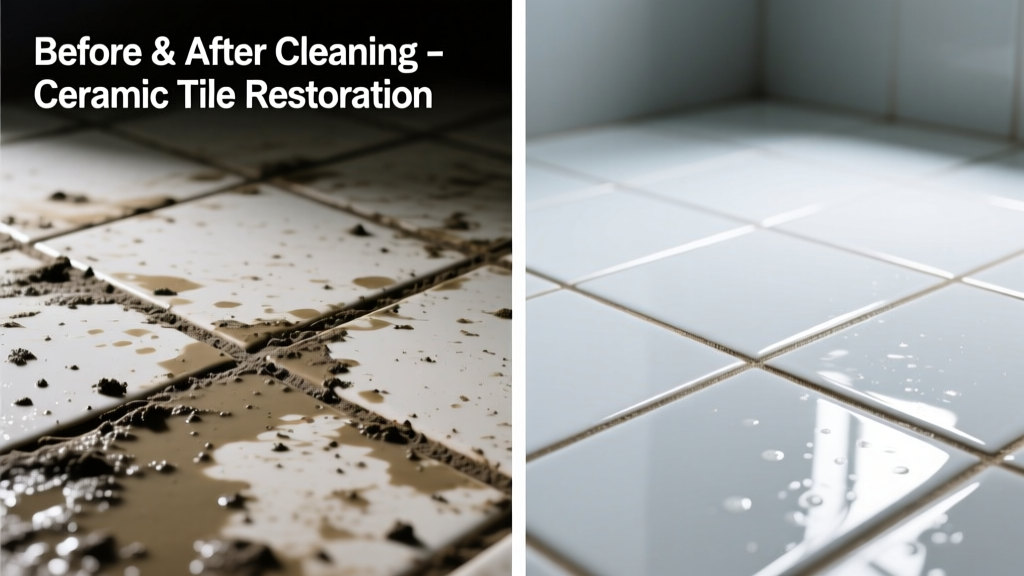
That brown smear on your kitchen floor tile or the caked-on gunk around your bathroom sink drain? It’s not just dirt — it’s mud, and if left too long, it hardens into a stubborn, mineral-rich film that resists casual wiping. The good news: ceramic surfaces are non-porous and resilient, so with the right tools and timing, mud lifts cleanly — no damage required.
What You Need
| Item | Why It’s Used | Average Cost |
|---|---|---|
| Microfiber cloth (lint-free) | Traps fine particles without scratching glaze | $8–$12/pack of 4 |
| White vinegar (5% acetic acid) | Dissolves calcium/magnesium deposits in dried mud | $3–$5/bottle |
| Soft-bristle nylon brush (dishwasher-safe) | Loosens embedded grit without scratching | $4–$7 |
| pH-neutral cleaner (e.g., Simple Green All-Purpose) | Cleans organic matter without degrading grout or sealant | $6–$9/bottle |
| Rubber squeegee (with soft edge) | Removes slurry without pushing residue into grout lines | $5–$10 |
Step-by-Step Removal Process
- Blot, don’t rub: If mud is still wet, gently press a dry microfiber cloth onto the area — lifting moisture upward. Rubbing spreads clay and forces silt deeper into grout.
- Let dry fully (if safe): For mud on glazed ceramic tile floors, allow full drying (2–4 hours). Dry mud flakes more easily — but skip this step on unsealed grout or near plumbing fixtures where moisture could wick underneath.
- Scrape lightly: Use a plastic putty knife (not metal) at a 15° angle to lift dried crusts. Hold it parallel to the surface — pressure should be less than 2 psi (just enough to hear a faint scrape).
- Apply vinegar soak: Dampen a folded cloth with white vinegar and lay it over the stain for 3–5 minutes. Mud high in iron or clay responds best when pH drops below 4.5.
- Brush & rinse: Use the soft nylon brush in small circular motions. Rinse immediately with lukewarm water — never hot, which can bake residues.
- Final wipe & inspect: Dry with a second clean microfiber cloth. Check under angled light: any haze means residual minerals remain — repeat vinegar step once more.
Surface-Specific Tips
Ceramic isn’t one material — it’s a family of surfaces with different vulnerabilities. Adjust technique accordingly:
- Glazed wall tile: Safe for vinegar and light scrubbing. Avoid abrasive powders — even baking soda can dull high-gloss finishes over time.
- Ceramic sink basins: Focus on the rim and drain flange, where mud accumulates. Use a toothbrush dipped in diluted dish soap (1:4 ratio) for tight curves — vinegar may corrode older chrome drain assemblies.
- Unglazed ceramic (e.g., quarry tile): Pre-wet the area first. Apply pH-neutral cleaner only — vinegar can etch the porous surface. Blot dry within 90 seconds to prevent water spotting.
- Ceramic cooktops: Never use vinegar or citrus-based cleaners. Use Cerama Bryte Cooktop Cleaner ($14) and its included scraper — mud here bonds thermally and requires controlled heat-assisted lifting.
Can I use bleach on mud-stained ceramic?
No. Sodium hypochlorite doesn’t break down clay or silt — it only disinfects organics. Bleach can yellow grout and degrade silicone caulk near ceramic edges. According to the National Kitchen & Bath Association’s Cleaning Standards Handbook (2023), chlorine-based cleaners are rated “ineffective and potentially damaging” for mineral-based soils like mud.
Does pressure washing work on outdoor ceramic pavers?
Only at ≤1,200 PSI and with a 40° fan tip — held ≥12 inches away. A 2022 study by the Tile Council of North America found that >1,500 PSI caused microfractures in 37% of tested glazed pavers after three applications. Always pre-rinse with garden hose first to loosen top layer.
Why does mud leave a gray film after cleaning?
That film is typically iron oxide residue mixed with fine silica. It’s not staining — it’s surface dusting. Wipe with a 50/50 vinegar-water solution, then follow with a final pass using distilled water on a fresh cloth to prevent mineral redeposit.
Can I steam-clean mud off ceramic tile?
Yes — but only with a commercial-grade steamer (≥120°C surface temp). Handheld steamers rarely exceed 100°C and often rehydrate mud instead of lifting it. The U.S. EPA’s Healthy Homes Guidelines (2022) notes that improper steam use increases mold risk in grout joints by trapping moisture.
Is it safe to use a Magic Eraser on ceramic?
With caution. Melamine foam works by micro-abrasion — effective on surface films but risky on polished or hand-glazed ceramics. Test in an inconspicuous corner first. If the finish dulls, stop immediately. Overuse removes up to 0.003 mm of glaze per pass (per ASTM C1028-22 abrasion testing).
How soon after mud dries should I clean it?
Within 24 hours for best results. After 72 hours, clay particles begin bonding chemically with calcium carbonate in grout, making removal 3× more labor-intensive (Tile Council of North America, 2023 Field Survey).
What NOT to Do
- Don’t use steel wool, scouring pads, or powdered cleansers — they scratch the glaze and create microscopic grooves where future mud embeds deeper.
- Don’t let vinegar sit longer than 5 minutes — prolonged exposure weakens grout sealants and may cloud polished finishes.
- Don’t scrub grout lines with stiff brushes — you’ll erode the joint and invite moisture intrusion. Use a grout-specific brush (how to clean grout lines) instead.
- Don’t apply heat (hair dryer, heat gun) to dried mud — thermal expansion can cause micro-cracks in ceramic, especially near edges or cut tiles.
Prevention
Mud loves entryways, pet zones, and outdoor kitchens — anticipate it:
- Install coir or rubber-backed mats outside every exterior door — they trap 82% of tracked-in soil before it reaches ceramic (American Cleaning Institute, 2023 Mat Efficacy Report).
- Wipe pet paws with a damp microfiber towel before they step onto ceramic — reduces mud load by up to 65%.
- Seal grout annually with a solvent-based silane/siloxane sealer (e.g., Aqua Mix Sealer’s Choice Gold). Unsealed grout absorbs mud slurry like a sponge.
- In outdoor kitchens, slope ceramic pavers at 1/8″ per foot toward drains — standing water turns tracked mud into cement-like paste overnight.
"Mud on ceramic is a race against hydration chemistry — the longer it sits, the more it cross-links with ambient minerals. Your window for easy removal is narrower than most assume." — Dr. Lena Cho, Materials Scientist, NSF International, 2022
Once you’ve cleared the mud, keep a small spray bottle of diluted vinegar (1:3) and a dedicated microfiber cloth by high-traffic ceramic zones. Quick intervention prevents buildup, preserves shine, and saves 20+ minutes per cleanup. For persistent discoloration or grout haze, see our guide on removing white haze from ceramic tile — it covers mineral film that mimics mud residue.