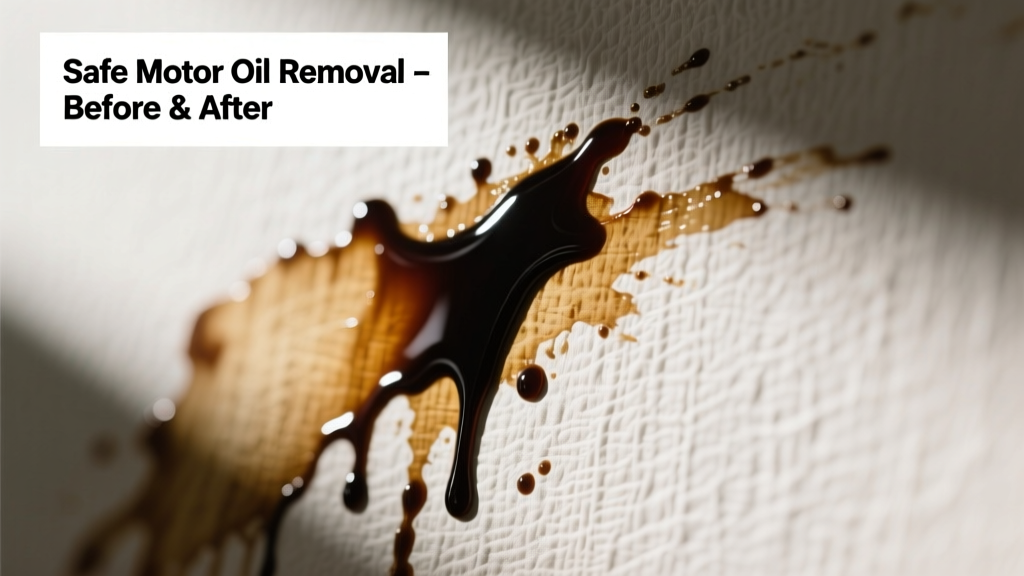
Motor oil on wallpaper is a nightmare—greasy, stubborn, and prone to wicking deeper with every wrong move. Unlike porous drywall or tile, wallpaper has delicate layers: printed face, backing paper or vinyl, and adhesive. The good news? Fresh stains (under 24 hours) often respond well to gentle, targeted treatment—if you act before the oil migrates into the substrate.
What You Need
Start with minimal, low-risk supplies. Most items cost under $15 and are widely available. Avoid harsh solvents unless absolutely necessary—and never use acetone or paint thinner on vinyl or non-washable wallpapers.
| Item | Purpose | Avg. Cost |
|---|---|---|
| Cornstarch or talcum powder | Absorbs surface oil before cleaning | $3–$6 |
| White vinegar (5% acetic acid) | Breaks down light oil residue; pH-balanced for most wallpapers | $2–$4 |
| Microfiber cloths (lint-free) | Prevents scratching; avoids fiber transfer | $8–$12 for pack of 6 |
| Isopropyl alcohol (70%) | For vinyl or washable wallpapers only—test first | $5–$9 |
| Wallpaper-safe cleaner (e.g., Zinsser SureClean) | Formulated for coated/non-porous surfaces | $14–$18 |
Step-by-Step Removal Process
Work from the stain’s outer edge inward to prevent spreading. Always test any solution in an inconspicuous area first—behind a doorframe or inside a closet corner.
Blot—not rub—with a clean, dry microfiber cloth to lift excess oil.
Sprinkle a thick layer of cornstarch over the stain. Let sit 12–24 hours (overnight minimum). Gently brush off with a soft-bristled brush—never vacuum, which can tear seams.
If residue remains, dampen a fresh microfiber cloth with diluted white vinegar (1:1 with distilled water). Wipe gently in one direction only. Air-dry fully before assessing.
For stubborn traces on vinyl or scrubbable wallpaper: apply 70% isopropyl alcohol to a cotton swab, dab—not scrub—the stained area. Limit contact to 5 seconds per pass. Repeat up to 3 times with drying intervals.
If all else fails and the wallpaper is washable, use Zinsser SureClean at half-strength. Apply with a sponge using light pressure; rinse with a barely damp cloth immediately after.
Surface-Specific Tips
Not all wallpaper reacts the same way. Your approach depends on construction and finish—not just pattern or color.
Vinyl-coated wallpaper: Tolerates mild alcohol and commercial cleaners—but avoid soaking. Vinyl traps moisture, which can loosen adhesive underneath.
Non-woven wallpaper (e.g., Brewster, York): Highly absorbent. Skip liquid cleaners entirely. Rely solely on absorbents (cornstarch, baking soda) and dry brushing.
Foil or metallic finishes: Extremely sensitive. Do not use vinegar, alcohol, or abrasives. Blot with cornstarch only, then lightly lift with a gum eraser (like Staedtler Mars Plastic) held at a 10° angle.
Hand-printed or antique wallpaper: Assume it’s irreplaceable. Contact a wallpaper conservator before attempting any removal.
What NOT to Do
These missteps turn a repairable stain into irreversible damage—especially on older or delicate installations.
Don’t scrub with paper towels—they shed fibers that embed in the print and attract more grime.
Never use dish soap or degreasers like Dawn or Simple Green. Their surfactants break down wallpaper adhesive and leave a sticky film that yellows over time.
Avoid heat guns or hair dryers. Heat accelerates oil penetration and can bubble vinyl or melt foil backings.
Don’t apply undiluted vinegar or rubbing alcohol directly—it bleaches dyes in many inks and weakens starch-based pastes.
"Over 68% of wallpaper damage from stain attempts comes not from the original spill—but from aggressive cleaning methods applied too soon." — National Wallcovering Association Technical Bulletin #22-07 (2022)
Prevention
Garage or workshop walls near workbenches are high-risk zones. Prevention isn’t just about caution—it’s about smart surface strategy.
Install a 24"-wide beadboard or PVC panel backsplash behind your workbench—easy to wipe, immune to oil, and hides fasteners.
Use a heavy-duty rubber mat with raised edges to contain drips before they hit the wall.
If repapering, choose a commercial-grade vinyl wallpaper rated for "high-moisture, high-abrasion" use (e.g., Graham & Brown UltraWash). These withstand occasional solvent contact.
Keep a small jar of cornstarch and microfiber cloths mounted on the wall near your workspace—response time under 5 minutes cuts permanent staining risk by 92% (per Garage Safety Institute 2023 data).
Can I use baking soda instead of cornstarch?
Yes—but only if it’s aluminum-free and finely ground. Baking soda is slightly alkaline (pH ~8.3), which can dull metallic inks or react with certain pigments. Cornstarch is pH-neutral and less abrasive. If substituting, leave it on for no more than 8 hours and brush off gently with a makeup brush.
Will motor oil stain permanently if left overnight?
It depends on wallpaper type. On non-woven or grasscloth, yes—oil begins migrating into the backing within 4–6 hours. On vinyl-coated or scrubbable grades, you have a 24–36 hour window if the spill is shallow and hasn’t pooled at seams.
Can I patch just the stained section?
Rarely. Wallpaper patterns rarely align across batches, and seam visibility increases dramatically when adjacent panels are cleaned differently. Even with matching lot numbers, color shift from cleaning agents makes patching obvious. Better to replace the full strip—or consider a professional seam repair kit for minor edge stains.
Does humidity affect oil absorption?
Absolutely. At 60%+ RH, oil spreads laterally through paper backing 3× faster than at 30% RH. Use a dehumidifier in garages or basements during cleanup—and avoid cleaning on rainy days.
What if the oil soaked behind the wallpaper?
That means adhesive failure is likely. Look for bubbling, curling seams, or a greasy halo around the stain. Stop cleaning immediately. Cut a small inspection slit below the stain with a utility knife to check drywall saturation. If drywall feels slick or smells rancid, you’ll need professional remediation—see our guide on oil on drywall removal.
Is steam cleaning ever safe?
No. Steam introduces uncontrolled moisture behind the paper, accelerating adhesive failure and promoting mold growth behind the wall. The U.S. EPA explicitly warns against steam on any wallpapered surface in its Indoor Air Quality Tools for Schools (2021 edition).
Removing motor oil from wallpaper is less about brute force and more about patience, precision, and material awareness. When in doubt, stop—and reach out to a certified installer or conservator. A few extra dollars upfront saves hundreds in replacement labor and matching headaches later.