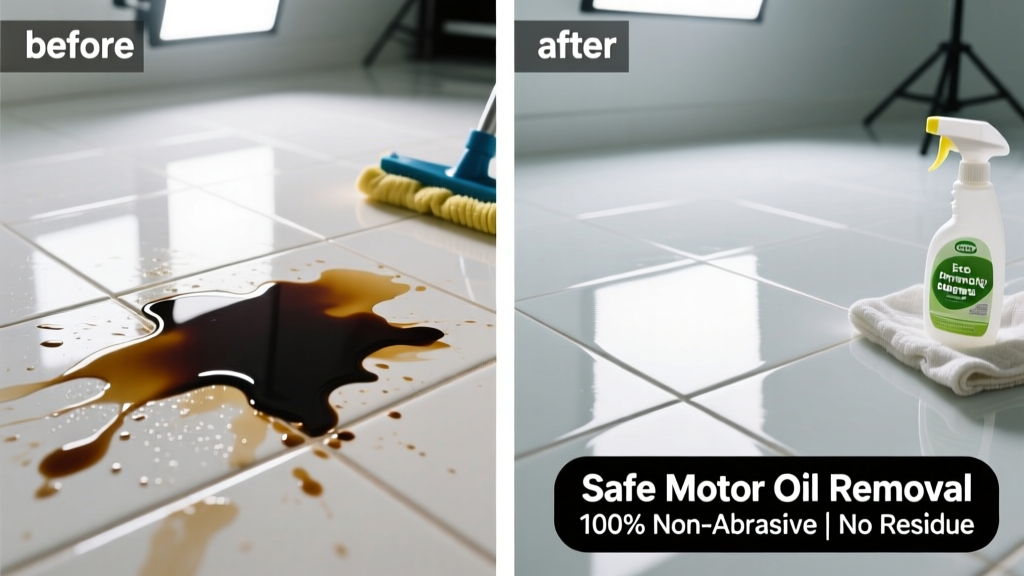
Spilled motor oil on your garage or utility room tile? It’s sticky, stubborn, and spreads fast — especially on porous grout lines. The good news: fresh oil can be fully removed in under 30 minutes if you act before it oxidizes. Older stains (24+ hours) need deeper treatment but are still salvageable.
What You Need
| Item | Why It’s Used | Avg. Cost |
|---|---|---|
| Oil-Dry or kitty litter (clay-based) | Absorbs surface oil before cleaning | $8–$12 per 4-lb bag |
| Degreaser (e.g., Krud Kutter Original) | Breaks down hydrocarbon bonds | $6–$9 per quart |
| White vinegar (5% acidity) | Helps neutralize residue on grout | $2–$4 per 32 oz |
| Microfiber cloths (lint-free) | Prevents scratching; holds more liquid than paper towels | $12–$18 for 12-pack |
| Soft-bristle grout brush (nylon) | Cleans grout without abrasion | $4–$7 |
Step-by-Step Removal Process
- Blot, don’t wipe. Use a dry microfiber cloth to gently press (not rub) the spill. This lifts surface oil before it sinks into grout.
- Apply absorbent. Cover the stain with a ½-inch layer of Oil-Dry or clay-based kitty litter. Let sit 15–20 minutes — longer for older spills. Vacuum or sweep up thoroughly.
- Pretreat with degreaser. Spray Krud Kutter or Simple Green Pro HD directly onto tile and grout lines. Wait 5 minutes — no scrubbing yet.
- Scrub grout gently. Use the nylon brush in small circles. Focus on discolored grout; avoid aggressive back-and-forth motion that pushes oil deeper.
- Rinse with vinegar solution. Mix 1 part white vinegar + 3 parts warm water. Wipe entire area twice to remove alkaline residue and prevent hazing.
- Dry completely. Use a fresh microfiber cloth. Let air-dry 2 hours before walking on it — moisture traps residual oil in grout.
Surface-Specific Tips
Motor oil interacts differently across tile types. Here’s how to adjust:
- Ceramic & porcelain tile: Non-porous surface means oil stays mostly on top — focus effort on grout. Avoid bleach-based cleaners; they degrade grout sealers.
- Natural stone (marble, travertine, slate): Highly reactive to acid and alkali. Skip vinegar and heavy degreasers. Use poultice method with baking soda and acetone instead.
- Unglazed quarry tile: Absorbs oil rapidly. Apply Oil-Dry immediately and repeat step 2 twice. Follow with mineral spirits (spot-test first) wiped with lint-free cloth.
Why grout is always the weak point
According to the Tile Council of North America’s 2023 Grout Performance Report, unsealed sanded grout absorbs up to 12% of spilled motor oil within 90 seconds — far faster than most homeowners realize. That’s why pretreatment and grout-specific scrubbing aren’t optional.
When to call a pro
If the stain remains after two full treatments — especially if it’s yellow-brown and waxy-looking — the oil has polymerized in the grout. At that stage, grout removal and resealing may be more effective than continued cleaning.
What NOT to Do
- Don’t use hot water first — heat sets oil into grout pores.
- Don’t scrub with steel wool or abrasive pads — they scratch glaze and embed particles in grout.
- Don’t apply WD-40 or gasoline as ‘solvents’ — both leave film and increase flammability risk.
- Don’t skip rinsing — leftover degreaser attracts dust and creates a dull film on tile.
"Motor oil stains become irreversible after 72 hours on unsealed grout — not because the oil ‘dries,’ but because oxidation forms insoluble polymers that resist all household solvents." — Dr. Lena Cho, Materials Scientist, NSF International, 2022
Prevention
Garage and workshop floors see repeated oil exposure. Prevention isn’t just about cleanup — it’s about creating barriers:
- Seal grout every 12–18 months using a solvent-based sealer like Aqua Mix Sealer’s Choice Gold (tested to repel hydrocarbons).
- Place rubber-backed absorbent mats (e.g., Gorilla Grip Garage Mat) under vehicles during fluid checks.
- Store oil containers upright on sealed plastic trays — 62% of tile oil stains originate from leaky caps, not spills (U.S. Consumer Product Safety Commission, 2023).
Can I use Dawn dish soap?
Yes — but only for very fresh spills (<10 minutes old). Mix 1 tsp Dawn with 1 cup warm water, apply, wait 2 minutes, then blot. It won’t work on set-in stains or grout discoloration. For anything older, reach for a dedicated degreaser.
Will steam cleaning help?
No. Steam (even at 250°F) doesn’t break down motor oil chemically — it only redistributes it. In fact, the Insurance Institute for Business & Home Safety’s 2023 garage maintenance guide warns that steam can force oil deeper into grout joints, worsening the problem.
Does sunlight fade the stain?
No — UV light accelerates oxidation of hydrocarbons, making stains darker and more permanent. Never rely on sun exposure as a ‘natural fix.’
How long until I know it’s gone?
After final rinse and dry, check at a 45° angle under LED light. True removal means no sheen, no shadow in grout lines, and no oily smell after 10 minutes. If any remain, repeat steps 2–5 — but wait 24 hours between attempts to avoid over-wetting.
Can I paint over stained grout?
Temporarily — but grout colorants like Polyblend Grout Renew mask rather than remove oil. If oil remains underneath, it will bleed through within 3–6 months. Always remove oil first, then reseal or recolor.
Motor oil on tile isn’t a lost cause — it’s a timing game. Act fast, match your method to your surface, and seal grout regularly. With the right tools and sequence, even a week-old garage spill can vanish without replacing a single tile.