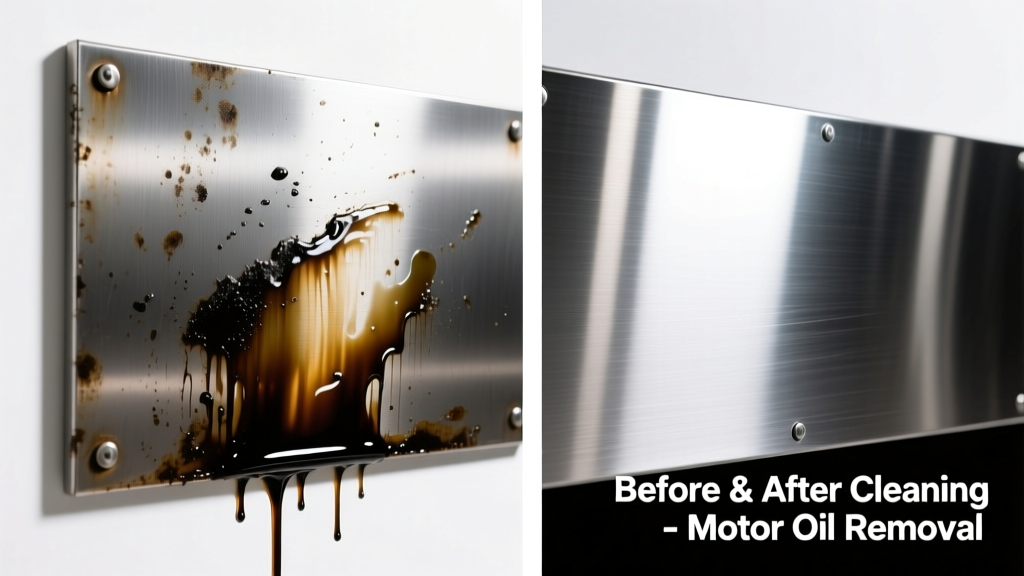
That greasy, rainbow-sheened smear of motor oil on your stainless steel appliance, sink, or tool bench isn’t just unsightly—it’s stubborn, hydrophobic, and can etch or attract grime if left untreated. The good news? With the right solvents and technique, you can restore the finish completely—no polishing compound needed in most cases.
What You Need
| Item | Purpose | Price Range |
|---|---|---|
| Isopropyl alcohol (90%+) | Breaks down light-to-moderate oil films without residue | $5–$12 per 32 oz |
| Citrus-based degreaser (e.g., Goo Gone Pro-Power) | Effective on aged or baked-on oil; biodegradable option | $7–$10 per 24 oz |
| Microfiber cloths (non-linting, 300+ gsm) | Prevents micro-scratches; absorbs oil without smearing | $8–$15 for pack of 6 |
| Stainless steel cleaner with passivation agents (e.g., Weiman Stainless Steel Cleaner) | Restores protective oxide layer post-cleaning | $6–$9 per 12 oz |
| Plastic scraper (credit-card thickness) | Safely lifts thick, congealed oil without scratching | $3–$5 |
Step-by-Step Removal Process
Blot excess oil immediately with a dry microfiber cloth—never rub, which spreads and embeds it deeper.
Apply isopropyl alcohol directly to a clean microfiber cloth (not the surface) and gently wipe along the grain. For heavy deposits, let it dwell 30 seconds before wiping.
If residue remains, switch to citrus degreaser: spray onto cloth, not surface, then wipe with firm, even strokes following the grain.
For congealed or baked-on oil (e.g., on an engine bay panel), use the plastic scraper at a 15° angle to lift—not scrape—oil away, then follow with alcohol wipe.
Rinse with distilled water (tap water may leave mineral spots), then dry thoroughly with a second clean microfiber cloth.
Finish with stainless steel cleaner to re-passivate the surface and prevent future staining—especially critical for outdoor or high-humidity areas.
Surface-Specific Tips
Stainless steel isn’t one material—it varies by grade, finish, and application. Here’s how to adapt:
Brushed or satin finishes (common on appliances): Always wipe parallel to the visible grain lines. Cross-grain wiping creates visible haze and micro-scratches that trap future oil.
Mirror-polished surfaces (e.g., commercial hoods): Use only alcohol or dedicated stainless polish—citrus degreasers can leave faint etching on ultra-smooth finishes.
Welded or heat-discolored zones: These areas have thinner chromium oxide layers. Avoid abrasive pads or ammonia-based cleaners—they accelerate corrosion. Stick to alcohol + gentle pressure.
What NOT to Do
Don’t use paper towels—they shed fibers that scratch and leave lint that binds oil.
Never apply oven cleaner or lye-based products—even diluted, they corrode stainless steel’s passive layer within minutes (per ASTM A967-23 testing).
Avoid steel wool or scouring pads: Grade 304 and 316 stainless can tolerate light abrasion, but any embedded iron particles will rust and stain permanently.
Don’t let vinegar sit longer than 30 seconds—its acetic acid degrades nickel content over time, especially on lower-grade steels.
Prevention
Motor oil stains are preventable with three simple habits:
Keep drip trays under tools or equipment—lined with absorbent clay granules (like Oil-Dri), which capture oil before contact.
Apply a thin coat of food-grade mineral oil monthly to high-risk surfaces (e.g., garage workbenches). It forms a sacrificial barrier and wipes off easily with alcohol.
Store oily rags in sealed metal containers—not plastic bins—since anaerobic decomposition can generate heat and ignite spontaneously (U.S. CPSC Fire Safety Bulletin, 2022).
Can I use WD-40 to remove motor oil?
No—WD-40 is a water displacer and light lubricant, not a degreaser. It temporarily dissolves oil but leaves behind its own petroleum residue, creating a sticky film that attracts dust and makes future cleaning harder. In fact,
"WD-40 increases surface tension on stainless steel by up to 40%, making subsequent oil adhesion more tenacious," says Dr. Lena Cho, materials scientist at the National Institute of Standards and Technology (NIST, 2021).
Will acetone damage stainless steel?
Acetone won’t corrode stainless steel itself—but it *will* degrade many plastic components nearby (gaskets, seals, trim) and evaporates so quickly it often leaves streaks or incomplete removal. Reserve it for spot-testing only, never for large surfaces.
How long does oil need to sit before it becomes permanent?
“Permanent” isn’t quite right—but after 72 hours, motor oil begins oxidizing and polymerizing, especially in UV or heat-exposed areas. That hardened film resists standard cleaners and requires mechanical lifting plus solvent soak. Act within 24 hours for easiest removal.
Can I use baking soda paste on stainless steel?
Yes—but only as a last-resort mild abrasive for stubborn residue *after* solvent treatment. Mix with distilled water (not vinegar), apply with soft cloth, rinse within 60 seconds, and follow immediately with stainless cleaner. Baking soda is alkaline and safe, but prolonged contact dries out the surface’s natural oxide layer.
Why does my stainless steel look streaky after cleaning?
Streaks usually mean either residual oil wasn’t fully removed before drying—or you wiped against the grain. Always finish with a dry, clean microfiber cloth moving *with* the grain, and inspect under angled light to catch missed film.
Do I need to re-polish after removing oil?
No—if you used non-abrasive methods and followed with a passivating cleaner like Weiman or Bar Keepers Friend Stainless Cleaner, the original luster returns. Polishing compounds are only necessary if the surface was already scratched or dulled prior to the oil spill.
Motor oil on stainless steel feels like a losing battle—until you match the right solvent to the right finish and motion. Most spills respond fully to isopropyl alcohol and proper wiping technique. And remember: the fastest fix is always the first one. Keep a microfiber cloth and alcohol bottle near your garage sink or workshop bench—you’ll use them far more than you expect. For related care, see our guide on grease removal from stainless sinks and maintaining stainless appliances year-round.