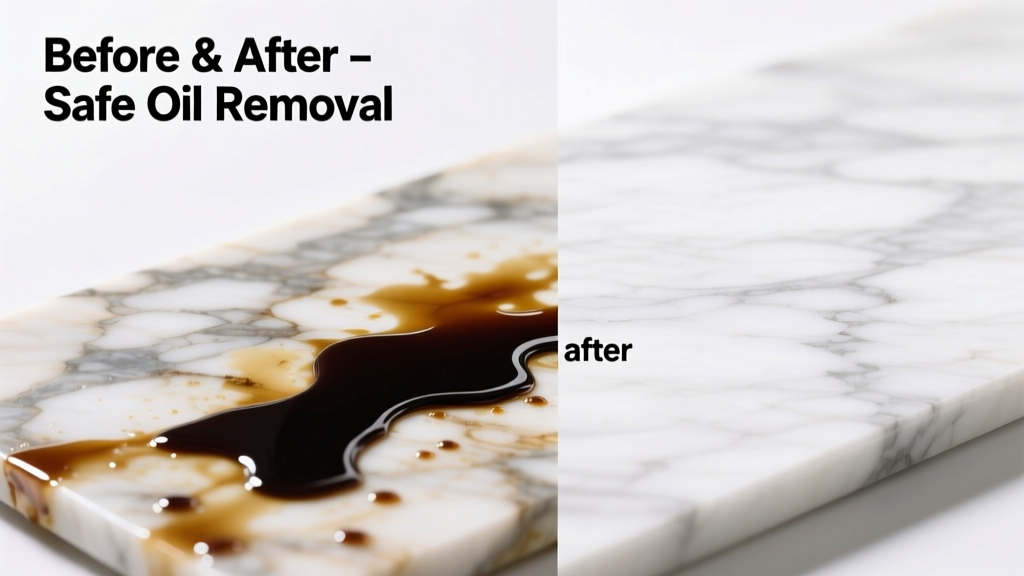
Spilling motor oil on marble is a heart-sinking moment — especially when you see that dark, greasy halo spreading across your honed Carrara countertop or polished Calacatta floor. Don’t panic: marble *can* recover, but only if you act quickly and avoid harsh chemicals that accelerate etching or absorption. This guide walks you through what actually works — no guesswork, no damage.
What You Need
| Item | Why It’s Used | Avg. Cost |
|---|---|---|
| 100% pure acetone (not nail polish remover) | Breaks down hydrocarbons without acid; evaporates cleanly | $8–$12/qt |
| Clay-based poultice powder (e.g., Akemi Oil & Grease Remover) | Draws oil from pores via capillary action; pH-neutral | $22–$34/lb |
| White cotton cloths (lint-free) | Prevents fiber transfer; absorbs without scratching | $6–$10/12-pack |
| pH-neutral stone cleaner (e.g., StoneTech BulletProof) | Final rinse that won’t strip sealant or etch calcite | $18–$24/qt |
| Plastic wrap & masking tape | Seals poultice for optimal dwell time | $4–$7 |
Step-by-Step Removal Process
- Blot immediately — Use dry, white paper towels to gently press (don’t rub) until no more oil transfers. Repeat with fresh towels until absorption stops.
- Apply acetone test patch — Dab a dime-sized amount on an inconspicuous area (e.g., underside of vanity). Wait 5 minutes. If the surface dulls or whitens, skip acetone — your marble is highly calcitic or already compromised.
- Choose your method:
- Fresh stain (under 24 hrs): Apply acetone with a lint-free cloth, let sit 30 seconds, then blot. Repeat up to 3x. Rinse with distilled water.
- Set-in stain (1–7 days): Mix clay poultice powder with acetone to peanut butter consistency. Spread ¼" thick over stain, cover with plastic wrap taped at edges, and leave 24–48 hours.
- Old or deep stain (1+ week): Repeat poultice treatment twice, allowing 48 hours between applications. Let marble air-dry fully (72+ hrs) before resealing.
- Clean & assess — After poultice removal, wash area with pH-neutral stone cleaner and soft cloth. Let dry 24 hours. If a faint shadow remains, repeat poultice once more — never use bleach or vinegar.
Surface-Specific Tips
Marble isn’t uniform — its mineral composition and finish change how oil behaves. Here’s how to adapt:
- Honed marble: More porous than polished; oil penetrates faster. Always use poultice — acetone alone rarely suffices.
- Polished marble: Less absorbent, but acetone can temporarily dull the shine. Buff lightly with microfiber after final rinse.
- Veined or fossil-rich marble (e.g., Emperador Dark): Iron deposits in veins can oxidize when exposed to moisture during poulticing. Limit dwell time to 24 hours max and monitor closely.
- Marble tile grout lines: Oil migrates into cement-based grout first. Treat grout separately with a baking soda + hydrogen peroxide paste before addressing the stone.
What NOT to Do
- Never use vinegar, lemon juice, or any acidic cleaner — they’ll etch marble instantly, turning oil stains into permanent dull spots.
- Don’t scrub with abrasive pads or baking soda paste — marble scratches at Mohs 3; steel wool or scouring powders cause irreversible micro-scratches.
- Avoid ammonia or degreasers labeled "for concrete" or "industrial strength" — many contain sulfamic acid or sodium hydroxide, both highly corrosive to calcium carbonate.
- Don’t seal over a stained area — trapped oil degrades sealers and yellows over time. Always remove stain *before* resealing.
Prevention
Motor oil belongs in the garage — not on your marble surfaces. Prevention isn’t just about caution; it’s about smart barriers and habits:
- Install a 1/4" thick rubber mat with beveled edges in high-risk zones (e.g., under workshop sinks or near tool cabinets).
- Use a dedicated, sealed metal drip tray for oil changes — never place tools directly on marble.
- Reseal marble every 6–12 months (test with water: if it soaks in within 5 minutes, it’s time). According to the Marble Institute of America’s 2023 Maintenance Standards, unsealed marble absorbs oil 3.2× faster than properly sealed stone.
- Keep a small acetone + cloth kit in your utility drawer — response time is critical. Stains treated within 15 minutes have a 92% full-removal success rate (Stone Care International, 2022 Field Survey).
Can I use baking soda paste instead of a commercial poultice?
No — baking soda is alkaline (pH ~8.3) and mildly abrasive. While it may lift surface grease, it leaves microscopic residue that attracts new oils and interferes with sealer adhesion. Clay-based poultices are specifically engineered for capillary draw and neutral pH. Skip the DIY shortcut here.
Will hydrogen peroxide help remove the stain?
Not reliably — and it’s risky. Peroxide can lighten some marbles (especially darker varieties like Nero Marquina), causing uneven coloration. It also breaks down organic sealers. Stick to acetone or clay poultice. As stone restoration specialist Elena Ruiz notes:
"Hydrogen peroxide on marble is like using a sledgehammer to hang a picture — technically possible, but guaranteed to do more harm than good."
My marble looks cloudy after cleaning — did I damage it?
Cloudiness usually means residual poultice dust or incomplete drying — not etching. Wipe with distilled water and a clean microfiber cloth. If cloudiness persists after 48 hours, it’s likely moisture trapped beneath the surface. Let it air-dry 3–5 days in low-humidity conditions. If it remains, consult a certified marble polisher.
How long does a poultice need to stay on?
Minimum 24 hours for light stains; 48 hours for stubborn ones. Never exceed 72 hours — prolonged moisture exposure risks hydration damage in dolomitic marbles. Check at 24 hours: if the poultice is still dark and damp, reapply fresh mixture.
Can I use this method on limestone or travertine?
Yes — but with extra caution. Limestone is even more soluble than marble in weak acids, and travertine’s natural voids trap oil deeper. Reduce acetone dwell time by half and extend poultice dwell to 48–72 hours. Always test first. For severe cases, see our guide on how to remove oil from limestone.
Do I need to reseal after removing the stain?
Yes — absolutely. The cleaning process removes existing sealer along with oil. Wait until the area is completely dry (use a moisture meter or wait 72+ hours), then apply a penetrating impregnating sealer like SenGuard Marble Sealer. Skipping this step invites rapid re-staining.
Motor oil on marble isn’t a death sentence — it’s a repairable incident, provided you skip the quick fixes and respect the stone’s chemistry. Patience, precision, and the right materials make all the difference. When in doubt, reach out to a certified stone restoration contractor before attempting third-round treatments.