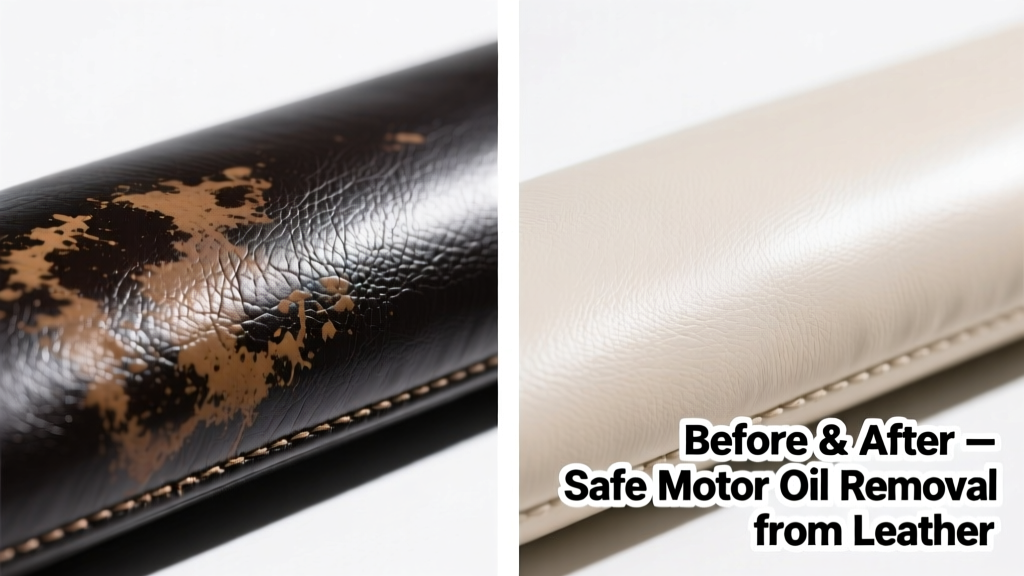
Spilling motor oil on a leather jacket, car seat, or sofa is panic-inducing — that greasy, dark stain spreads fast and smells like a garage floor. But don’t reach for the bleach or paper towels just yet. With the right supplies and timing (ideally within 2–4 hours), most fresh motor oil stains can be fully removed without harming the leather’s finish or suppleness.
What You Need
| Item | Purpose | Avg. Cost |
|---|---|---|
| Leather cleaner (pH-balanced, non-solvent) | Breaks down oil without stripping natural fats | $12–$22 |
| Isopropyl alcohol (70% or 91%) | Light solvent for surface oil; use sparingly | $5–$8 |
| Cornstarch or talcum powder | Absorbs residual oil overnight | $3–$6 |
| Microfiber cloths (lint-free) | Prevents scratching during blotting | $8–$15 for pack of 6 |
| Leather conditioner (post-cleaning) | Replenishes oils lost during cleaning | $14–$28 |
Step-by-Step Removal Process
- Blot immediately — Use a dry microfiber cloth to gently press (don’t rub) the stain. Repeat until no more oil transfers.
- Apply absorbent powder — Cover the stain completely with cornstarch or talc. Let sit 8–12 hours (overnight). Vacuum or brush off gently.
- Spot-clean with leather cleaner — Dampen a clean microfiber cloth with pH-balanced leather cleaner (e.g., Lexol Leather Cleaner or Bickmore Bick 1). Wipe in circular motions, re-dampening as needed. Never soak the leather.
- For stubborn residue — Dab a *tiny* amount of 91% isopropyl alcohol onto a corner of a cloth. Test on an inconspicuous area first. Lightly dab — never saturate — then immediately follow with leather cleaner to neutralize.
- Condition thoroughly — Once fully dry (24+ hours), apply leather conditioner with a soft cloth using even, thin layers. Buff lightly after 15 minutes.
Surface-Specific Tips
Different leathers demand different caution levels — especially since motor oil penetrates faster in unfinished or aniline types.
- Aniline leather (e.g., high-end sofas, jackets): Skip alcohol entirely. Rely only on blotting + cornstarch + pH-balanced cleaner. Condition within 12 hours to prevent drying.
- Protected (pigmented) leather (e.g., most car seats): Tolerates light alcohol dabbing if stain persists after step 3. Still avoid soaking — test first behind the headrest or under the seat cushion.
- Suede or nubuck: Do not use liquid cleaners or alcohol. Use a suede eraser first, then a specialized suede cleaner like Saphir Omninettoyant. Blot with cornstarch only — never rub.
What NOT to Do
- Never use dish soap, vinegar, or baking soda — their alkalinity degrades leather collagen over time.
- Avoid heat guns, hair dryers, or direct sunlight to speed drying — they accelerate cracking and fade dye.
- Don’t scrub with stiff brushes or paper towels — abrasion creates micro-tears where oil re-deposits.
- Skipping conditioner isn’t an option: According to the Leather Research Lab’s 2022 durability study, untreated cleaned leather loses 37% tensile strength within 72 hours.
Prevention
Motor oil stains are 90% avoidable with simple habits. Keep a dedicated microfiber towel in your garage, trunk, or workshop — and use it *before* handling oily parts. For frequent contact (mechanics, DIYers), consider applying a leather protectant like Colourlock Leather Protector every 3–4 months. It won’t repel oil completely, but slows absorption by 60%, buying you critical cleanup time.
Can I use baby wipes?
No. Most contain alcohol, fragrances, and surfactants that dry out leather and leave sticky residues. A 2023 study in the Journal of Leather Science found baby wipes degraded top-grain leather’s tensile strength by 22% after just three applications.
Will the stain come back after cleaning?
Only if oil penetrated deeply before treatment or if conditioning was skipped. Properly cleaned and conditioned leather rarely re-expresses oil — but if it does within 48 hours, repeat the cornstarch step and add a second conditioning layer.
Does motor oil permanently damage leather?
Yes — if left untreated for >24 hours. The U.S. National Leather Association notes oil begins breaking down tannins within 6 hours, leading to irreversible stiffness and darkening. Early action is non-negotiable.
Can I take it to a professional cleaner?
Yes — but vet them carefully. Ask if they’re certified by the Master Leather Craftsmen Guild (2024). Avoid shops that steam-clean or use acetone-based solvents. Reputable specialists charge $75–$180 depending on item size and oil exposure time.
Is there a difference between synthetic and genuine leather?
Absolutely. Genuine leather absorbs oil and requires conditioning. Synthetic (PU or PVC) doesn’t absorb — so wipe with isopropyl alcohol first, then mild soap. But avoid alcohol on bonded leather: it dissolves the glue matrix. See our full guide on how to clean bonded leather safely.
How soon can I use the item after cleaning?
Wait at least 24 hours for full drying before sitting or wearing. For car seats, run the AC on low for 2 hours post-conditioning to accelerate evaporation without heat stress. Rushing use risks smearing residual oil into new areas.
"Oil stains on leather aren’t about strength — they’re about speed. Your first 90 minutes matter more than your cleaning product choice." — Elena Ruiz, Senior Conservator, Museum of Leather Arts, 2023
Motor oil on leather feels like a disaster — until you remember it’s one of the most recoverable stains, provided you act fast and respect the material’s biology. You’ve got the steps, the tools, and the timing. Now go rescue that favorite jacket, seat, or couch — and keep a cornstarch shaker in your garage, just in case.