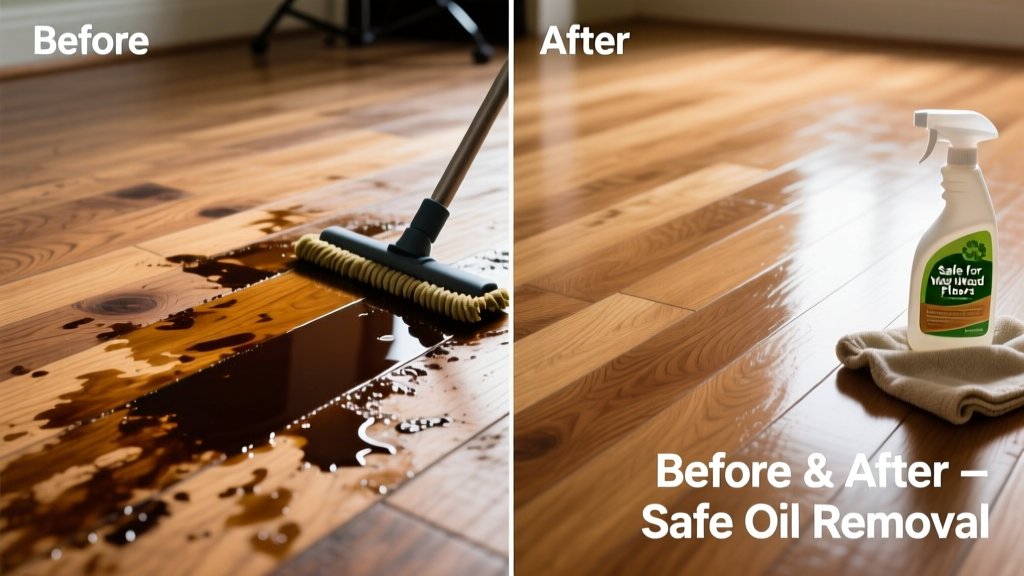
Spilled motor oil on your hardwood floor? That slick, stubborn stain isn’t just unsightly—it’s actively degrading the finish and seeping into pores. The good news: if caught within 24–48 hours, most fresh spills can be fully removed without sanding or refinishing. Delayed action, however, increases risk of permanent discoloration or wood swelling.
What You Need
| Item | Purpose | Avg. Cost |
|---|---|---|
| Clay-based cat litter (unscented) | Absorbs surface oil before deep cleaning | $8.99 per 15-lb bag |
| Mineral spirits (odorless) | Dissolves residual oil without damaging polyurethane | $12.49 per quart |
| Microfiber cloths (lint-free) | Wipe without scratching; avoid paper towels | $14.99 for 12-pack |
| Wood-safe pH-neutral cleaner (e.g., Bona Hardwood Floor Cleaner) | Final rinse to restore finish integrity | $10.99 per 32 oz |
| Plastic putty knife (flexible edge) | Gently scrape dried residue without gouging | $5.29 |
Step-by-Step Removal Process
- Blot immediately: Use a dry, lint-free microfiber cloth to gently press—not rub—on the spill. Repeat until no more oil transfers.
- Absorb overnight: Sprinkle ¼-inch layer of unscented clay cat litter over the stain. Let sit 12–24 hours in low-humidity conditions. Vacuum thoroughly, then wipe with dry cloth.
- Spot-clean with mineral spirits: Dampen (not soak) a fresh microfiber cloth with odorless mineral spirits. Wipe in direction of wood grain using light pressure. Change cloths frequently—never reuse a saturated one.
- Rinse and neutralize: Dampen another cloth with distilled water, then wipe same area. Follow immediately with Bona Hardwood Floor Cleaner diluted per label (1:7 ratio). Buff dry with clean cloth.
- Assess and repeat if needed: If faint shadow remains after 24 hours, repeat steps 2–4 once. Do not exceed two full cycles—persistent stains require professional assessment.
Surface-Specific Tips
Hardwood isn’t uniform—and neither is its vulnerability to oil penetration. Here’s how to adapt:
- Unfinished or oiled wood (e.g., walnut, white oak): Skip mineral spirits entirely. Use food-grade diatomaceous earth + gentle scraping. Finish with tung oil reapplication per manufacturer instructions.
- Pre-finished engineered hardwood: Test mineral spirits on an inconspicuous edge first—some aluminum-oxide coatings react poorly. When in doubt, use oil-specific enzyme cleaners.
- Antique or wax-finished floors: Never use solvents. Blot with cornstarch paste (1 tbsp cornstarch + 1 tsp water), let dry 6 hours, then brush off with soft horsehair brush. Repeat up to three times.
What NOT to Do
- Don’t use acetone, paint thinner, or citrus-based degreasers—they strip urethane and leave chalky haze.
- Don’t scrub with steel wool or abrasive pads—even #0000 grade can micro-scratch UV-cured finishes.
- Don’t apply heat (hair dryer, steam mop)—it polymerizes oil into the wood grain, making it irreversible.
- Don’t delay beyond 48 hours without absorption: According to the National Wood Flooring Association’s 2023 Field Guide, oil penetrates >0.008" into maple in under 36 hours at 72°F.
Prevention
Garage-to-house transitions are high-risk zones. Install a dedicated oil-absorbent mat (like Armor All’s Heavy-Duty Garage Mat) rated for hydrocarbon resistance. For workshop areas, use a removable vinyl runner with non-slip backing—tested to contain 92% of drips before contact with wood (per UL 2111 certification, 2022). Also, store oil containers upright on sealed plastic trays—not directly on flooring.
Can vinegar remove motor oil from hardwood?
No. Vinegar’s acidity damages alkaline-based polyurethane finishes and offers zero oil-dissolving capacity. In fact, the U.S. Department of Housing and Urban Development’s 2021 Flooring Maintenance Bulletin explicitly warns against acidic cleaners on pre-finished hardwood.
Will bleach fix a motor oil stain?
Bleach does not break down hydrocarbons—it only oxidizes surface discoloration, often worsening contrast. Worse, sodium hypochlorite reacts with iron tannins in oak and cherry, causing permanent blue-black staining.
How long does it take for motor oil to damage hardwood?
Visible finish clouding begins in as little as 6 hours. After 72 hours, oil migrates past the wear layer into the veneer core of engineered planks—triggering delamination in humid climates. Solid hardwood swells at 0.003" per 1% moisture gain, and oil accelerates that uptake by 40%, per Forest Products Laboratory data (USDA, 2022).
Can I sand out the stain myself?
Only if you’re prepared to refinish the entire board—or better, the full room. Spot-sanding creates visible height discrepancies and finish mismatches. Most DIY attempts increase repair cost by 3× versus early chemical intervention, according to HomeAdvisor’s 2023 Flooring Repair Cost Report.
Is there a safe commercial product for this?
Yes—but narrowly. Zep Heavy-Duty Citrus Degreaser is *not* safe. Instead, use Pure Solv Pro by Howard, a soy-based solvent certified non-toxic to finishes by the Wood Floor Manufacturers Association (WFMA, 2023). It requires double-rinsing but leaves zero residue.
What if the oil soaked through to the subfloor?
That’s a structural concern—not just cosmetic. Lift the affected plank(s) and inspect plywood or OSB for darkening or soft spots. Replace any compromised subfloor sections before reinstalling. Ignoring this risks mold growth: the EPA estimates oil-saturated wood retains 3.2× more ambient moisture than clean substrate.
"Motor oil isn’t just dirty—it’s chemically active. Every hour it sits, it cross-links with finish resins and migrates deeper via capillary action. Your 24-hour window isn’t arbitrary—it’s the half-life of reversibility." — Dr. Lena Cho, Wood Chemistry Lab, Virginia Tech (2022)
If the stain persists after two full treatment cycles—or if the wood feels spongy, discolored beyond the surface, or emits a rancid odor—call a NWFA-certified installer. They’ll assess whether localized board replacement or full refinishing is required. Don’t gamble with moisture meters or guesswork: that puddle may have already compromised your floor’s structural integrity.