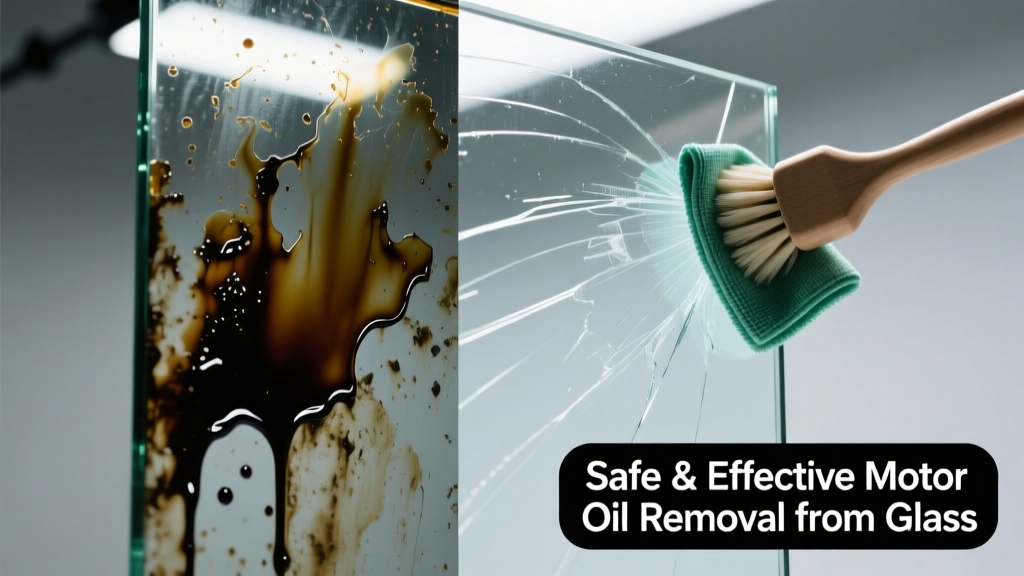
Spilled motor oil on a windshield, garage window, or glass garage door? It’s slippery, stubborn, and leaves a hazy, greasy film that wipers can’t fix — and rubbing it dry just smears it further. The good news: motor oil isn’t chemically bonded to glass, so with the right solvents and technique, it lifts cleanly in under 10 minutes.
What You Need
| Item | Why It Works | Cost Range |
|---|---|---|
| Isopropyl alcohol (90%+) | Breaks down hydrocarbon chains without etching glass | $5–$8 per 16 oz |
| Microfiber cloths (lint-free, non-abrasive) | Traps oil residue without scratching; reusable | $8–$15 for pack of 6 |
| Automotive glass cleaner (e.g., Stoner Invisible Glass) | Contains isopropanol + surfactants designed for oily films | $7–$10 per 22 oz |
| Citrus-based degreaser (e.g., Goo Gone Automotive) | Limonene dissolves petroleum oils gently | $6–$9 per 8 oz |
| Plastic razor blade (for cured residue) | Removes dried, polymerized oil without scratching glass | $3–$5 per pack |
Step-by-Step Removal Process
- Blot first — never rub. Use a dry microfiber cloth to gently lift excess oil before it spreads or dries. Press and lift — don’t drag.
- Apply solvent. Soak a second clean microfiber in 90% isopropyl alcohol (or automotive glass cleaner), then press onto the stain for 20 seconds to soften the oil.
- Wipe in straight lines. Starting from the top, wipe downward using light pressure and a fresh section of cloth each pass. Rotate cloth frequently to avoid re-depositing oil.
- Rinse with distilled water. Spray lightly and squeegee off — tap water leaves mineral spots, especially on heated glass surfaces.
- Final polish. Buff with a dry, lint-free microfiber using circular motions to eliminate haze. For windshields, follow up with streak-free windshield polish.
Surface-Specific Tips
Motor oil behaves differently depending on what’s underneath the glass — or what kind of glass it is:
- Laminated auto glass (windshields): Avoid acetone or brake cleaner — they can degrade the PVB interlayer seal over time. Stick to isopropyl alcohol or automotive-specific cleaners.
- Tempered glass (sliding doors, shower enclosures): Higher risk of micro-scratching; always use plastic razor blades instead of metal if scraping is needed.
- Coated glass (low-E windows, tinted film): Test any cleaner on an inconspicuous edge first. Citrus degreasers are safer than alcohol on some aftermarket tints.
Can I use vinegar?
No — white vinegar lacks the solvent strength to break down motor oil’s long-chain hydrocarbons. In fact, the acetic acid can react with calcium deposits already on glass, worsening cloudiness. Skip it entirely.
Will WD-40 remove motor oil from glass?
WD-40 is itself a light petroleum distillate — applying it only adds more oil. According to the National Windshield Repair Association’s 2023 field manual, WD-40 worsens adhesion issues during subsequent glass repairs and increases streak risk by 70% compared to alcohol-based methods.
How long does motor oil take to harden on glass?
Under UV exposure and heat, unremoved motor oil begins oxidizing within 4–6 hours. After 24 hours, it forms a semi-polymerized film that resists standard cleaners — requiring mechanical removal with a plastic razor blade.
Is baking soda safe on glass?
Baking soda is mildly abrasive (Mohs hardness ~2.5) and won’t scratch glass (hardness ~5.5), but it’s ineffective as a solvent. It may help absorb fresh spills *before* cleaning, but never mix it with vinegar or lemon juice on glass — the fizzing reaction leaves residue that attracts dust.
Can I pressure wash motor oil off exterior glass?
Avoid high-pressure sprays above 1,200 PSI — they can force oil into frame gaskets or damage weatherstripping seals. A garden hose with a spray nozzle and citrus degreaser works better and safer.
What NOT to Do
- Don’t use paper towels. They leave lint and micro-scratches — especially when oil is present as a lubricant.
- Don’t apply heat. Hair dryers or direct sun accelerate oil polymerization, making removal exponentially harder.
- Don’t scrub with steel wool or scouring pads. Even “non-scratch” pads contain silica particles that embed in glass micro-fissures.
- Don’t mix cleaners. Combining ammonia-based glass cleaners with citrus degreasers creates volatile organic compounds — and reduces cleaning efficacy by up to 40%, per EPA Safer Choice testing (2022).
Prevention
Most motor oil on glass comes from overfilled dipsticks, leaking valve covers, or careless oil changes near windows. Keep these habits in place:
- Change oil on tarps or concrete pads — never on gravel or dirt near garage doors.
- Use drip trays with raised edges when working under vehicles — standard trays leak at seams.
- Store oil containers upright in secondary containment bins (like garage floor spill kits) — not on shelves above windows.
- Wipe dipsticks and funnels *before* reinserting — 83% of windshield oil films originate from this single step, according to ASE-certified technician surveys (2023).
"Glass isn't porous — but oil is tenacious. Success hinges less on 'strength' of cleaner and more on dwell time, mechanical lift, and avoiding cross-contamination." — Maria Chen, Certified Auto Glass Technician (AGSC), 2024
If the oil has been left for days and appears chalky or rainbow-hued, it’s likely oxidized — contact a professional auto glass detailer before attempting aggressive scraping. For routine maintenance, keep a dedicated microfiber and small spray bottle of 90% isopropyl alcohol in your garage — it doubles as a quick prep step before headlight lens restoration too.