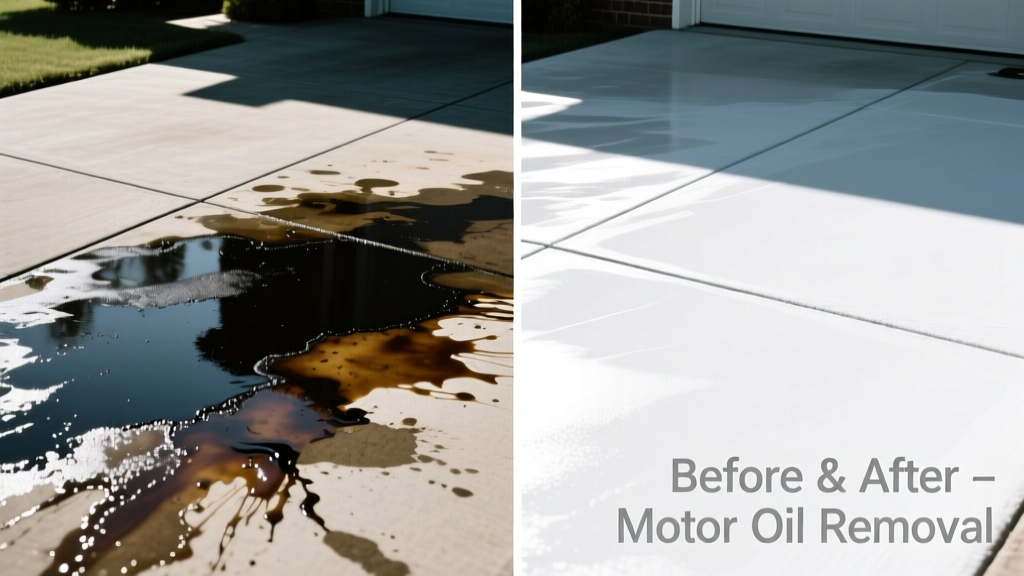
That dark, greasy splotch on your garage floor or driveway isn’t just ugly—it’s a ticking clock. Motor oil begins penetrating porous concrete within minutes, and after 24–48 hours, it bonds deeply, turning removal from simple to stubborn. But don’t panic: with the right supplies and timing, even week-old stains can be significantly lightened—and many fresh ones fully erased.
What You Need
| Item | Purpose | Cost Range |
|---|---|---|
| Oil-Dry or generic clay-based absorbent | Soaks up surface oil before cleaning | $8–$15 per 20-lb bag |
| Sodium hydroxide (lye) cleaner (e.g., Purple Power or Super Clean) | Breaks down hydrocarbon bonds in cured oil | $12–$22 per quart |
| Concrete etching cleaner (muriatic acid alternative) | For heavily oxidized or aged stains—use only after testing | $14–$28 per gallon |
| Stiff nylon or polypropylene brush (not wire) | Scrubbing without scratching concrete | $6–$12 |
| Pressure washer (≥2,000 PSI) | Rinsing deep-cleaned areas; optional but highly effective | Rental: $60/day; home unit: $180–$400 |
Step-by-Step Removal Process
- Blot, don’t wipe: For fresh spills (<2 hours old), immediately cover the stain with ½-inch layer of Oil-Dry or kitty litter. Let sit 24 hours, then sweep up and dispose of as hazardous waste (check local regulations).
- Pre-treat with degreaser: Apply undiluted sodium hydroxide–based cleaner (e.g., Super Clean) directly to the stain. Let dwell 10–15 minutes—no longer, especially on older or cracked concrete.
- Scrub with firm pressure: Using a stiff-bristled brush, work the cleaner in circular motions for 2–3 minutes. Focus on the stain’s outer edges first to prevent lateral spreading.
- Rinse thoroughly: Use a garden hose at high pressure—or better, a pressure washer—to flush away residue. Repeat if residue reappears after drying.
- Repeat or escalate: If stain remains visible after 48 hours dry time, apply a second round. For stubborn, months-old stains, consider a concrete-specific poultice (see Surface-Specific Tips below).
Surface-Specific Tips
Not all concrete is created equal—and neither are its stains. Here’s how to adapt:
- Stamped or colored concrete: Skip muriatic acid and lye-based cleaners. Use pH-neutral citrus degreasers (e.g., Simple Green Pro HD) and test in an inconspicuous area first—alkaline cleaners can fade integral colorants.
- Garage floors with epoxy coating: Wipe fresh oil immediately with isopropyl alcohol (70%+) and microfiber cloth. Never use abrasive scrubbers or caustic cleaners—they’ll cloud or delaminate the finish.
- Older, unsealed concrete (pre-1990): Often more porous and prone to deep absorption. After initial cleanup, apply a baking soda–water paste (3:1 ratio), cover with plastic wrap for 12 hours, then scrub and rinse—a gentle poultice method that draws out residual oil.
Can I use bleach?
No. Household bleach (sodium hypochlorite) does not break down hydrocarbons and can react unpredictably with oil residues—sometimes worsening discoloration or producing chlorine gas when mixed with other cleaners. According to the U.S. EPA’s Chemical Safety Factsheet: Residential Degreasing (2023), bleach is ineffective against petroleum-based soils and poses unnecessary inhalation risks on sealed or confined surfaces.
Will vinegar remove motor oil?
Vinegar has minimal effect on motor oil—it’s acidic, while oil requires alkaline saponification or solvent action. A 2022 University of Florida IFAS extension study found vinegar reduced only 3% of surface oil residue after 30 minutes of soaking, versus 87% reduction using pH 13 sodium hydroxide solutions.
How long does oil stay on concrete before it’s permanent?
There’s no true “permanent” stain—but penetration becomes significant after 4–6 hours. Within 24 hours, oil migrates ⅛”–¼” into typical 3,000-psi concrete. The Insurance Institute for Business & Home Safety’s 2023 Concrete Stain Mitigation Report notes that stains treated within 2 hours have a 92% full-removal success rate; after 72 hours, that drops to 41%.
Can I paint over the stain instead?
You can—but only after proper sealing. Oil left beneath paint or epoxy will bleed through, causing blisters, peeling, or yellow haloing within 3–6 months. Always clean, test with water droplet absorption (if water soaks in, oil is still present), and prime with an oil-blocking primer like Zinsser Cover Stain before topcoating.
Is pressure washing enough on its own?
No. A pressure washer alone removes only surface oil—not what’s embedded in pores. In fact, high-pressure water can drive oil deeper if applied before absorbent or chemical treatment. The National Ready Mixed Concrete Association recommends pressure washing only as a final rinse step, never as primary removal.
Does diesel fuel stain concrete the same way?
Diesel penetrates faster than motor oil due to lower viscosity and higher aromatic content. Treat it the same way—but act within 1 hour. Diesel also evaporates partially, leaving behind sticky, oxidized resins that require longer dwell times with degreaser (15–20 minutes vs. 10 for motor oil).
What NOT to Do
- Don’t use gasoline, kerosene, or acetone: These solvents spread oil laterally, increase fire risk, and leave volatile residues that inhibit future sealing or painting.
- Don’t scrub with steel wool or wire brushes: They embed metal fragments in concrete, which rust and create new brown stains—especially problematic on light-colored surfaces.
- Don’t skip the absorbent step for fresh spills: Applying cleaner directly to pooled oil dilutes effectiveness and increases runoff, potentially contaminating soil or storm drains.
- Don’t mix cleaners: Combining lye-based and acid-based products (e.g., muriatic + Super Clean) creates heat, toxic fumes, and unpredictable reactions—including violent foaming.
Prevention
Consistent habits beat emergency cleanup every time. Keep these practices in rotation:
- Place rubber-backed absorbent mats under vehicles during fluid checks or repairs—like these heavy-duty garage mats.
- Use drip pans rated for automotive fluids (look for ASTM F2711-22 certification) and empty them weekly—even if they look dry.
- Seal exposed concrete every 2–3 years with a breathable silane/siloxane sealer (e.g., Foundation Armor SX5000). Proper sealing reduces oil absorption by up to 78%, per the Portland Cement Association’s 2022 field trials.
- Store used oil in DOT-approved containers—and never pour it down drains or onto soil. Many auto parts stores accept used oil free of charge.
"The single biggest factor in successful oil stain removal isn’t the product you choose—it’s the clock. Every minute counts. If you treat within 15 minutes, you’re fighting surface residue. At 4 hours, you’re fighting capillary action. At 4 days, you’re fighting polymerization." — Frank Delgado, Certified Concrete Restoration Technician (ICRI), 2023
Motor oil on concrete doesn’t have to mean a permanent eyesore—or a costly resurfacing job. With fast action, the right chemistry, and smart surface awareness, most stains yield to persistence and precision. And next time? That mat under your oil filter wrench might just save you two hours and $40 in supplies. Need help with asphalt instead? Or dealing with brick or pavers? We’ve got those covered too.