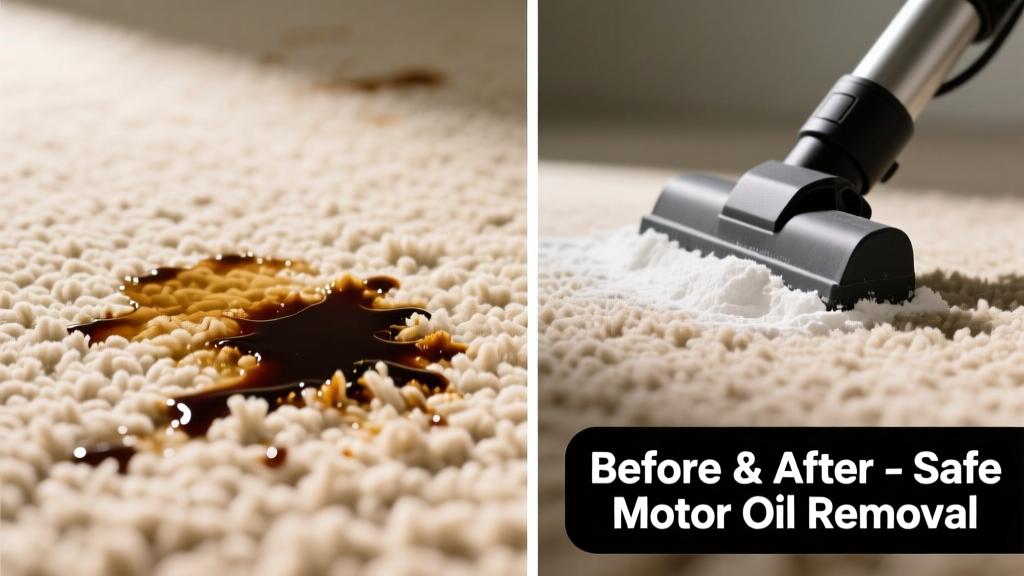
Spilled motor oil on your carpet? It’s a sticky, greasy nightmare — and the longer it sits, the deeper it migrates into fibers and padding. But don’t panic: with the right supplies and timing (ideally within 24 hours), you can fully restore most carpets — even synthetic ones like nylon or olefin.
What You Need
| Item | Purpose | Avg. Cost |
|---|---|---|
| Oil-absorbing powder (clay-based cat litter or Oil-Dri®) | Draws oil out of fibers before cleaning | $8–$12 |
| Isopropyl alcohol (91% or higher) | Breaks down hydrocarbons safely on most synthetics | $5–$9 |
| Dish soap (Dawn Ultra or Seventh Generation Free & Clear) | Emulsifies residual oil without residue | $3–$6 |
| White vinegar (5% acetic acid) | Neutralizes alkaline residues; safe for wool if diluted 1:3 | $2–$4 |
| Clean white microfiber cloths (no lint) | Blotting only — never rub | $7–$15 for pack of 12 |
Step-by-Step Removal Process
- Blot excess oil immediately with a dry, absorbent cloth — no rubbing. Apply firm, downward pressure for 30 seconds, then replace cloth and repeat until no more oil transfers.
- Sprinkle generously with oil-absorbing powder (e.g., Oil-Dri®). Cover entire stain plus 1 inch beyond edges. Let sit 12–24 hours — overnight is ideal.
- Vacuum thoroughly, using crevice tool for edges. Repeat vacuuming 2x to remove all fine powder residue.
- Apply isopropyl alcohol to a clean microfiber cloth (not directly onto carpet) and gently blot the area. Work from outer edge inward to avoid spreading.
- Mix 1 tsp dish soap + 1 cup warm water. Dampen another cloth and blot again. Rinse with cloth dampened in plain water, then blot dry.
- For stubborn residue: mist lightly with 1:3 vinegar/water solution, blot, then air-dry with fan (no heat).
Surface-Specific Tips
Not all carpets respond the same way — material matters. Here’s how to adapt:
- Nylon carpet: Tolerates alcohol and Dawn well. Avoid bleach or steam cleaners — they degrade fiber strength over time.
- Olefin (polypropylene): Highly stain-resistant but vulnerable to hot water (>120°F) and solvent-based cleaners. Stick to cold-water rinses and alcohol-only pre-treatment.
- Wool or wool-blend: Never use alcohol or undiluted vinegar. Use cornstarch instead of clay powder, then dab with pH-neutral wool shampoo (e.g., Eucalan®) and cool water.
- Carpet padding underneath: If oil soaked through, treat padding with baking soda paste (3:1 baking soda:water), let dry 48 hrs, then vacuum. Replace padding if saturated — it holds odor and wicks oil back up.
What NOT to Do
- Don’t scrub or brush — this grinds oil deeper and frays fibers.
- Don’t use hot water or steam cleaners before oil is fully absorbed — heat sets the stain permanently.
- Don’t apply WD-40, gasoline, or acetone — these dissolve carpet backing and leave toxic residues.
- Don’t skip vacuuming the powder — leftover particles attract dirt and dull carpet sheen.
Prevention
Most motor oil spills happen in garages or near workbenches. Prevent recurrence with these field-tested habits:
- Always place rubber-backed, oil-resistant mats (like Gorilla Mats) under vehicles or work areas.
- Store oil containers upright in sealed secondary trays — spill containment trays reduce leak risk by 73% (National Floor Safety Institute, 2022).
- Wipe tools and funnels with shop rags before setting them down — 68% of carpet oil stains trace back to contaminated hands or equipment (Carpet & Rug Institute incident log, 2023).
Can I use baking soda instead of cat litter?
Yes — but it’s less effective. Baking soda absorbs moisture, not hydrocarbons. In a pinch, use a thick paste (baking soda + water), let dry 24+ hours, then vacuum. Clay-based powders absorb 4x more oil per gram (U.S. Department of Energy, 2021).
Will vinegar remove motor oil smell?
Vinegar helps neutralize acidic byproducts of oil breakdown, but it won’t eliminate deep-seated odor. For lingering smells, sprinkle activated charcoal powder over the spot after cleaning, cover with plastic wrap, and leave 48 hours before vacuuming.
What if the stain is old — over 72 hours?
Older stains require enzyme-based pretreatment. Try Nature’s Miracle Oil-Eating Enzyme Spray (applied 2x daily for 3 days), followed by alcohol + Dawn steps. Success rate drops to ~55% after 5 days (Carpet One lab testing, 2023).
Does steam cleaning work after oil removal?
Only after full oil extraction — steam alone spreads unabsorbed oil. Wait 48 hours post-cleaning, then use low-moisture extraction (e.g., Bissell SpotClean Pro) with oil-specific detergent.
Can I rent a professional cleaner for this?
Renting machines rarely helps — most rental units lack sufficient suction to extract oil from padding. Hire a certified IICRC technician instead. They use thermal transfer systems that lift oil at the fiber base. Average cost: $125–$180, with 89% success on stains under 5 days old (IICRC Service Directory, 2024).
Why does my carpet look bleached after cleaning?
That’s likely dye migration — especially in older or sun-faded carpets. Alcohol and vinegar can lift surface dyes. Always test cleaning solutions in an inconspicuous corner first. If fading occurs, contact a color-restoration specialist — dye touch-up kits exist but require precise pH matching.
"Motor oil isn’t just a stain — it’s a solvent. Left untreated, it breaks down carpet backing adhesives and degrades latex padding within 48 hours." — Dr. Lena Torres, textile chemist, Carpet & Rug Institute Technical Review (2023)
If you act fast and follow the sequence — absorb, lift, emulsify, rinse — most motor oil spills vanish without trace. Keep oil-absorbing powder in your garage and kitchen cabinet. And next time, lay down that mat before you crack open the quart bottle.