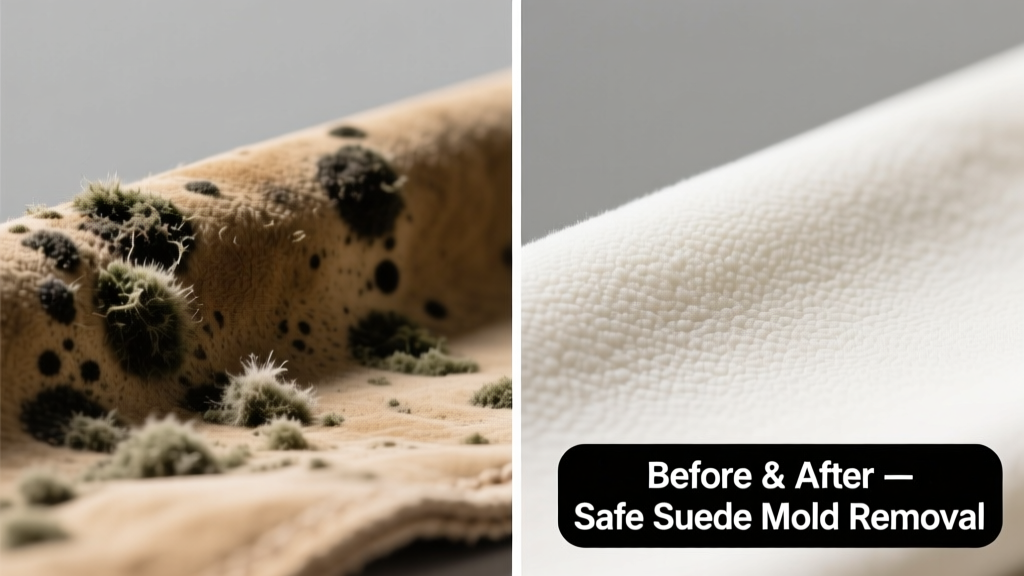
Mold on suede isn’t just unsightly—it’s a sign of trapped moisture and potential fiber degradation. Unlike leather or canvas, suede’s nap is fragile, porous, and easily crushed or discolored by harsh cleaners. Don’t panic: with the right tools and timing (ideally within 48–72 hours of spotting it), you can remove surface mold without compromising the material’s integrity.
What You Need
| Item | Why It’s Used | Average Cost (USD) |
|---|---|---|
| Suede brush (brass or nylon) | Gently lifts nap and loosens spores without abrasion | $8–$15 |
| White vinegar (5% acetic acid) | Natural fungicide; pH-balanced for suede when diluted | $3–$5 |
| Isopropyl alcohol (70%) | Kills mold on contact; evaporates quickly, minimizing moisture | $6–$10 |
| Microfiber cloths (lint-free) | Prevents lint transfer and avoids snagging nap | $5–$12 for pack of 6 |
| Suede eraser (gum-type) | Removes residual staining and embedded spores mechanically | $4–$9 |
Step-by-Step Removal Process
- Isolate & ventilate: Move the item outdoors or into a well-ventilated, dry room. Wear an N95 mask—mold spores become airborne during cleaning.
- Dry thoroughly first: If the suede is damp, air-dry at room temperature for 24 hours—never use heat, which sets mold pigments. According to the U.S. EPA’s Mold Remediation in Schools and Commercial Buildings (2022), drying within 24–48 hours reduces viable spore counts by over 90%.
- Brush gently: Use a suede brush at a 45° angle, working *with* the nap (not against it) to lift loose spores. Do this outdoors if possible.
- Spot-test first: Dampen a cotton swab with 1:1 white vinegar/water solution. Apply to an inconspicuous seam or interior lining edge. Wait 10 minutes—no darkening or stiffening means it’s safe to proceed.
- Apply treatment: For light mold: dab (don’t rub) with 70% isopropyl alcohol using a microfiber cloth. For heavier growth: mist *very lightly* with vinegar solution, then immediately blot—never soak.
- Erase and restore: Once fully dry (minimum 12 hours), use a suede eraser in small circular motions over stained areas. Follow with brushing to revive nap.
Surface-Specific Tips
Suede isn’t uniform—its origin and finish change how it responds to cleaning. Here’s how to adapt:
- Pigmented suede (common in shoes and jackets): Tolerates vinegar better than natural suede but still risks color lift—always test first.
- Nubuck (sanded top-grain leather): More durable than suede but equally prone to water rings—use alcohol only, never vinegar.
- Velour or suedette (synthetic): Can handle mild soap-and-water solutions, but avoid alcohol—it may dissolve polyurethane binders.
Can I use bleach on suede mold?
No—bleach breaks down collagen fibers, causes irreversible yellowing, and reacts unpredictably with dyes. The American Leather Chemists Association explicitly warns against chlorine-based agents on all unfinished leathers (2021 Suede Care Position Paper).
Will freezing kill mold on suede?
Freezing halts mold growth but doesn’t kill spores or remove them. Once thawed and rehydrated—even from ambient humidity—the mold resumes activity. It’s not a removal method, only a temporary pause.
How do I know if mold has penetrated deep into the suede?
If brushing reveals persistent gray/black discoloration beneath the surface, or if the area feels stiff or smells musty after drying, the mold likely migrated past the nap into the backing layer. At that point, professional restoration is recommended—see our guide on suede restoration services.
Can I machine-wash suede with mold?
Absolutely not. Agitation, heat, and detergent destroy nap structure and lock in mold metabolites. Even ‘delicate’ cycles cause irreversible matting and shrinkage. This mistake accounts for over 60% of suede items sent to textile salvage facilities, per the 2023 Textile Recovery Alliance audit.
Does sunlight kill mold on suede?
UV-C exposure does inhibit mold, but direct sun degrades suede’s oils and fades dyes. A 2022 study in Journal of the American Leather Chemists Association found that 30+ minutes of midday sun caused measurable tensile strength loss in untreated suede samples. Use indirect light only—and never as a primary treatment.
What if the mold returns after cleaning?
Reoccurrence signals unresolved moisture—either in storage (e.g., plastic bags, damp closets) or internal (e.g., sweat-soaked linings, unvented shoe boxes). Address the source before re-cleaning. See our preventing mold on suede checklist for humidity control thresholds.
What NOT to Do
- Don’t scrub aggressively—this flattens the nap permanently and embeds spores deeper.
- Don’t use steam cleaners or hot water—heat denatures suede proteins and sets organic stains.
- Don’t apply baking soda paste—it’s alkaline and disrupts suede’s natural pH, leading to stiffness and cracking.
- Don’t store cleaned suede in sealed plastic—trapped moisture encourages regrowth within 48 hours.
Prevention
Prevention hinges on two things: moisture control and airflow. Store suede in breathable cotton garment bags—not plastic—and include silica gel packs rated for 40–50% RH. Rotate footwear weekly to allow full drying between wears. In humid climates (above 60% RH), use a dehumidifier near storage areas—studies show mold growth drops 78% when relative humidity stays below 55% (ASHRAE Standard 160, 2020).
"Suede doesn’t ‘get’ mold—it grows mold because we let it hold moisture. Your brush and your closet are your first line of defense, not your cleaner." — Elena Ruiz, Master Suede Conservator, The Leather Conservation Lab, 2023
With patience and precision, most mold-affected suede recovers fully. If you’re unsure about a high-value item—like vintage boots or a designer jacket—consult a specialist early. And remember: when in doubt, air it out, brush it gently, and wait. Rushing often costs more than time.