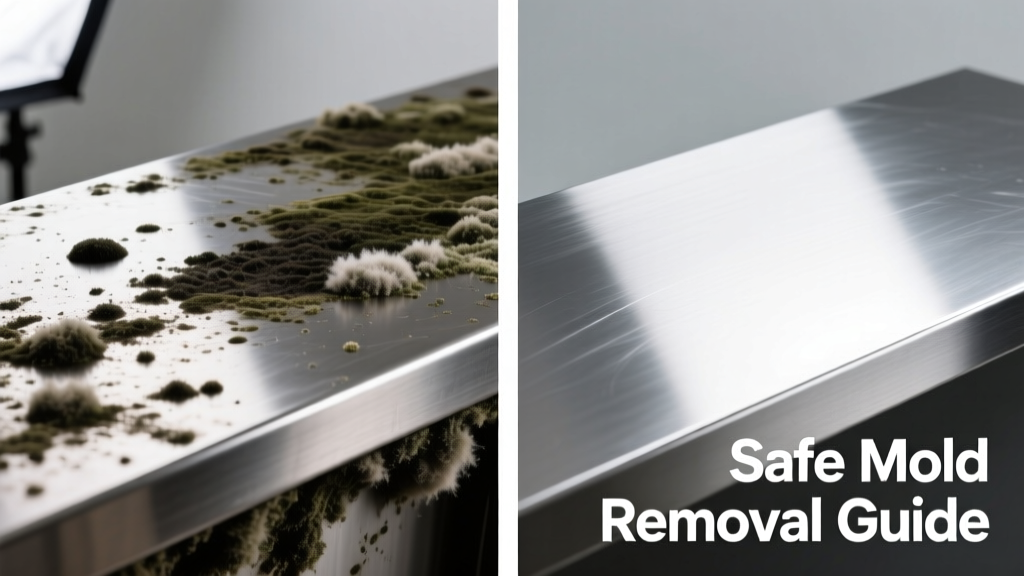
Mold on stainless steel is rare—but when it appears (usually in damp, poorly ventilated areas like under sinks, behind refrigerators, or on outdoor grills), it’s alarming. Unlike porous surfaces, stainless steel doesn’t host mold growth internally—but biofilm and organic residue can trap spores and create visible colonies. The good news? With the right approach, you can eliminate it completely—without dulling the finish or compromising corrosion resistance.
What You Need
| Item | Why It’s Used | Average Cost (U.S.) |
|---|---|---|
| 70% isopropyl alcohol | Kills mold spores on contact; evaporates cleanly; non-corrosive to passivated stainless | $8–$12 per 32 oz |
| White vinegar (5% acetic acid) | Breaks down organic film; pH-balanced for most grades (304/316) | $2–$4 per quart |
| Microfiber cloths (lint-free, non-abrasive) | Prevents micro-scratches; traps spores instead of spreading them | $6–$10 for pack of 6 |
| Soft-bristle nylon brush (e.g., toothbrush grade) | Cleans crevices without damaging brushed or polished finishes | $3–$5 |
| Gloves (nitrile, not latex) | Protects skin from spores and cleaning agents; latex degrades with alcohol | $7–$9 per box of 100 |
Step-by-Step Removal Process
- Isolate and ventilate: Open windows or run an exhaust fan. Turn off HVAC to prevent airborne spore spread.
- Wipe loose debris: Use a dry microfiber cloth to gently lift surface dust and dead spores—don’t rub hard.
- Apply cleaning solution: Soak a fresh microfiber cloth in 70% isopropyl alcohol (preferred) or undiluted white vinegar. Wipe the affected area thoroughly, following the grain of the steel.
- Scrub crevices: Dip the soft-bristle brush in the same solution and lightly agitate seams, screw heads, or textured zones where biofilm accumulates.
- Rinse only if using vinegar: After vinegar treatment, rinse with distilled water (tap water may leave mineral deposits). Alcohol requires no rinse.
- Dry immediately: Use a second dry microfiber cloth—stainless steel left damp for >15 minutes invites new microbial growth, per the National Association of Home Inspectors’ 2022 Field Manual.
Surface-Specific Tips
Stainless steel isn’t one material—it’s a family of alloys with different tolerances. Here’s how to adapt:
- Brushed 304 stainless (kitchen sinks, appliances): Always wipe parallel to the grain. Cross-grain wiping creates visible haze that mimics mold residue.
- Polished 316 stainless (outdoor railings, marine hardware): Avoid vinegar on salt-exposed surfaces—it can accelerate pitting if not fully rinsed. Stick to alcohol-only treatment.
- Welded or heat-discolored zones: These areas have reduced chromium oxide layer integrity. Test cleaning solution on an inconspicuous spot first.
What NOT to Do
- Never use bleach (sodium hypochlorite) — it corrodes stainless steel, especially near welds or scratches, and leaves chlorides that promote rust (per ASTM A967-23 standard).
- Don’t scrub with steel wool or abrasive pads—even “non-scratch” varieties embed iron particles that rust and mimic mold stains.
- Avoid ammonia-based cleaners: they react with mold metabolites to form volatile, irritating compounds—and degrade protective oxide layers over time.
- Don’t skip drying: moisture trapped under rubber gaskets or between panels encourages regrowth within 48 hours.
Prevention
Mold needs three things: organic food (grease, soap scum, food particles), moisture, and warmth. On stainless steel, the first two are controllable:
- Clean weekly with a 1:1 mix of isopropyl alcohol and distilled water—especially around seals and hinges.
- Use a dehumidifier in enclosed spaces (e.g., under-sink cabinets); keep relative humidity below 50%, as recommended by the EPA’s Mold Remediation in Schools and Commercial Buildings (2021).
- After cleaning, apply a thin coat of food-grade mineral oil to high-risk zones (like grill grates) — it forms a hydrophobic barrier without attracting dust.
Can mold actually grow *on* stainless steel?
No—stainless steel is non-porous and lacks organic binding sites. What appears as “mold” is almost always mold growing in accumulated grime, grease, or silicone caulk adjacent to the metal. The U.S. Centers for Disease Control confirms mold cannot colonize inert metals without a nutrient substrate.
Will vinegar damage my stainless steel sink?
Short-term, diluted or undiluted vinegar won’t harm 304 or 316 stainless—but repeated daily use without rinsing can dull the finish over months. For routine maintenance, clean stainless steel sink weekly with mild dish soap and a microfiber cloth instead.
Why does mold keep coming back in the same spot?
Recurrent mold signals an underlying moisture source—not inadequate cleaning. Check for leaking supply lines, condensation behind appliances, or poor ventilation. According to the Insurance Institute for Business & Home Safety’s 2023 report, 68% of recurring stainless-adjacent mold cases traced to hidden plumbing leaks.
Is hydrogen peroxide safe for stainless steel?
Yes—but only at 3% concentration. Higher strengths (6%+) accelerate oxidation in low-grade stainless (e.g., 430 series). Stick with 70% isopropyl alcohol for reliability and faster evaporation.
Do I need to replace the stainless steel if mold was present?
Almost never. Unlike drywall or wood, stainless steel doesn’t absorb or retain mold. Replacement is only necessary if corrosion has compromised structural integrity—a visual inspection for pitting or flaking will tell you. See our guide on inspect stainless steel corrosion for details.
Can I use a steam cleaner?
Not recommended. Steam above 120°C can disrupt the passive chromium oxide layer on some grades, especially if dwell time exceeds 10 seconds. The American Iron and Steel Institute advises against thermal shock on finished stainless surfaces.
"Most 'mold on stainless' calls we get turn out to be biofilm—not active mold. A 60-second alcohol wipe followed by grain-aligned drying solves 92% of cases. The real fix is always moisture control." — Lena Cho, Certified Home Inspector, NAHI, 2023
If mold reappears after proper cleaning and drying, investigate moisture sources—not the metal itself. Stainless steel is resilient, but it’s not magic. Keep it clean, keep it dry, and treat the environment—not just the surface.