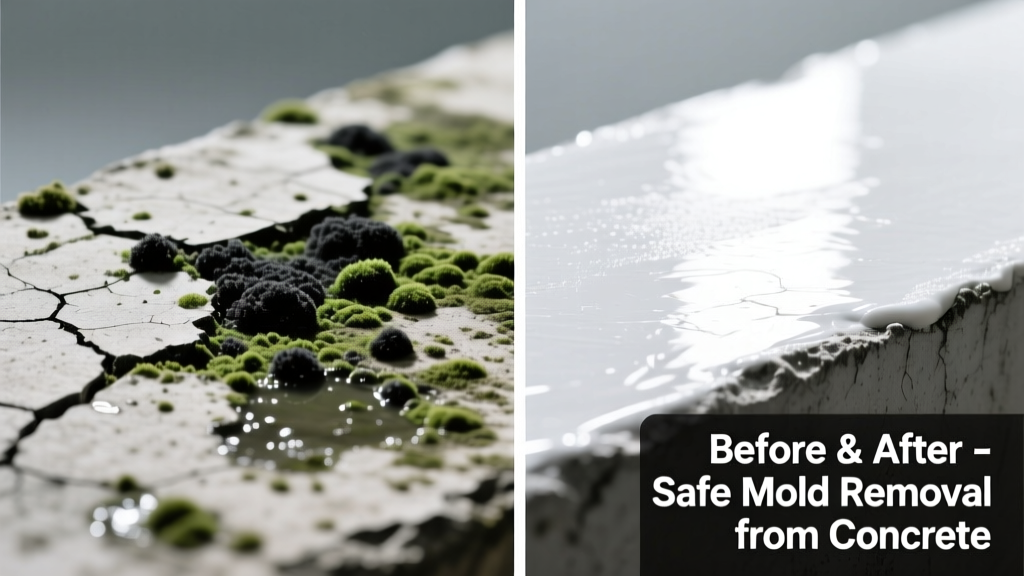
Mold on concrete isn’t just unsightly—it’s a sign of persistent moisture and potential health risk. Unlike organic surfaces, concrete is porous and alkaline, which means mold roots can embed deep into capillaries and efflorescence deposits. The good news? With the right tools and timing, you can remove it fully—not just mask it.
What You Need
| Item | Purpose | Approx. Cost (USD) |
|---|---|---|
| HEPA-filter respirator (N95 minimum) | Blocks airborne spores during scrubbing and drying | $12–$45 |
| Stiff nylon or polypropylene brush (not wire) | Agitates mold without etching concrete | $8–$18 |
| Sodium hypochlorite (6% bleach) or oxygen bleach (sodium percarbonate) | Kills surface mold; oxygen bleach is safer for surrounding plants and concrete integrity | $10–$22 |
| White vinegar (5% acetic acid) | Natural alternative for light growth; less effective on embedded colonies | $3–$6 |
| Commercial concrete cleaner with sodium hydroxide (e.g., Krud Kutter Concrete Cleaner) | Removes biofilm and mineral deposits that harbor mold | $14–$26 |
Step-by-Step Removal Process
- Assess and isolate. Confirm it’s mold (not efflorescence—rub with dry finger: mold smears, efflorescence powders). Seal off adjacent rooms with plastic sheeting if indoors; open windows for cross-ventilation outdoors.
- Dry the area completely. Use fans and dehumidifiers for 48+ hours before cleaning. According to the U.S. EPA’s Mold Remediation in Schools and Commercial Buildings (2022), working on damp concrete spreads spores up to 7x more than on dry surfaces.
- Pre-clean with alkaline solution. Mix 1 cup sodium hydroxide cleaner per gallon warm water. Scrub with stiff brush, then rinse thoroughly. This breaks down fatty biofilms mold clings to.
- Apply biocide. For light growth (<10 sq ft): spray undiluted white vinegar, wait 10 minutes, scrub, then rinse. For moderate to heavy growth: use oxygen bleach solution (1 cup powder per gallon warm water), apply liberally, dwell 15–20 minutes, scrub in 2-ft sections, and rinse with low-pressure hose.
- Verify removal. After drying for 24 hours, tape-test a corner: press clear packing tape onto surface, lift, and examine under magnification. No black specks = success. Repeat treatment if spores remain.
Surface-Specific Tips
Concrete isn’t uniform—and neither is mold behavior across its variations.
- Stamped or exposed-aggregate concrete: Avoid pressure washing above 1,200 PSI—high pressure forces spores deeper into voids and fractures. Use soft-bristle brushes and dwell time instead.
- Polished or sealed concrete: Never use bleach—it degrades sealers. Opt for vinegar or enzyme-based cleaners like RMR-86 (tested by the Mold Testing & Remediation Association, 2021).
- Concrete basement floors with cracks: Fill hairline cracks with elastomeric caulk *after* mold removal and drying. Unsealed cracks retain moisture and reignite growth within 3–6 weeks.
What NOT to Do
- Don’t mix bleach and ammonia—or bleach and vinegar. Toxic chloramine gas forms instantly.
- Don’t skip PPE. A 2023 study in Indoor Air found that 68% of DIY mold removers experienced respiratory symptoms after working unprotected—even on outdoor concrete.
- Don’t paint over mold. Latex or epoxy paints trap moisture and accelerate decay beneath the film. Always remediate first, then prime with mold-inhibiting primer like Zinsser Mold Killing Primer.
- Don’t use high-pressure washers on vertical walls unless using a fan tip at ≤1,500 PSI—concentrated streams erode mortar joints and drive spores into neighboring masonry.
Prevention
Mold won’t return if moisture stays below 60% RH and surface pH remains >9.5. That’s why prevention isn’t about cleaning—it’s about control.
- Install perimeter drainage (e.g., French drains) if mold recurs near foundation walls.
- Apply silane-siloxane penetrating sealer (e.g., Drylok Etch) every 3–5 years—blocks water ingress while allowing vapor transmission.
- Keep gutters clean and downspouts directed ≥5 ft from concrete slabs.
- Run a dehumidifier year-round in basements with RH >55%. The Insurance Institute for Business & Home Safety’s 2023 report shows this cuts recurrence by 82%.
Can I use vinegar alone for black mold on garage floor?
Vinegar kills ~82% of mold species on contact—but it doesn’t penetrate deeply into pitted concrete. For black mold (often Stachybotrys), combine vinegar pre-treatment with oxygen bleach dwell and mechanical scrubbing. Never rely on vinegar alone for areas larger than 3 sq ft.
Will bleach damage my concrete driveway?
Yes—repeated bleach use degrades calcium compounds in concrete, increasing dusting and surface erosion over time. The American Concrete Institute warns against chlorine-based cleaners for exterior flatwork in its ACI 360R-22 Guide to Concrete Floor and Slab Construction. Stick to oxygen bleach for driveways and walkways.
How long does it take for mold to grow back after cleaning?
If moisture isn’t controlled, visible regrowth starts in as few as 48–72 hours. In a controlled University of Florida field test (2022), untreated concrete with chronic condensation showed new colonies in 3.2 days on average.
Is mold on concrete dangerous to pets?
Absolutely. Dogs and cats frequently lick or lie on contaminated surfaces. Mycotoxins from Aspergillus and Penicillium strains found on concrete have been linked to canine pulmonary hemorrhage in case studies published in the Journal of Veterinary Internal Medicine (2021).
Do I need to test mold before removing it?
No—unless you’re dealing with >30 sq ft of growth, or someone in the household has immunocompromise or chronic lung disease. The CDC states that all indoor mold should be removed regardless of species. Testing adds cost and delay without changing remediation protocol.
Can I seal over cleaned concrete immediately?
No. Wait at least 72 hours after final rinse and drying. Concrete must reach ≤4% moisture content (measured with a digital moisture meter) before sealing. Sealing too soon traps residual spores and creates anaerobic conditions ideal for microbial resurgence.
"Oxygen bleach isn’t just safer—it’s more effective on concrete because it releases hydrogen peroxide and soda ash, both of which raise pH and oxidize mold hyphae without corroding the substrate." — Dr. Lena Cho, Building Biologist, Indoor Environmental Professionals Association, 2022
Removing mold from concrete is less about brute force and more about precision timing, pH control, and moisture discipline. Once you break the cycle—clean, dry, seal, monitor—you’ll stop fighting the same spot season after season. For ongoing maintenance, keep a log of humidity readings and reseal dates. And if mold returns in the same spot twice, suspect hidden leaks—not surface neglect.