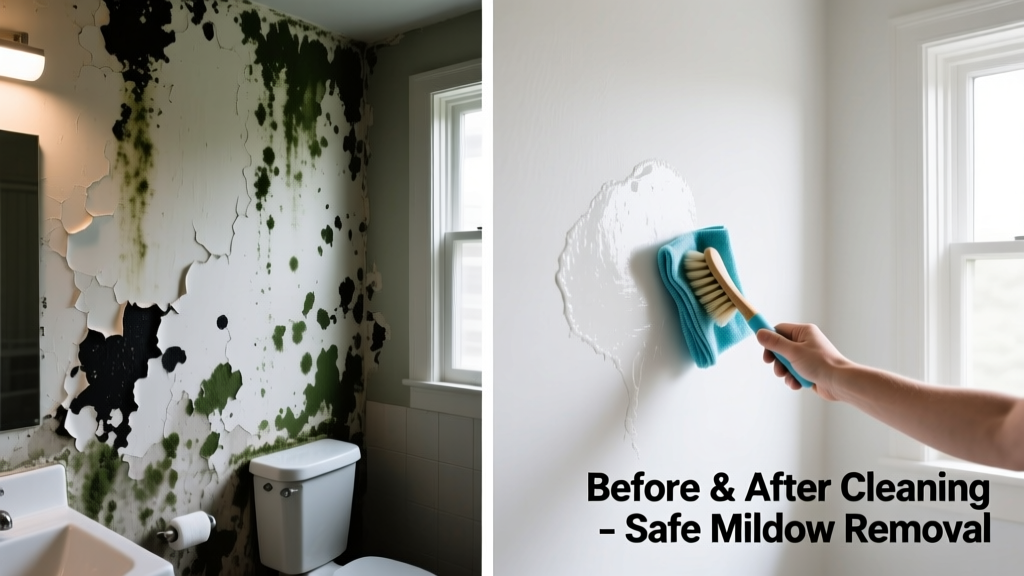
Waking up to fuzzy black or green splotches creeping across your wallpaper is equal parts alarming and frustrating—especially when you realize it’s mildew, not just dirt. Unlike surface grime, mildew roots into porous paper and adhesive, so aggressive scrubbing or bleach-heavy solutions often worsen the problem. The good news? With the right tools and timing, you *can* remove early-stage mildew safely—if the wallpaper hasn’t been saturated for more than 48 hours and the drywall beneath remains sound.
What You Need
Gather these supplies before starting. Costs reflect average U.S. retail prices (2024) for standard household quantities:
| Item | Purpose | Approx. Cost |
|---|---|---|
| 70% isopropyl alcohol (16 oz) | Kills spores without saturating paper | $5.99 |
| White vinegar (32 oz) | Natural fungicide; pH-balanced for cellulose fibers | $2.49 |
| Microfiber cloths (pack of 6) | Lint-free, low-abrasion wiping | $8.99 |
| Soft-bristle nylon brush (1-inch head) | Gentle agitation without tearing paper | $4.25 |
| HEPA-filter vacuum with crevice tool | Removes airborne spores pre- and post-treatment | $129.00 (rental: $25/day) |
| Disposable N95 mask & nitrile gloves | Protects against inhalation and skin contact | $6.50 |
Step-by-Step Removal Process
Act fast—but never rush. Mildew spreads rapidly in warm, humid conditions. Follow this sequence for best results:
- Isolate the area: Close doors, turn off HVAC, and seal vents with painter’s tape to prevent spore dispersal.
- Vacuum first: Use the HEPA vacuum’s crevice tool on low suction to lift loose spores from seams and edges—do not touch the stain yet.
- Spot-test: Dampen a cotton swab with 70% isopropyl alcohol and apply to an inconspicuous corner (e.g., behind a door frame). Wait 5 minutes. If color bleeds or paper bubbles, skip alcohol and use diluted white vinegar (1:1 with water) instead.
- Treat gently: Lightly mist affected area with alcohol (or vinegar solution) using a fine-spray bottle—never soak. Let sit 2–3 minutes, then blot with folded microfiber cloth. Repeat 2–3 times until discoloration lifts.
- Dry thoroughly: Run a dehumidifier in the room at 40–45% RH for 48 hours. Use fans on low speed—not directed at the wall—to encourage airflow without flapping paper.
Surface-Specific Tips
Not all wallpaper reacts the same. Adjust technique based on material:
- Vinyl-coated wallpaper: Tolerates light alcohol misting and soft brush agitation. Avoid vinegar—it may dull the sheen over time.
- Non-woven (fabric-backed): Highly absorbent. Use only vinegar solution, applied with a damp (not wet) cloth. Never spray directly—apply via cloth wicking.
- Traditional paper-based wallpaper: Most vulnerable. Skip brushing entirely. Blot only. If staining persists after two treatments, replacement is safer than risking adhesive failure.
- Textured or embossed wallpaper: Use a clean, dry soft-bristle brush *after* drying to lift residual dust trapped in grooves—never during active treatment.
Can I use bleach on wallpaper?
No. According to the CDC’s Mold Remediation in Schools and Commercial Buildings (2023), chlorine bleach does not penetrate porous surfaces and leaves viable spores embedded in paper backing. Worse, it degrades cellulose fibers and weakens adhesive bonds—often causing bubbling or delamination within 24–48 hours.
Will a steam cleaner help?
Steam adds moisture—exactly what mildew thrives on. The U.S. EPA explicitly warns against steam cleaning for mold/mildew on papered walls (EPA Mold Guide, 2022). It risks pushing spores deeper and warping the substrate.
How do I know if the drywall is compromised?
Gently press around the stained area with gloved fingers. If the wall feels spongy, gives slightly, or emits a musty odor *behind* the paper, the gypsum board is likely water-damaged. In that case, consult a certified IAQ professional—do not attempt DIY removal.
Can I paint over mildew-stained wallpaper?
Painting seals spores in place and creates a food source for future growth. The American Coatings Association advises against covering mildew with primer or paint unless the underlying cause (e.g., leak, condensation) is fully resolved and the surface is microbiologically clean (CoatingsTech, March 2024).
Is mildew the same as mold?
No. Mildew is a surface-level fungus (usually Cladosporium or Oidium) that grows flat and powdery on organic materials like paper and fabric. Mold penetrates deeper and can produce mycotoxins. Both require similar removal protocols on wallpaper—but mildew is easier to treat *if caught early*.
Do I need to replace the entire wall?
Not always. If staining covers less than 10 square feet, is confined to one panel, and shows no signs of adhesive failure or wall damage, targeted treatment is appropriate. But per the Institute of Inspection, Cleaning and Restoration Certification (IICRC S520 Standard, 2023), any mildew affecting >30 sq ft or recurring within 30 days warrants full removal and substrate inspection.
What NOT to Do
- Don’t scrub aggressively—even with soft brushes. Wallpaper tears easily when damp.
- Don’t use ammonia, hydrogen peroxide, or essential oils. These degrade adhesives or leave residues that attract dust and future spores.
- Don’t ignore the source. Removing mildew without fixing the humidity or leak invites immediate regrowth.
- Don’t reuse cloths or sponges—even after washing. Spores survive laundering. Discard used microfiber after each session.
"On wallpaper, mildew isn’t just cosmetic—it’s a red flag. If you’re treating it more than once a year, your relative humidity is consistently above 60%. That’s not a cleaning issue; it’s a building science issue." — Dr. Lena Cho, Indoor Air Quality Specialist, Building Science Corporation (2023)
Prevention
Preventing recurrence means managing moisture at the source—not just cleaning surfaces. Install a hygrometer ($12–$25) to monitor room RH daily. Keep levels between 30–50% year-round. Fix leaks within 24 hours. Add exhaust fans rated for ≥50 CFM in bathrooms and kitchens—and run them for 20 minutes post-shower or cooking. For exterior walls prone to condensation, consider adding rigid foam insulation behind drywall during renovations. Also, avoid placing furniture directly against walls; leave 2–3 inches of airflow space behind dressers or bookshelves.
If mildew returns despite these steps, it’s time to investigate hidden sources—like leaking window flashing or uninsulated rim joists. For deeper guidance on diagnosing moisture pathways, see our guide on diagnose-wall-moisture-problems. And if your wallpaper is peeling, bubbling, or discolored beyond mildew spots, review our repair-peeling-wallpaper troubleshooting checklist. Finally, for long-term protection, consider switching to washable, vinyl-coated wallpaper in high-humidity zones—like bathrooms or basements—where moisture resistance matters most.