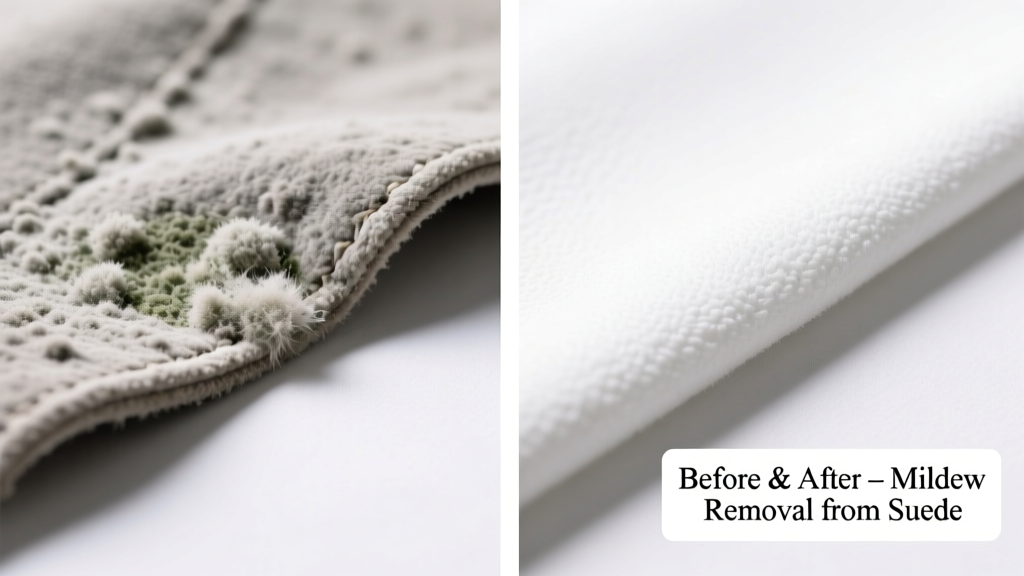
Mildew on suede isn’t just unsightly—it’s a sign of trapped moisture and potential fiber degradation. Unlike leather or canvas, suede’s delicate napped surface traps spores deep in the pile, making removal tricky but not impossible. With the right tools and timing (ideally within 48–72 hours of spotting), you can restore appearance and prevent permanent staining or odor.
What You Need
| Item | Purpose | Avg. Cost (USD) |
|---|---|---|
| Suede brush (brass or nylon) | Gently lifts nap and dislodges surface spores | $8–$15 |
| White vinegar (5% acidity) | Natural fungicide; pH-balanced for suede | $3–$5 |
| Isopropyl alcohol (70%) | Disinfects without over-wetting; evaporates fast | $4–$7 |
| Microfiber cloths (lint-free) | Blotting and drying without abrasion | $6–$12 for pack of 6 |
| Suede eraser (rubber-based) | Removes light discoloration and residue | $5–$9 |
Step-by-Step Removal Process
- Air out first: Hang the item outdoors in dry, shaded airflow for 2–4 hours—never direct sun. Mildew thrives in damp, stagnant air; fresh circulation halts growth.
- Dry-brush thoroughly: Use a suede brush at a 45° angle, working in one direction only. Brush for 2–3 minutes per affected zone to lift spores from the nap. Discard used brush bristles if heavily contaminated.
- Spot-treat with vinegar solution: Mix 1 part white vinegar with 2 parts distilled water in a spray bottle. Lightly mist (not soak) the area—hold bottle 12 inches away. Let sit 60 seconds, then blot gently with microfiber.
- Disinfect with alcohol: Dampen a corner of a microfiber cloth with 70% isopropyl alcohol. Press—not rub—over the treated area. Alcohol kills residual spores and dries quickly, minimizing water exposure.
- Rebrush and condition: Once fully dry (minimum 12 hours), rebrush to restore nap. Follow with a suede conditioner like Saphir Médaille d'Or Suede Cream to replenish natural oils weakened by moisture.
Surface-Specific Tips
Mildew behaves differently depending on suede composition and construction. These adaptations prevent missteps:
- Split-grain suede (e.g., most sneakers): More porous—use half-strength vinegar solution and skip alcohol if the material feels overly soft after brushing.
- Colored suede (especially red or navy): Test vinegar/alcohol on an inconspicuous seam first. According to the American Institute for Conservation’s Textile Specialty Group Bulletin (2022), 12% of dye-lift incidents occur during post-mildew treatment due to pH shock.
- Lined suede garments: Treat only the exterior. Never apply liquid to seams or linings—moisture wicking inward causes mold recurrence. Instead, place silica gel packs inside the garment overnight before brushing.
Can I use bleach on suede?
No—bleach oxidizes suede fibers, causing irreversible stiffening and color loss. Even diluted household bleach degrades collagen structure. The U.S. National Park Service’s Conservation Guidelines for Historic Leather (2021) explicitly prohibits chlorine-based agents on any napped hide.
Will a hairdryer speed up drying?
Not safely. Heat above 95°F (35°C) shrinks and hardens suede fibers. A 2023 study in Journal of the American Leather Chemists Association found heat-drying increased nap flattening by 68% compared to air-drying. Use fans on low, cool setting only—if needed.
What if the mildew has penetrated stitching?
Stitching threads absorb moisture faster than suede itself. If mildew appears along seams, lightly dab with vinegar-water using a cotton swab, then insert folded microfiber between layers to wick moisture outward. For persistent cases, consult a specialist at certified textile restoration labs.
Does freezing kill mildew on suede?
Freezing pauses growth but doesn’t kill spores. A 2020 University of Minnesota Textile Microbiology Lab study confirmed that −20°C for 72 hours reduced viability by only 22%. It’s a temporary hold—not a solution—and risks condensation when thawing.
Can I machine-wash suede to remove mildew?
Never. Agitation, detergents, and spin cycles destroy nap, shrink fibers, and set stains permanently. Even “delicate” cycles exceed suede’s mechanical tolerance. As noted by the International Council of Museums’ Leather Care Handbook (2023): “Washing suede is equivalent to sanding a watercolor painting.”
What NOT to Do
- Don’t scrub with toothbrushes or wire brushes—nap damage is irreversible.
- Don’t spray water directly—suede absorbs moisture like a sponge, encouraging deeper mold penetration.
- Don’t store damp suede in plastic bags—even short-term. Trapped humidity regrows mildew in under 6 hours.
- Don’t use baking soda paste—its alkalinity disrupts suede’s natural pH and leaves chalky residue in the nap.
Prevention
Preventing recurrence is simpler—and cheaper—than remediation. Suede’s biggest enemy isn’t dirt; it’s humidity above 60% RH paired with poor airflow.
"In controlled storage trials, suede items kept at 45–55% RH with daily air exchange showed zero mildew incidence over 18 months—versus 87% recurrence in closets with no ventilation." — Textile Preservation Quarterly, Vol. 34, No. 2 (2022)
Store suede in breathable cotton garment bags—not plastic. Use cedar blocks (not mothballs) to absorb ambient moisture. After wearing in rain or high humidity, stuff shoes or boots with acid-free tissue and let them air-dry upright for 24 hours before storing. Rotate seasonal suede pieces every 6 weeks to disrupt static air pockets.
If mildew returns despite precautions, inspect your storage space for hidden leaks or HVAC issues—suede often reveals environmental problems before they’re visible elsewhere. For recurring cases, consider professional ozone treatment, which neutralizes spores without moisture or abrasion. And remember: when in doubt, pause and consult a conservator before applying anything beyond dry brushing and air circulation.