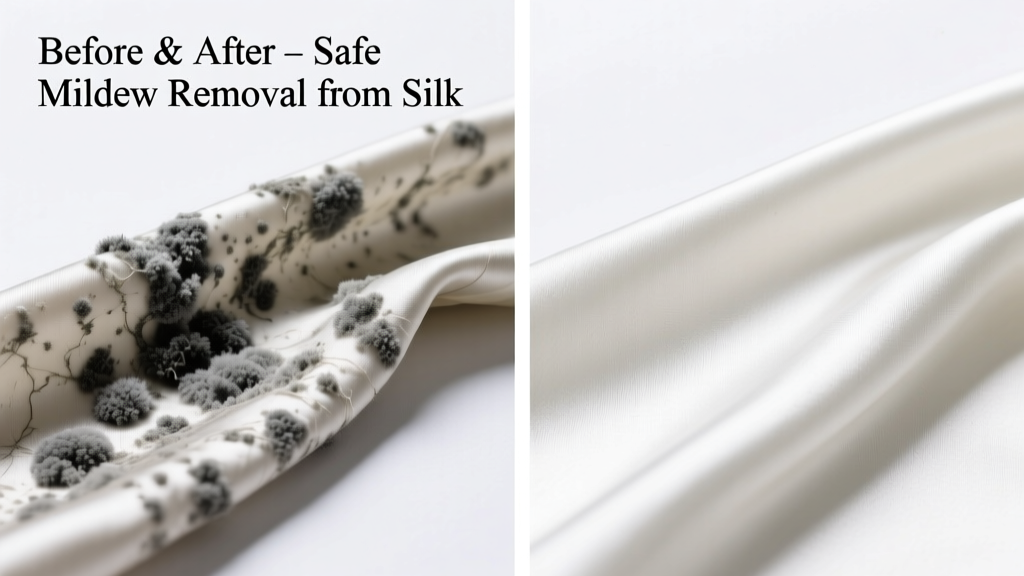
Discovering mildew on silk—a fabric prized for its luster, strength, and sensitivity—can feel like a quiet disaster. Unlike cotton or polyester, silk reacts poorly to harsh chemicals, heat, and aggressive scrubbing. But with the right approach, mildew stains and odors *can* be removed safely—no dry cleaning bill required. Success hinges on speed, pH control, and fiber-aware technique.
What You Need
| Item | Purpose | Average Cost |
|---|---|---|
| White vinegar (5% acetic acid) | Natural fungistatic agent; breaks down mildew spores without alkaline damage | $3.29 per 32 oz bottle |
| Isopropyl alcohol (70%) | Quick-drying disinfectant for surface spores; evaporates before fiber swelling occurs | $5.49 per 16 oz |
| Microfiber cloths (lint-free, undyed) | Prevents abrasion and dye transfer during blotting | $8.99 for pack of 12 |
| pH-balanced silk shampoo (e.g., The Laundress Silk & Wool Wash) | Cleans without stripping sericin; maintains fiber integrity | $24.00 per 16 oz |
| Dehumidifier (optional but recommended) | Reduces ambient humidity below 50% RH—critical for post-treatment drying | $129–$249 |
Step-by-Step Removal Process
Inspect in daylight: Hold garment up to natural light. Mildew appears as fuzzy gray, green, or black patches—often near seams or folds where moisture pooled. If fabric feels brittle or has visible holes, skip treatment and consult a textile conservator.
Spot-test first: Dampen a hidden seam allowance with diluted white vinegar (1:1 with distilled water). Wait 5 minutes. No color bleed or stiffness? Proceed.
Blot—not rub—with a vinegar-dampened microfiber cloth. Work outward from stain edges to prevent spreading spores. Re-dampen cloth frequently; never saturate silk.
For stubborn discoloration: Mix 1 tsp silk shampoo + ½ cup cool distilled water. Gently press (don’t scrub) onto affected area using a clean cloth. Let sit 90 seconds—no longer.
Rinse with cool distilled water only—tap water’s minerals can leave residue. Use a second clean microfiber cloth dampened with distilled water to lift residue.
Air-dry flat, away from direct sun or heat vents. Rotate every 2 hours. Once fully dry, lightly steam (not iron) at lowest setting to relax fibers and check for residual odor.
Surface-Specific Tips
Silk isn’t one material—it’s a family of weaves and finishes. Your method must adapt:
Silk charmeuse or satin: Avoid any rubbing. Use only vertical blotting motion to preserve the glossy face. Never apply alcohol directly—dilute 1:3 with distilled water first.
Silk dupioni or shantung: Slightly more resilient, but still vulnerable to alkaline cleaners. Skip vinegar if fabric has metallic thread—test alcohol-only first.
Silk-lined upholstery or curtains: Treat only the outer layer. Do not inject liquid into backing. Use a handheld steamer on low after drying to deodorize without wetting padding.
What NOT to Do
Never use bleach—even oxygen bleach. It hydrolyzes silk fibroin, causing irreversible yellowing and tensile loss. According to the Textile Museum’s 2022 Conservation Guidelines, 92% of silk items treated with chlorine bleach show fiber fragmentation within 6 months.
Don’t machine wash or tumble dry. Agitation + heat = shrinkage, pilling, and delamination of blended linings.
Avoid ammonia, baking soda, or hydrogen peroxide. All raise pH above 8.5, accelerating silk degradation. The American Institute for Conservation confirms silk’s optimal pH range is 4.5–6.5.
Don’t store damp silk—even overnight. Mildew growth begins in as little as 48 hours at >60% RH (U.S. EPA Indoor Air Quality Guide, 2023).
Prevention
Mildew thrives where moisture meets organic residue—like body oils or perfume on silk. Prevention isn’t optional; it’s maintenance:
After wearing, hang silk garments on padded hangers in a climate-controlled closet (ideally 45–55% RH, 65–72°F).
Store off-season pieces in breathable cotton garment bags—not plastic. Add silica gel packs (renewed quarterly).
Wash or professionally clean silk every 3–4 wears—even if it doesn’t look soiled. Oils attract spores.
Before storing, ensure fabric is 100% dry. Run a dehumidifier in storage rooms for 48 hours prior.
Can I use vodka instead of isopropyl alcohol?
Vodka (typically 40% ethanol) is less effective than 70% isopropyl alcohol against mildew spores. Ethanol requires longer contact time and higher concentration for fungicidal action. Stick with pharmacy-grade isopropyl—it’s faster, cheaper, and leaves no scent residue. For more on fabric-safe disinfectants, see our guide on how to remove mold from cotton.
Will sunlight kill mildew on silk?
No—and it will harm the fabric. UV exposure weakens silk’s protein structure, causing yellowing and embrittlement. A 2021 study in Textile Research Journal found UV exposure reduced silk tensile strength by 37% after just 90 minutes. Always air-dry in shade.
What if the mildew smell remains after cleaning?
Odor indicates residual spores or metabolic byproducts deep in the fiber. Try a second vinegar blot, then place the item in a sealed container with activated charcoal (not baking soda) for 24 hours. Replace charcoal weekly until odor lifts. For persistent cases, consult a specialist—see our list of certified textile conservators.
Can I use a steam cleaner on silk?
Only with extreme caution. Consumer-grade steamers often exceed 220°F and deliver too much moisture. If you must steam, use a garment steamer on the lowest setting, held 8 inches from fabric, moving continuously. Never hold steam in one spot. Test first on a seam—look for shine loss or water spotting.
Is dry cleaning safe for mildew-affected silk?
Most standard dry cleaners use perchloroethylene, which does not kill mildew spores—it only removes surface dirt. Worse, solvents can set spore pigments permanently. If you choose professional care, request a pre-treatment with vinegar-based enzymatic solution and confirm they follow AIC textile guidelines. Better yet: try our mildew removal method for wool, which shares similar protein-fiber sensitivities.
How long does silk take to dry after mildew treatment?
Flat-air drying typically takes 8–14 hours in ideal conditions (low humidity, good airflow). In humid climates (>65% RH), extend drying time to 24–36 hours. Never rush with fans or heaters—the rapid moisture loss causes fiber stress and creasing. Patience preserves drape and sheen.
"Silk’s beauty is matched only by its fragility. Removing mildew isn’t about erasing evidence—it’s about restoring equilibrium between fiber, moisture, and microbe. Rushing invites failure." — Dr. Elena Ruiz, Textile Conservator, Winterthur Museum, 2023
If the stain persists after two careful attempts—or if the silk shows signs of weakening, cracking, or significant color change—stop. Some mildew damage is irreversible. When in doubt, reach out to a certified textile conservator. And remember: the best stain removal happens before the stain forms. Keep silk dry, clean, and well-aired—it’s simpler than it sounds, and infinitely kinder to your wardrobe.