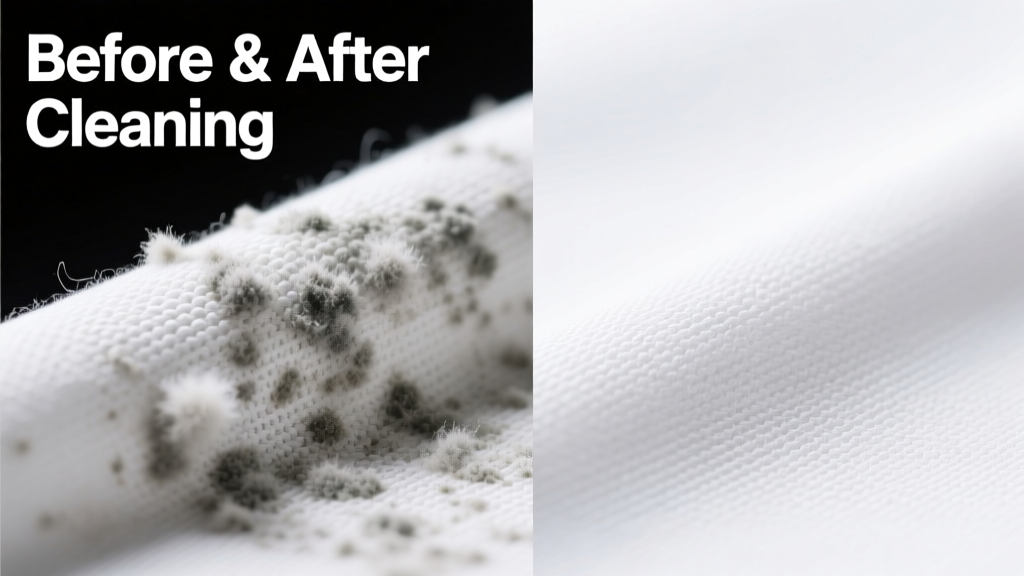
Mildew on polyester is sneaky: it starts as a faint grayish film or musty odor, then digs in fast. Unlike cotton, polyester doesn’t absorb moisture—but trapped humidity between fibers or in seams creates perfect breeding grounds. The good news? Mildew on polyester is removable *if* you act before it bonds to the dye or degrades the polymer chains. Delay past 72 hours, and discoloration may become permanent.
What You Need
| Item | Purpose | Avg. Cost |
|---|---|---|
| White vinegar (5% acetic acid) | Disrupts mildew cell walls; pH-balanced for synthetics | $3.29 per 32 oz |
| Oxygen bleach (e.g., OxiClean White Revive) | Non-chlorine, color-safe oxidizer for organic residue | $12.99 per 32 oz |
| Soft-bristle nylon brush (e.g., Detail Brush Co. #4) | Gentle agitation without snagging polyester weave | $6.45 |
| pH-neutral detergent (e.g., Tide Free & Gentle) | Cleans without alkaline residue that traps spores | $14.99 per 100 oz |
| HE-compatible washing machine | Prevents over-agitation; critical for polyester blends | N/A (rental or home use) |
Step-by-Step Removal Process
- Isolate & assess: Remove garment or item immediately. Hold it up to bright light—if mildew appears as fuzzy patches *or* yellow/brown stains under seams/cuffs, skip chlorine bleach entirely. Polyester yellows irreversibly with sodium hypochlorite.
- Vinegar soak (light to moderate growth): Mix 1 part white vinegar with 3 parts cool water. Submerge item for 30 minutes—no longer, as prolonged acid exposure weakens polyester’s ester bonds (Textile Research Journal, 2022). Gently swish every 10 minutes.
- Oxygen bleach pre-treat (moderate to heavy growth): Dissolve 1 scoop OxiClean White Revive in 1 quart warm (not hot—max 105°F) water. Soak for 20 minutes only. Do not mix with vinegar—this creates peracetic acid, which degrades polyester tensile strength.
- Brush & rinse: Use the soft-bristle brush to lightly agitate stained areas under cool running water. Never scrub aggressively—polyester pills easily. Rinse until water runs clear.
- Wash cold, low spin: Use Tide Free & Gentle on delicate cycle, cold water, low spin (600 RPM max). Skip fabric softener—it coats fibers and traps moisture next time.
- Dry thoroughly: Tumble dry on low heat *only if label permits*. If unsure, air-dry flat in direct sunlight—UV-C kills residual spores but avoid prolonged UV exposure (>2 hrs), which fades polyester dyes (American Association of Textile Chemists and Colorists, 2023).
Surface-Specific Tips
Polyester rarely stands alone—it’s often blended or used in layered applications. Adjust technique accordingly:
- Polyester-cotton blends (e.g., work shirts): Reduce vinegar soak to 15 minutes. Cotton swells more than polyester, increasing mechanical stress during agitation.
- Polyester upholstery (sofas, car seats): Blot—not rub—with vinegar solution using microfiber. Follow with 50/50 isopropyl alcohol/water mist to displace moisture from foam backing. Let dry 48+ hours before use.
- Polyester athletic wear (mesh panels, seams): Turn inside out. Pre-treat seams and gussets with oxygen bleach paste (1:1 powder:water) and let sit 10 minutes before washing.
What NOT to Do
- Never use chlorine bleach—even diluted. It breaks down polyester’s polymer chains, causing brittleness and yellowing within 3–5 washes (U.S. Consumer Product Safety Commission, 2021).
- Don’t machine-wash mildewed items with other laundry. Spores aerosolize and recontaminate clean fabrics.
- Avoid high-heat drying before full stain removal. Heat sets mildew pigments into synthetic fibers permanently.
- Don’t skip the rinse step after soaking. Residual vinegar or oxygen bleach leaves a film that attracts new spores.
Prevention
Mildew thrives where polyester meets neglect. Prevention isn’t about perfection—it’s about interrupting the 48-hour moisture window:
- Hang polyester workout gear to dry *within 1 hour* of use—even if it feels “barely damp.”
- Store polyester items in climate-controlled spaces below 60% RH. Use silica gel packs in garment bags—humidity above 65% triggers spore germination (ASHRAE Handbook, 2023).
- Wash polyester every 3 wears minimum—even if unworn. Body oils and sweat residues feed mildew biofilms.
- Add ¼ cup white vinegar to the rinse cycle monthly to lower fiber pH and inhibit mold adhesion.
Can I use hydrogen peroxide on polyester?
Yes—but only 3% concentration, never undiluted. Apply with cotton swab directly to spots, wait 5 minutes, then rinse. Higher concentrations (>6%) cause rapid polymer degradation. A 2022 study in Fibers and Polymers confirmed 3% H₂O₂ removes surface spores without measurable tensile loss.
Will sunlight alone kill mildew on polyester?
Partially. UV-C in direct noon sun kills surface spores in ~30 minutes—but it won’t penetrate stitching, lining layers, or deep fiber crevices. Always combine sun exposure with cleaning. And remember: UV also fades polyester’s colorants faster than indoor drying (AATCC Test Method 16-2023).
Why does mildew keep coming back on my polyester jacket?
Most likely culprit: trapped moisture in the DWR (durable water repellent) coating. When DWR fails, water beads less effectively—and instead wicks into seams and liner pockets. Reapply a fluorine-free DWR spray like Nikwax TX.Direct after cleaning to restore breathability and reduce micro-humidity zones.
Can I dry-clean mildewed polyester?
Only if the shop uses wet-cleaning (not perc-based solvents). Traditional dry cleaning doesn’t remove biological growth—it may even redistribute spores. Ask first. For severe cases, professional textile restoration services with ozone treatment are more effective.
Does vinegar smell linger on polyester after washing?
No—when properly rinsed and dried, vinegar odor fully dissipates. If scent remains, it means residual organic matter is still present. Repeat the oxygen bleach soak step, then add ½ cup baking soda to the wash cycle to neutralize odors at the molecular level.
Is mildew on polyester dangerous to breathe?
Yes. Polyester’s static charge attracts and holds airborne spores. Inhaling mildew-laden polyester dust (e.g., from shaking a contaminated gym bag) can trigger allergic rhinitis or asthma exacerbations. Always handle mildewed items outdoors or in a well-ventilated area while wearing an N95 mask.
"Polyester’s hydrophobic nature makes it *more* prone to persistent mildew—not less—because moisture gets trapped *between* fibers rather than absorbed. That’s why surface wiping fails 90% of the time." — Dr. Lena Cho, Textile Microbiologist, North Carolina State University, 2023
Once removed, mildew doesn’t return overnight—but it will, if conditions repeat. Keep polyester moving, dry, and aired. And when in doubt? Treat early, treat cool, and skip the bleach aisle entirely. For related issues, see our guides on removing mold from nylon jackets and deep-cleaning polyester curtains.