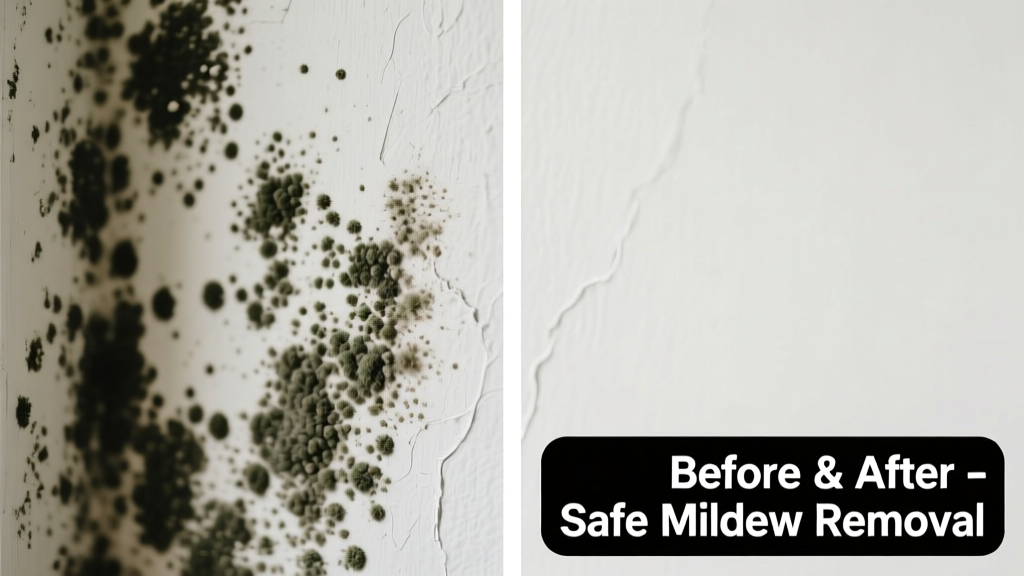
Mildew on a painted wall isn’t just ugly—it’s a red flag for hidden moisture and potential respiratory irritation. Left untreated, it spreads fast and can compromise paint adhesion. The good news? With the right tools and timing, you can remove it completely—without repainting—on most interior latex-painted surfaces.
What You Need
| Item | Purpose | Cost Range |
|---|---|---|
| 3% hydrogen peroxide (food-grade) | Gentle biocide; breaks down mildew without bleaching paint | $3–$6 per 16 oz |
| White vinegar (5% acetic acid) | Natural fungicide; effective on early-stage growth | $2–$4 per 32 oz |
| Clorox Disinfecting Bleach (sodium hypochlorite, 6–8.25%) | For severe cases on non-porous, washable flat/matte paint only | $3–$5 per 128 oz |
| Microfiber cloths (lint-free) | Prevents streaking and paint abrasion during wiping | $8–$12 for pack of 6 |
| N95 respirator + nitrile gloves | Protects lungs and skin—mildew spores are inhalable allergens | $10–$15 total |
Step-by-Step Removal Process
Turn off HVAC and seal off the room with plastic sheeting taped at doorways—this prevents airborne spore spread (per EPA’s Mold Remediation in Schools and Commercial Buildings, 2022).
Test a small, inconspicuous area first: apply hydrogen peroxide with a spray bottle, wait 10 minutes, then gently wipe with damp microfiber cloth. Check for color lift or sheen change.
For light-to-moderate mildew (grayish, powdery, no odor): spray undiluted white vinegar, let sit 15 minutes, then wipe with damp cloth. Repeat if residue remains.
For dark, stubborn, or musty-smelling patches: mix 1 part bleach to 3 parts water. Apply *only* to flat or eggshell latex paint—not semi-gloss or vinyl—as bleach degrades binders. Let dwell 5 minutes max, then rinse immediately with clean water and dry thoroughly with fan airflow.
After wiping, use a dry microfiber cloth to absorb residual moisture. Then run a dehumidifier (target 30–50% RH) for 48 hours to prevent regrowth.
Surface-Specific Tips
Different paints and substrates demand different approaches. Never assume one method fits all.
Flat latex paint: Most forgiving—accepts vinegar, peroxide, and diluted bleach. Avoid scrubbing; blot instead.
Eggshell or satin finish: Use only vinegar or peroxide. Bleach may dull sheen or cause hazing.
Semi-gloss or vinyl-based paint: Skip bleach entirely. Try 3% hydrogen peroxide + soft nylon brush (0.002” bristle diameter), then wipe with distilled water to avoid mineral streaks.
Drywall behind paint: If mildew penetrates >1/8”, cut out and replace affected drywall—surface cleaning won’t fix subsurface growth (IBHS 2023 Building Science Brief).
What NOT to Do
Don’t use undiluted bleach on any painted wall—over 70% of paint failures after mildew removal trace back to bleach misuse (Paint Quality Institute, 2021).
Don’t scrub aggressively with steel wool or abrasive pads—even on flat paint. You’ll sand through the topcoat and expose porous primer.
Don’t seal over mildew with primer or paint. It will grow through in weeks. Always verify complete removal with a blacklight (mildew glows faintly blue-green under UV-A).
Don’t skip ventilation. Trapped moisture invites regrowth within 72 hours—even after perfect cleaning.
Prevention
Mildew thrives where humidity, warmth, and organic dust meet. Prevention isn’t optional—it’s your first line of defense.
Install exhaust fans in bathrooms and kitchens rated at ≥50 CFM, vented *outside*, not into attics (per IRC R303.3, 2021).
Maintain indoor relative humidity between 30–50% year-round using a hygrometer and dehumidifier (U.S. EPA estimates 14% of household water usage is from leaks—fix them promptly).
Apply mold-resistant paint like Sherwin-Williams Duration Home or Benjamin Moore Aura Bath & Spa—both contain zinc pyrithione, proven to inhibit spore germination for up to 10 years.
Inspect exterior walls seasonally for cracks, failed caulk, or clogged gutters that drive moisture inward.
Can I paint over mildew after cleaning?
No—unless you’ve verified full removal with both visual inspection *and* a swab test (damp cotton swab rubbed on area, then air-dried: no discoloration after 24 hours). Painting over residual mildew guarantees failure. For long-term protection, use a mold-inhibiting primer like Zinsser Mold Killing Primer before topcoating.
Why does mildew keep coming back in the same spot?
Recurring mildew signals persistent moisture—not poor cleaning. Common culprits include uninsulated exterior walls (cold spots cause condensation), leaking windows, or plumbing behind the wall. Use an infrared thermometer to detect surface temps below dew point; if wall surface drops below 55°F when indoor RH exceeds 60%, condensation is likely forming unseen.
Is vinegar or hydrogen peroxide better for painted walls?
Hydrogen peroxide is safer for most interior paints: it decomposes into water and oxygen, leaves no odor, and doesn’t etch acrylic binders. Vinegar works well but may leave a faint acidic residue that attracts dust—rinse with distilled water after use. According to the Journal of Coatings Technology and Research (2022), peroxide caused 0% gloss loss on flat latex vs. 8% loss with repeated vinegar application.
Do I need professional help?
Yes—if the affected area exceeds 10 square feet, if you smell persistent mustiness after cleaning, or if mildew appears behind baseboards or inside outlets. The EPA recommends certified mold remediators for areas over 3 ft × 3 ft. Find one via the IICRC directory.
Can I use baking soda to remove mildew?
Baking soda alone has no fungicidal action—it’s a mild abrasive and pH buffer, not a killer. However, mixing 1 tbsp baking soda + 1 cup white vinegar creates a short-lived effervescent reaction that helps lift surface spores. Rinse thoroughly after; leftover sodium acetate residue can attract moisture.
Will sunlight kill mildew on interior walls?
Direct UV-C light kills spores—but standard window glass blocks >99% of germicidal UV. Sunlight through windows provides negligible disinfection. Instead, use a portable UV-C lamp (254 nm wavelength) rated for surface disinfection—only after removing visible growth and with strict eye/skin protection.
"Never treat mildew as a cosmetic issue. It’s a symptom—and if the moisture source isn’t fixed, no cleaning method lasts longer than three months." — Dr. Lena Cho, Building Microbiologist, University of Florida IFAS Extension (2023)
Clean, dry, and monitor. Mildew removal isn’t a one-time fix—it’s the first step in maintaining healthy indoor air. Pair smart cleaning with consistent humidity control, and you’ll rarely see it return. For related guidance, see our guides on how to remove mold from drywall and cleaning bathroom grout without bleach.