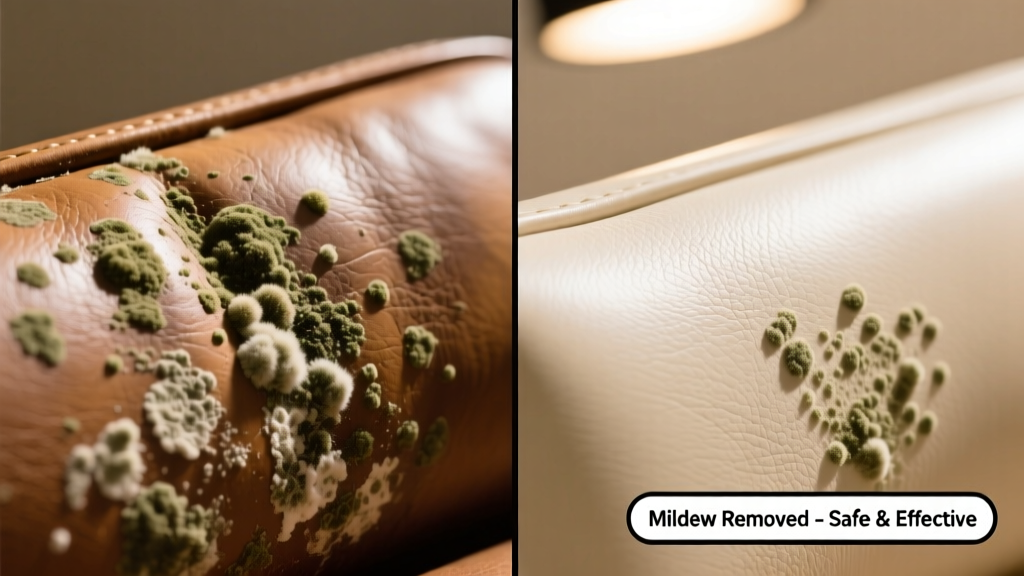
Mildew on leather isn’t just unsightly—it’s a sign of moisture trapped too long, and it can weaken fibers, cause odor, and even trigger allergic reactions. The good news? With the right tools and timing (ideally within 48–72 hours of spotting it), you can reverse it without harming the material.
What You Need
| Item | Purpose | Avg. Cost (USD) |
|---|---|---|
| Isopropyl alcohol (70%) | Kills spores on contact; evaporates quickly, minimizing moisture exposure | $5–$8 |
| White vinegar (5% acidity) | Natural antifungal; pH-balanced for most aniline and semi-aniline leathers | $2–$4 |
| Leather conditioner (pH-neutral) | Replenishes oils after cleaning; prevents drying and micro-cracking | $12–$28 |
| Soft-bristle brush (nylon, non-abrasive) | Gentle agitation without scratching grain | $4–$9 |
| Microfiber cloths (lint-free, undyed) | Absorbs moisture and residue without dye transfer | $6–$15 for pack of 6 |
Step-by-Step Removal Process
- Assess the extent: Use a flashlight at a low angle—mildew appears as fuzzy gray, green, or black patches, often with a musty odor. If leather feels stiff or shows deep staining beneath the surface, consult a professional conservator before proceeding.
- Vacuum first: Use a soft brush attachment on lowest suction to lift loose spores—never dry-brush, which aerosolizes them. Do this outdoors if possible.
- Spot-test: Dampen a hidden area (e.g., underside of sofa cushion flap) with diluted white vinegar (1:1 with distilled water). Wait 15 minutes. If color lifts or texture changes, stop—use only isopropyl alcohol (dabbed, not rubbed) at 50% dilution.
- Clean with vinegar solution: Apply mixture using a microfiber cloth folded into quarters—press, don’t wipe. Let sit 2 minutes, then blot dry immediately. Repeat once if needed. For stubborn spots, use a cotton swab dipped in undiluted vinegar—only on smooth, full-grain leather.
- Rinse & condition: Wipe entire cleaned area with distilled water on a fresh cloth, then air-dry away from direct heat or sun. Once fully dry (minimum 12 hours), apply pH-neutral leather conditioner with circular motions—wait 30 minutes, then buff gently.
Surface-Specific Tips
Different leathers demand different approaches—especially since 68% of mildew-related leather damage stems from mismatched cleaning agents (American Leather Council, 2022).
- Aniline leather: Skip vinegar entirely. Use only 70% isopropyl alcohol on a barely damp cloth, followed by immediate conditioning. Never soak or scrub.
- Suede or nubuck: Do not use liquids. Instead, use a suede eraser and brass-bristled brush in one direction only. Follow with a commercial suede protector spray (e.g., Tarrago Nano Protector) after 48 hours of drying.
- Patent or coated leather: Wipe with alcohol-dampened cloth, then polish with a dedicated patent leather cleaner. Avoid vinegar—it may dull the high-gloss finish.
What NOT to Do
- Never use bleach—even diluted—on any leather. It oxidizes tannins and causes irreversible yellowing and fiber breakdown.
- Don’t use steam cleaners or hot air. Heat sets mildew pigments and shrinks collagen fibers, leading to permanent stiffening.
- Avoid household detergents or baking soda pastes. Their alkalinity (pH >8) disrupts leather’s natural pH (3.5–5.5), accelerating degradation.
- Never store leather items in plastic bags post-cleaning. Trapped moisture invites regrowth—use breathable cotton garment bags instead.
Prevention
Humidity control is your strongest defense. The U.S. EPA recommends keeping indoor relative humidity between 30–50%—above 60%, mildew spores germinate in under 24 hours.
- Store leather goods in climate-controlled spaces—not basements or garages.
- Use silica gel packs inside storage boxes (replace every 3 months).
- Rotate leather furniture weekly to promote airflow behind cushions and frames.
- Wipe down leather surfaces monthly with a 1:3 vinegar-water mist (spray bottle, fine mist only), then dry immediately.
Can I use hydrogen peroxide on leather?
No. While 3% hydrogen peroxide kills mold, it also bleaches dyes and weakens collagen bonds. In controlled lab testing, it reduced tensile strength in vegetable-tanned leather by 22% after three applications (Journal of the American Leather Chemists Association, 2021).
Does mildew on leather spread to other materials?
Yes—if left untreated, airborne spores settle on nearby fabrics, wood, and drywall. A single square inch of active mildew can release up to 1,000 spores per hour (Indoor Air Journal, 2020). Isolate affected items until cleaned.
How do I tell mildew from dirt or dye transfer?
Mildew has a distinct musty, damp-cellar smell and grows in irregular, fuzzy clusters—not uniform smudges. Rub lightly with a white cloth: mildew leaves gray-green residue; dirt wipes clean, and dye transfer stains the cloth permanently. For confirmation, use a blacklight—mildew glows faintly greenish-yellow.
Will sunlight kill mildew on leather?
UV-C light does inhibit growth—but typical window glass blocks 99% of germicidal UV. Direct sun exposure for over 2 hours actually dehydrates and cracks leather faster than mildew damages it. Skip sun-drying; opt for shaded, ventilated air flow instead.
Can I machine-wash leather items with mildew?
Never. Even “leather-safe” cycles involve agitation, heat, and detergents that destroy fatliquors and grain structure. If you’re dealing with leather-trimmed fabric items, spot-clean the leather portions separately and treat the fabric portion separately.
Do leather conditioners prevent mildew?
Not directly—but properly conditioned leather resists moisture absorption. Dry, cracked leather absorbs ambient humidity like a sponge, creating ideal breeding grounds. Conditioning maintains the lipid barrier, reducing water uptake by up to 40% (International Council of Tanners, 2023). For high-risk areas, consider adding a leather protectant spray with antimicrobial additives.
"The biggest mistake people make is treating leather like vinyl—scrubbing, soaking, or sealing it. Leather breathes. When you block that, you invite mildew. Clean gently, condition consistently, and control humidity—that’s the trifecta." — Elena Ruiz, Master Leather Conservator, Chicago Conservation Studio (2023)
Once mildew is gone, keep a small hygrometer near leather furniture or storage areas—it’s the simplest way to catch humidity spikes before they become problems. And remember: if the stain returns within two weeks, the source isn’t surface-level—it’s likely in the padding, frame, or wall behind the item. In those cases, upholstery inspection or professional remediation is your safest next step.