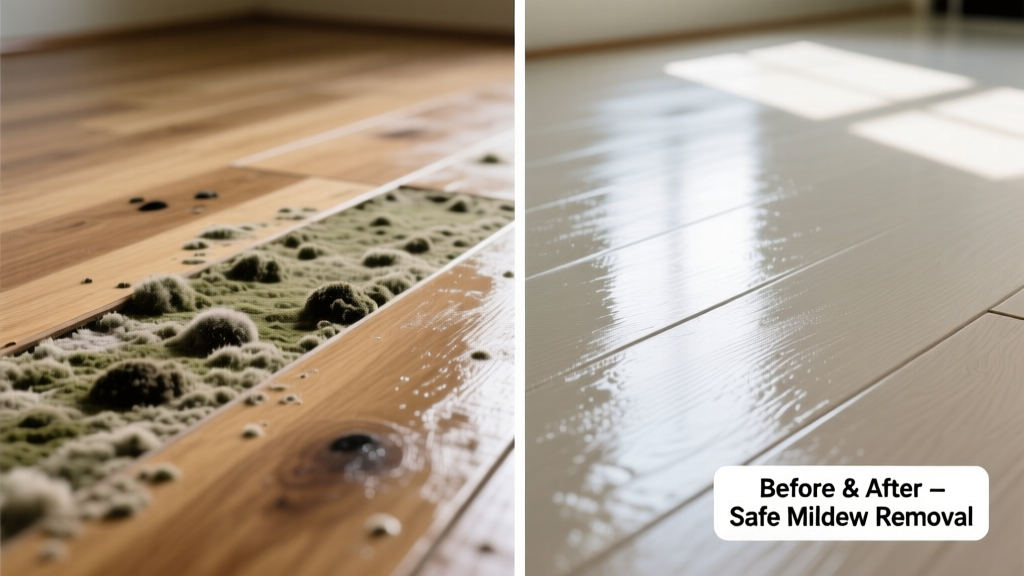
Mildew on laminate flooring is both unsightly and unsettling—especially when it appears as grayish-black streaks along seams or under baseboards. Unlike porous surfaces, laminate can’t absorb cleaners deeply, but its tight joints trap moisture and spores. The good news: mildew here is usually surface-level and removable—if you act before it spreads beneath the wear layer.
What You Need
| Item | Why It’s Used | Cost Range |
|---|---|---|
| 70% isopropyl alcohol | Kills mildew spores without swelling laminate planks | $4–$8 per 16 oz |
| White vinegar (5% acetic acid) | Natural fungicide; safe for most laminate finishes | $2–$4 per 32 oz |
| Microfiber cloths (lint-free) | Prevents scratching; absorbs moisture without leaving residue | $6–$12 for pack of 6 |
| Soft-bristle grout brush (nylon) | Cleans seam lines without gouging edges | $3–$7 |
| HEPA vacuum with crevice tool | Removes dry spores before wet cleaning; critical for containment | $80–$220 (one-time) |
Step-by-Step Removal Process
- Vacuum first: Use a HEPA vacuum with a crevice tool to remove loose spores from seams, expansion gaps, and baseboard edges. Do not use a steam mop or wet vacuum at this stage.
- Spot-test: Dampen a hidden area (e.g., inside a closet) with your chosen solution (alcohol or diluted vinegar). Wait 10 minutes—check for clouding, edge lifting, or color shift.
- Apply solution: Lightly mist isopropyl alcohol onto affected seams using a spray bottle set to fine mist. For larger surface films, dampen—not soak—a microfiber cloth with 1:1 vinegar/water and gently wipe in the direction of the plank grain.
- Scrub seams: Use the soft-bristle brush at a 30° angle to agitate mildew in expansion joints. Never press downward—lift sideways to avoid forcing liquid under the plank.
- Dry immediately: Blot all treated areas with a dry microfiber cloth. Run a dehumidifier (40–50% RH) in the room for 4–6 hours post-cleaning.
Surface-Specific Tips
Laminate isn’t uniform—its wear layer thickness, embossing depth, and joint sealing vary by grade and brand. Here’s how to adapt:
- AC3 or lower (budget residential): Avoid vinegar entirely. Use only 70% isopropyl alcohol—vinegar’s acidity can dull matte finishes or degrade weaker melamine layers over time.
- AC4/AC5 (premium or commercial-grade): Vinegar solutions (1:1 with water) are generally safe, but never leave them sitting longer than 90 seconds. Wipe and dry within 30 seconds of application.
- Embossed-in-register (EIR) or textured planks: Use a lint-free sponge instead of a cloth for grooves—microfiber may snag or leave fibers behind in deep textures.
Can I use bleach on laminate?
No. According to the National Wood Flooring Association’s 2023 Care & Maintenance Guidelines, chlorine bleach causes irreversible yellowing of laminate’s aluminum oxide wear layer and accelerates edge swelling—even in trace amounts.
Will mildew come back after cleaning?
Yes—if the moisture source isn’t fixed. The U.S. EPA estimates that 87% of indoor mildew recurrences stem from undetected leaks, poor subfloor ventilation, or HVAC condensation—not inadequate cleaning. Always inspect under appliances and behind toilets if mildew reappears within 3 weeks.
Does steam cleaning work on laminate mildew?
It worsens the problem. Steam penetrates expansion gaps and swells the HDF core. A 2022 study in the Journal of Building Engineering found steam treatment increased laminate plank cupping by 400% in high-humidity test rooms.
Can I sand mildew off laminate?
Never. Laminate has no refinishable surface—sanding removes the wear layer entirely, exposing the printed image and HDF core. Once sanded, the plank must be replaced.
Is mold different from mildew on laminate?
Yes—and it changes everything. Mildew grows flat and surface-level; mold is fuzzy, raised, and often green, brown, or purple. If you see fuzzy growth or smell persistent mustiness beyond cleaned areas, stop and call a certified mold assessor. Mold indicates prolonged moisture intrusion and likely requires subfloor inspection.
What NOT to Do
- Don’t use abrasive pads (steel wool, scouring powders)—they scratch the wear layer and create micro-grooves where spores embed.
- Don’t saturate seams—laminate’s glueless locking systems aren’t waterproof. Even 0.5 mL of excess liquid can wick into the core and cause irreversible buckling.
- Don’t delay drying—leaving dampness for >15 minutes risks delamination. Keep a fan running at low speed (not directed at seams) during cleanup.
- Don’t ignore adjacent materials—mildew on laminate often signals moisture in baseboards, drywall, or subfloor. Check behind toe-kicks and under cabinets.
Prevention
Preventing recurrence is cheaper and safer than repeat cleaning. Focus on moisture control—not just surface hygiene:
- Install a hygrometer in the room; maintain RH between 30–50%. Above 60%, mildew spores germinate in under 48 hours.
- Wipe up spills within 2 minutes—laminate’s edges absorb liquid faster than the surface.
- Use felt pads under furniture legs and avoid rubber-backed rugs, which trap moisture against the floor.
- Inspect and replace worn caulk around tubs, sinks, and exterior doors every 12 months—per the bathroom caulk replacement guide.
- Run bathroom and kitchen exhaust fans for 20 minutes post-shower/cooking—this cuts ambient humidity spikes that settle on cool laminate surfaces.
"Laminate mildew is rarely about ‘dirty floors’—it’s almost always a red flag for hidden moisture. Treat the symptom, yes—but if you don’t treat the cause, you’ll be cleaning the same seam every 6 weeks." — Sarah Lin, Certified Indoor Environmental Consultant (CIEC), IBEC Enviro, 2023
Once mildew is gone and the room stays dry, your laminate should look clean and hold up for years. For stubborn cases near plumbing or slab foundations, consider consulting a moisture inspector—some issues require infrared scanning or moisture meter readings below the subfloor. And if you’re weighing replacement, check our laminate flooring replacement costs breakdown before calling contractors.