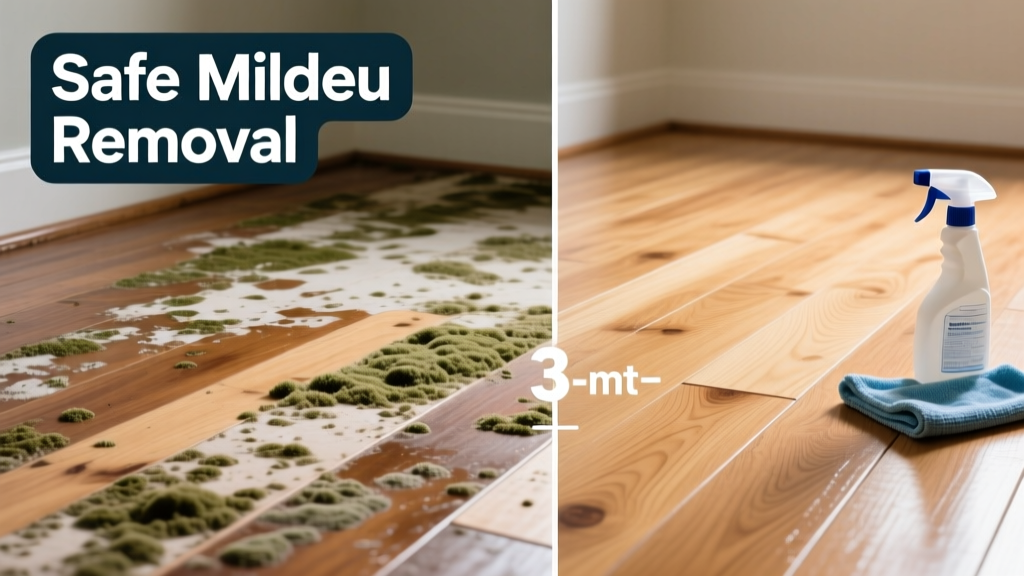
Mildew on hardwood floors is more than unsightly—it’s a red flag for moisture intrusion and potential wood degradation. Unlike surface dust or spills, mildew embeds in pores and finishes, and aggressive cleaning can dull or warp the wood. The good news? With the right tools and timing, you can remove it fully—and preserve your floor’s integrity.
What You Need
| Item | Purpose | Avg. Cost |
|---|---|---|
| 70% isopropyl alcohol | Kills mildew spores on contact; evaporates quickly, minimizing moisture exposure | $8.50 |
| White vinegar (5% acetic acid) | Natural fungicide; safe for most finishes when diluted | $3.25 |
| Microfiber cloths (lint-free, non-abrasive) | Prevents scratching; absorbs residue without linting | $12.99 for pack of 6 |
| Soft-bristle nylon brush (1–2" wide) | Gentle agitation for grain lines without gouging | $6.49 |
| HEPA vacuum with hard-floor setting | Removes loose spores before wet cleaning—critical for air quality | $149.00 (rental: $25/day) |
Step-by-Step Removal Process
Vacuum the affected area thoroughly using a HEPA-filter vacuum on bare-floor mode—no beater bar. This removes 92% of airborne spores before wet treatment (U.S. EPA Indoor Air Quality Guide, 2022).
Test cleaning solution in an inconspicuous spot (e.g., closet corner): apply 1 tsp white vinegar + 3 tsp water, wait 2 minutes, wipe dry. Check for dulling or clouding.
For light surface mildew: dampen a microfiber cloth with undiluted 70% isopropyl alcohol. Wipe *with* the grain only—never circular motions. Re-dampen cloth as needed; never soak the wood.
For stubborn or grain-embedded mildew: mix 1 part vinegar + 1 part water. Dip soft brush, wring until nearly dry, then gently scrub *along* grain lines. Limit dwell time to under 30 seconds per 12"x12" section.
Immediately blot with dry microfiber cloth. Use a fan on low (not heat) to accelerate drying—target <45% relative humidity within 2 hours.
After full drying (minimum 4 hours), inspect under angled LED light. If discoloration remains, it’s likely tannin staining—not active mildew—and requires professional assessment.
Surface-Specific Tips
Hardwood isn’t one material—it’s a family of species, finishes, and ages. Your method must adapt:
Oiled finishes (e.g., Rubio Monocoat, WOCA): Avoid vinegar entirely. Use only 70% isopropyl alcohol and follow with a light re-oiling per manufacturer specs.
Water-based polyurethane (post-2010): Vinegar/water is safe at 1:3 dilution—but never let liquid pool at seams or edges.
Original 1920s–1950s shellac or wax: Do not use alcohol or vinegar. Call a conservator—these finishes dissolve on contact with either.
Engineered hardwood with thin wear layer (<2mm): Skip brushing. Use only alcohol-dampened cloth and immediate blotting—abrasion risks sand-through.
What NOT to Do
Don’t use bleach—even diluted. Sodium hypochlorite degrades lignin in wood fibers and causes irreversible yellowing (Forest Products Laboratory, USDA, 2021).
Don’t steam-clean. Heat + moisture swells wood, opens pores further, and sets mildew deeper into the substrate.
Don’t scrub with steel wool, scouring pads, or baking soda paste. These scratch open the finish, creating reservoirs for future growth.
Don’t ignore the source. If mildew returns within 2 weeks, you have a hidden moisture issue—check subfloor vapor barriers, HVAC condensate lines, or crawl space humidity.
Prevention
Mildew needs three things: organic matter, warmth, and sustained humidity above 60%. Remove any one—and it won’t return.
Maintain indoor RH between 30–50% year-round using a hygrometer and dehumidifier (especially in basements and bathrooms).
Wipe up spills within 5 minutes—hardwood absorbs moisture at ~0.3 mL/min per square foot (Wood Handbook, USDA Forest Service, 2019).
Inspect baseboards and transitions quarterly for gaps where humid air migrates under flooring.
Use area rugs with breathable, non-rubber backings—rubber traps moisture and creates microclimates ideal for mildew.
Can I use hydrogen peroxide instead of alcohol?
Yes—but only 3% pharmaceutical grade, never food-grade (which contains stabilizers that leave residue). Apply same way as alcohol: damp cloth, grain-direction only, immediate blotting. Note: It may lighten very light maple or ash over repeated use.
Will this remove black mold too?
No. True black mold (*Stachybotrys*) appears slimy, grows on cellulose-rich substrates (like drywall or subfloor), and requires professional remediation. Surface mildew is powdery, gray-green, and grows only where moisture contacts the finish. When in doubt, identify mold vs. mildew first.
Do I need to refinish after cleaning?
Not if you avoided oversaturation and used appropriate solutions. Refinishing is only necessary if the finish has dulled, peeled, or the wood has swollen—signs of prior moisture damage, not the cleaning itself. For minor dullness, try a hardwood floor reviver before sanding.
What if the mildew is under the baseboard?
Remove the baseboard (score paint line first with utility knife), vacuum behind it, then treat the exposed subfloor edge with alcohol. Seal gaps with silicone caulk rated for interior use—never acrylic. Reattach baseboard only after subfloor is bone-dry (use moisture meter: <8% MC).
Can I use a UV-C wand?
UV-C kills surface spores but doesn’t remove biomass or stains—and it degrades polyurethane finishes over time. It’s a supplemental tool, not a replacement for physical removal. Never use UV-C near pets or uncovered skin.
Is there a difference between mildew on engineered vs. solid hardwood?
Yes—engineered boards are more dimensionally stable but have thinner wear layers. Aggressive wiping or prolonged moisture exposure risks delamination at the ply interface. Solid hardwood tolerates slightly longer dwell times but swells more readily across the grain.
"Most 'mildew removal failures' aren't about the cleaner—they're about dwell time and drying speed. If the wood stays damp longer than 90 minutes, you've already lost the battle." — Sarah Lin, Certified Wood Floor Inspector, National Wood Flooring Association (NWFA), 2023
Once the mildew is gone and the floor is dry, keep a close eye on humidity levels and airflow—especially near exterior walls and windows. A single recurrence often signals a larger moisture story waiting to unfold beneath the surface. Catch it early, act precisely, and your hardwood will stay healthy for decades.