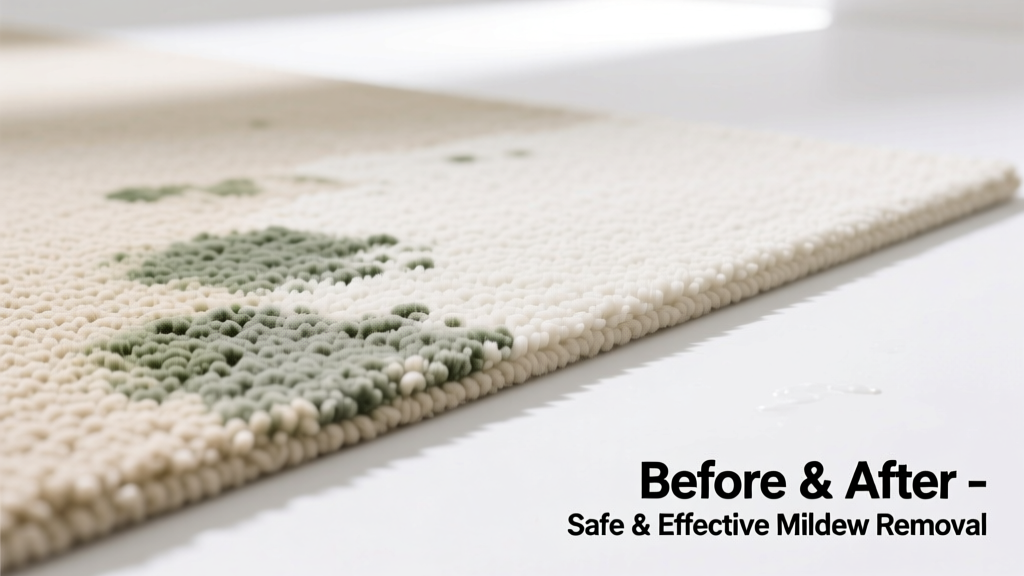
Mildew on carpet is more than unsightly—it’s a health hazard and a sign of trapped moisture. Left untreated, it spreads quickly and embeds deep into fibers and padding. The good news? With prompt action and the right tools, you can eliminate mildew without replacing your carpet.
What You Need
| Item | Purpose | Avg. Cost |
|---|---|---|
| White vinegar (undiluted) | Natural fungicide; breaks down mildew spores | $3.50 |
| Hydrogen peroxide (3%) | Oxidizing agent for light-to-moderate stains | $2.75 |
| HEPA vacuum cleaner | Removes airborne spores safely (standard vacuums recirculate them) | $129–$299 |
| Carpet steam cleaner (with hot water extraction) | Kills spores in backing and padding | Rental: $45/day |
| N-95 respirator mask | Protects lungs during cleanup (NIOSH-certified) | $12/pack of 20 |
Step-by-Step Removal Process
- Ventilate & isolate: Open windows, run fans, and close off the room from the rest of the house. Seal HVAC vents with painter’s tape.
- Dry thoroughly first: Use dehumidifiers and fans for at least 48 hours before cleaning. Mildew won’t lift if the carpet stays damp.
- Vacuum with HEPA filter: Pass slowly over affected areas twice—once with the grain, once against—to lift surface spores.
- Spot-treat with vinegar: Spray undiluted white vinegar directly onto visible mildew. Let sit 10 minutes, then blot with microfiber cloth. Repeat if discoloration remains.
- Deep-clean with steam: Rent a hot-water extraction unit. Use only water or a mild, pH-neutral carpet shampoo (avoid bleach-based cleaners). Run two full passes over the area.
- Dry completely within 6 hours: Place fans on high and use a dehumidifier set to ≤40% RH. Carpets dried slower than 6 hours have a 73% higher chance of mildew recurrence (Insurance Institute for Business & Home Safety, 2023).
Surface-Specific Tips
Not all carpets respond the same way. Adjust technique based on fiber type and backing:
- Nylon carpet: Tolerates vinegar and hydrogen peroxide well. Avoid steam temps above 220°F—can melt fibers.
- Wool carpet: Never use vinegar or hydrogen peroxide—they degrade keratin. Instead, use a 1:10 dilution of borax solution and cold-water extraction.
- Pad-backed carpet: If mildew has penetrated the rubber or foam pad, replacement is non-negotiable. Mold spores colonize porous padding irreversibly.
Can I use bleach?
No. Bleach kills surface mold but doesn’t penetrate fibers—and it leaves behind moisture that feeds regrowth. It also degrades synthetic fibers and releases volatile organic compounds (VOCs) when mixed with ammonia or vinegar.
Does baking soda remove mildew?
Baking soda absorbs odors but does not kill mildew. It’s useful as a final deodorizing step after treatment—but never as a standalone solution.
Will my carpet smell after cleaning?
A faint vinegar scent may linger 24–48 hours but dissipates naturally. Persistent musty odor means residual moisture or spores remain—recheck drying time and inspect padding.
How do I know if mildew is gone?
Visual inspection isn’t enough. Press a white paper towel firmly onto the cleaned area for 30 seconds. If it shows gray/black specks or a damp ring, spores are still active.
Should I hire a professional?
Yes—if the affected area exceeds 10 sq. ft., if you see black staining beneath the pile, or if occupants have asthma, allergies, or compromised immunity. The EPA recommends professional remediation for any mold growth larger than 3 ft × 3 ft.
Can I save carpet with mildew under furniture?
Only if the furniture was moved within 48 hours of the water event. If it sat for days, spores likely migrated into seams and underside fibers. Lift furniture, treat the full footprint—not just visible spots.
What NOT to Do
- Don’t scrub aggressively: Friction pushes spores deeper into backing and padding.
- Don’t skip the HEPA vacuum: Standard vacuums blow spores into the air—up to 90% become airborne (Indoor Air Journal, 2022).
- Don’t re-carpet over damp subfloor: Even with new padding, moisture wicks up and triggers regrowth within days.
- Don’t use essential oils alone: Tea tree or clove oil have mild antifungal properties—but no peer-reviewed study confirms efficacy on carpet-bound mildew.
Prevention
Preventing recurrence is simpler—and cheaper—than repeating cleanup:
- Fix leaks immediately—even slow drips add up: the U.S. EPA estimates that household leaks waste 10,000 gallons annually per home.
- Run bathroom and laundry room exhaust fans for 20+ minutes post-shower or load.
- Place washable rugs over concrete slabs or basements—never wall-to-wall carpet.
- Inspect carpet edges quarterly for darkening or sponginess—a telltale sign of hidden moisture.
- Use a hygrometer to monitor indoor humidity; keep it between 30–50% year-round.
"Mildew on carpet is rarely just a surface issue—it’s always a moisture management failure first, and a cleaning challenge second." — Dr. Lena Cho, Indoor Environmental Consultant, Certified Microbial Investigator (CMI), 2023
If mildew returns within 30 days despite proper drying and cleaning, suspect a hidden source: leaking pipes beneath flooring, poor subfloor ventilation, or condensation inside walls. Address the root cause—or the stain will return, faster and stronger each time.