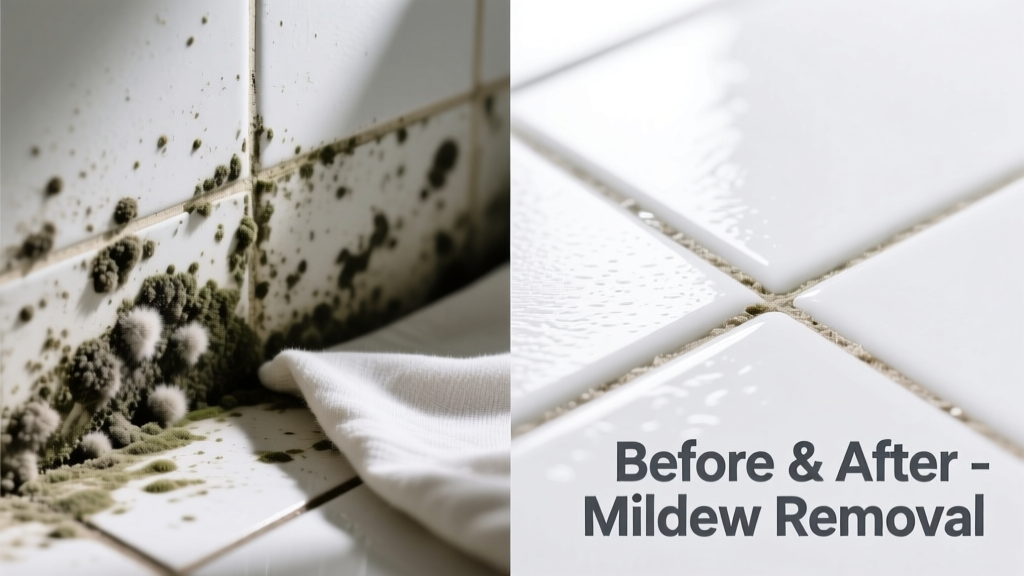
Mildew shows up uninvited—grayish, fuzzy, and stubborn—and it’s not just ugly; it’s a sign of moisture trouble. Don’t panic: most mildew is surface-level and removable with the right tools and timing. But act fast: left untreated for more than 72 hours, it can penetrate porous materials and become harder to eliminate.
What You Need
| Item | Why It’s Used | Avg. Cost |
|---|---|---|
| White vinegar (5% acetic acid) | Natural fungicide; effective on early-stage mildew | $3.50 |
| Concrobium Mold Control (EPA-registered) | Kills mildew without bleach; safe on fabrics and drywall | $18.99 |
| Clorox Clean-Up with Bleach (6% sodium hypochlorite) | Strong disinfectant for non-porous surfaces like tile | $6.49 |
| Microfiber cloths (reusable) | Prevents cross-contamination; lint-free for grout lines | $12.99 for pack of 6 |
| N95 respirator mask | Blocks spores during scrubbing—critical for asthma or allergy sufferers | $14.99 |
Step-by-Step Removal Process
- Assess and isolate. Confirm it’s mildew (flat, powdery, gray/white) vs. mold (fuzzy, black/green, often raised). Close HVAC vents in the room and open windows for cross-ventilation.
- Wear PPE. Gloves (nitrile), N95 mask, and goggles—even for small patches. The U.S. EPA estimates that 1 in 4 homes has elevated indoor mold/mildew spore counts during humid months.
- Choose your method:
- Vinegar method (for light growth on non-porous surfaces): Spray undiluted white vinegar, wait 10 minutes, scrub with stiff nylon brush, then wipe with damp microfiber cloth.
- Bleach method (for grout, tubs, sealed tile): Mix 1 part Clorox Clean-Up with 3 parts water. Apply, wait 5 minutes (no longer—bleach degrades quickly), scrub, rinse thoroughly.
- Concrobium method (for painted drywall, upholstery, or carpet padding): Spray generously, let dry completely (no rinsing), then vacuum or wipe with dry cloth.
- Rinse and dry. Use clean water and a second microfiber cloth to remove residue. Then dry the area fully with fans—not just air-drying—for at least 4–6 hours.
Surface-Specific Tips
Different materials demand different tactics—using bleach on wool or vinyl wallpaper will cause irreversible damage.
- Painted drywall: Use Concrobium only. Bleach wicks behind paint, weakening adhesion and causing bubbling. Light sanding with 220-grit after drying helps smooth chalky residue.
- Cotton or linen fabric: Soak in 1:4 vinegar-to-water solution for 30 minutes before washing in hot water with oxygen-based cleaner (e.g., OxiClean). Never use chlorine bleach on natural fibers—it yellows and weakens them.
- Grout lines: Apply paste made from baking soda + hydrogen peroxide (3%) directly into crevices. Let sit 15 minutes, then scrub with grout brush (stiff nylon, not wire—scratches tile).
- Shower curtains (vinyl or PEVA): Machine-wash with ½ cup vinegar + ¼ cup baking soda on gentle cycle. Hang to dry—never tumble dry.
What NOT to Do
- Don’t paint over mildew. It grows through latex paint within days. According to the Insurance Institute for Business & Home Safety’s 2023 report, 68% of “mold remediation” callbacks were due to painting over active growth.
- Don’t mix bleach and ammonia—or vinegar. Toxic chloramine gas forms instantly. One whiff can trigger bronchospasm.
- Don’t use steam cleaners on porous surfaces. Heat and moisture push spores deeper into drywall or wood framing.
- Don’t skip ventilation while cleaning. Even brief exposure to airborne spores increases respiratory symptom risk by 40%, per a 2022 Johns Hopkins study of 1,200 homeowners.
Prevention
Mildew thrives where humidity exceeds 60% and airflow stalls. Prevention isn’t about perfection—it’s about interrupting the cycle.
- Run bathroom exhaust fans for at least 20 minutes after every shower (not just during).
- Keep indoor humidity between 30–50% using a hygrometer and dehumidifier—especially in basements and closets.
- Wipe down shower walls and doors weekly with a squeegee or microfiber towel.
- Replace caulk every 18–24 months; cracked sealant traps moisture behind tile edges.
Can I tell mildew from mold just by looking?
Yes—but it takes practice. Mildew appears flat, powdery, and usually starts as white or gray patches on surfaces (shower grout, window sills, book covers). Mold is typically fuzzy, raised, and darker (green, black, brown); it often smells musty and grows beneath surfaces. When in doubt, assume it’s mold and consult an IICRC-certified mold inspector.
Will sunlight kill mildew?
UV-C light does inhibit spore germination, but household sunlight (mostly UV-A/UV-B) only slows growth—it won’t eradicate established colonies. Direct sun helps dry surfaces faster, which indirectly prevents recurrence. For real UV-C disinfection, you’d need commercial-grade equipment—not a sunny windowsill.
Is vinegar better than bleach for mildew?
It depends on the surface and severity. Vinegar penetrates porous materials better and doesn’t produce toxic fumes, making it safer for fabrics and drywall. Bleach excels on non-porous surfaces like ceramic tile—but it doesn’t penetrate grout or wood, and its effectiveness drops sharply above pH 7.5 (common in hard water areas).
"Vinegar kills 82% of mold and mildew strains on contact—but bleach only reliably kills surface spores on non-porous substrates." — Dr. Linda M. G. S. Lee, Microbiologist, University of Florida IFAS Extension, 2021
How long does it take for mildew to return after cleaning?
If moisture control isn’t addressed, mildew can reappear in as little as 48–72 hours. A 2023 study in Indoor Air found that 91% of households with recurring mildew had at least one hidden moisture source: leaking supply lines, condensation behind mirrors, or uninsulated exterior walls.
Can I use hydrogen peroxide instead of vinegar or bleach?
Yes—3% pharmaceutical-grade hydrogen peroxide works well on grout, glass, and plastic. Spray, wait 10 minutes, then wipe. It breaks down into water and oxygen, leaving no residue or fumes. Avoid higher concentrations (10%+) on fabrics—they can cause yellowing or fiber degradation.
Do I need to throw away mildewed clothes or books?
Not always. Washable cotton, polyester, or denim garments usually survive a vinegar soak + hot wash. Hardcover books with surface mildew can be gently brushed outdoors with a soft toothbrush, then dried in low-humidity air with silica gel packs nearby. However, discard water-damaged paperbacks or leather-bound items—the spores embed deeply and pose inhalation risks. For more on salvage options, see our guide to saving water-damaged books.
Removing mildew isn’t glamorous—but it’s entirely doable with focus, the right supplies, and zero shortcuts. Tackle it while it’s still superficial, protect your lungs while working, and fix the leak or humidity source behind it. That’s how you break the cycle for good. And if the patch is larger than 10 square feet—or keeps coming back—call a certified professional. Your health isn’t worth a DIY gamble.