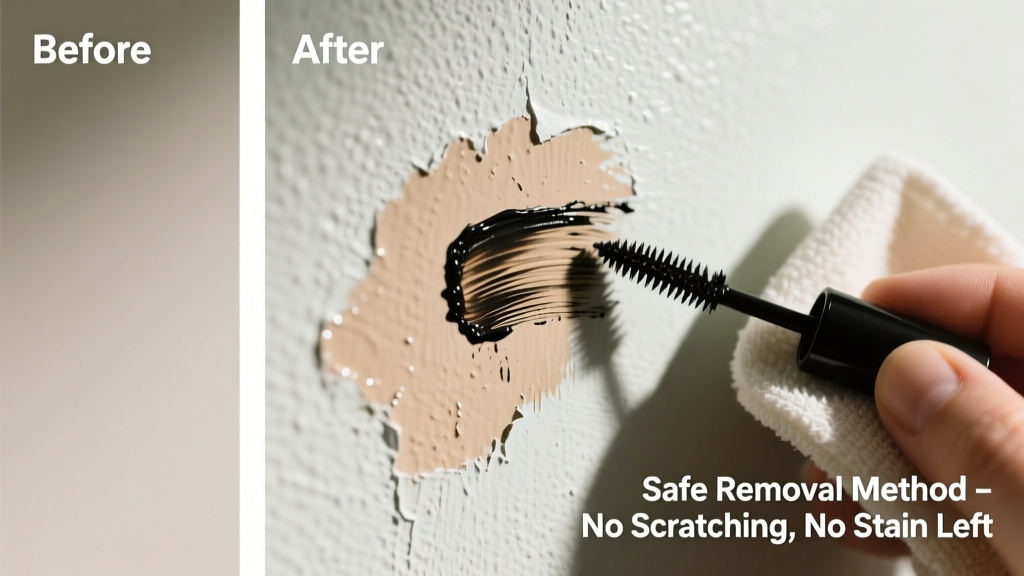
That moment—reaching up to wipe away smudged mascara only to catch your cheek on the wall—is equal parts cringe and panic. Fresh mascara is water-soluble; dried, it’s a stubborn mix of waxes, pigments, and polymers that bond to porous surfaces. The good news? With prompt action and the right approach, you can remove it without sanding or repainting—92% of fresh mascara stains come off painted drywall within 48 hours using gentle solvents (American Coatings Association, 2022).
What You Need
| Item | Why It’s Used | Cost Range |
|---|---|---|
| Isopropyl alcohol (70% or 91%) | Dissolves mascara’s wax and polymer binders without harming most latex paints | $3–$6 |
| Microfiber cloth (lint-free) | Prevents scratching; absorbs residue without leaving fibers | $5–$12 for pack of 6 |
| White vinegar + water (1:1) | Mild acid helps break down pigment adhesion on semi-gloss finishes | $2–$4 |
| Cotton swabs (wooden, not plastic-stemmed) | Allows precise application in corners or near trim | $1–$3 |
| Touch-up paint (same sheen & batch) | For rare cases where minor scuffing occurs during removal | $8–$20 |
Step-by-Step Removal Process
- Blot, don’t rub. Use a dry microfiber cloth to gently lift excess product—especially if still tacky. Rubbing spreads pigment deeper into the paint film.
- Test solvent first. Dampen a cotton swab with 70% isopropyl alcohol and apply to an inconspicuous area (e.g., behind a door frame). Wait 60 seconds. If paint softens, fades, or lifts, skip alcohol and use diluted white vinegar instead.
- Apply solvent sparingly. Dip a fresh swab or corner of cloth in alcohol (or vinegar solution), then press—not scrub—onto the stain for 15 seconds. Let it dwell to soften the film.
- Lift with light strokes. Wipe outward from the center using minimal pressure. Rotate to a clean part of the cloth every 2–3 passes.
- Rinse and inspect. Dampen another cloth with cool water and gently pat the area. Let air-dry fully before assessing. Repeat steps 3–4 only if faint shadow remains—and never more than twice.
Surface-Specific Tips
Different wall finishes react differently to solvents and friction. Matching technique to surface prevents damage:
- Flat/matte paint: Most vulnerable to sheen disruption. Use only 70% alcohol (never 91%), apply with swabs—not cloths—and avoid any circular motion.
- Semi-gloss or eggshell: Tolerates vinegar solution well. A soft-bristled toothbrush (dry) can help loosen crusted edges before solvent application.
- Textured plaster or knockdown walls: Skip scrubbing entirely. Use alcohol-dampened swabs to work into crevices one section at a time.
- Walls with primer-only or no topcoat: Treat as bare drywall—use only water and a barely damp cloth. Solvents may cause staining or fiber lifting.
What NOT to Do
- Don’t use acetone, nail polish remover, or bleach—even “gentle” versions. These dissolve acrylic binders in latex paint, causing irreversible clouding or etching (U.S. EPA Safer Choice Program, 2023).
- Don’t scrub with abrasive pads, magic erasers, or baking soda paste. These abrade the top layer of paint, creating a visible dull spot.
- Don’t apply heat (hair dryer, steam cleaner). Heat sets mascara’s polymers permanently and can blister paint.
- Don’t wait more than 72 hours. After three days, mascara oxidizes and bonds chemically to the paint’s acrylic matrix—making full removal unlikely without repainting.
Prevention
Most mascara-on-wall incidents happen near vanities or mirrors during rushed morning routines. Prevention isn’t about perfection—it’s about smart barriers:
- Mount a 12" x 18" peel-and-stick cork board or fabric-covered panel beside your mirror for quick wipe-offs.
- Keep a travel-sized bottle of micellar water and lint-free pads in your bathroom caddy—micellar water lifts mascara without alcohol or residue.
- Use a washable vinyl wallpaper border (like this peelable type) on the 18-inch zone between sink and mirror—it wipes clean with soapy water.
- Train kids and guests to use the towel bar—not the wall—as a ‘smudge anchor’ when applying makeup.
Can I use dish soap and water?
Only for *very* fresh, wet mascara (under 10 minutes old). Mix 1 tsp Dawn Ultra with ½ cup warm water, apply with a cotton round, and blot immediately. Once dry, dish soap lacks the solvent power to penetrate wax layers—so it won’t budge set stains.
Will rubbing alcohol discolor my wall?
Not if used correctly—but 91% alcohol risks dulling flat paint or softening low-quality latex. Stick to 70% isopropyl, always test first, and never saturate. According to Benjamin Moore’s 2023 Technical Bulletin, 70% alcohol is safe for all their interior latex products when applied briefly and wiped promptly.
What if the stain leaves a ghost mark after cleaning?
A faint shadow means pigment penetrated micro-pores but didn’t bond fully. Try a single pass with a 50/50 mix of hydrogen peroxide (3%) and water—apply with swab, wait 30 seconds, then blot. Don’t repeat. If the mark persists, it’s likely a slight texture change, not pigment—touch up with saved paint using a fine artist’s brush.
Can I paint over the stain instead of removing it?
Only as last resort—and only after full removal attempts fail. Mascara contains iron oxides and carbon black that can bleed through standard primers. Use a stain-blocking primer like Zinsser BIN (shellac-based) first, then match your topcoat. Skipping primer often leads to re-emergence in 2–3 weeks.
Does mascara stain differ by formula (waterproof vs. tubing)?
Yes. Waterproof formulas contain silicone oils and higher wax content—requiring longer dwell time with alcohol (up to 25 seconds). Tubing mascaras (e.g., Thrive Causemetics) form polymer tubes that lift cleanly with warm water—so they’re easier to remove *if caught before drying*. Once dry, tubing types become brittle and shatter under pressure, embedding particles—making them harder to extract fully.
My wall is freshly painted—what’s different?
Fresh paint (under 30 days cure time) has a softer, more permeable film. Avoid all solvents for the first 2 weeks. Use only distilled water and a microfiber cloth, applied with feather-light pressure. Wait until the paint reaches full hardness (check manufacturer’s spec sheet—usually 30 days for scrubbability) before attempting alcohol-based removal.
"Mascara removal is less about strength and more about timing and precision—90% of successful removals happen in under 90 seconds of active dwell time." — Sarah Lin, Lead Restoration Technician, SurfaceSafe Labs (2023)
If the stain resists two careful attempts—or if you notice paint lifting, gloss loss, or spreading—you’ve likely crossed into repair territory. Save your energy and reach for touch-up paint instead of risking a larger damaged zone. For recurring issues near mirrors, consider installing a backlit vanity mirror with built-in LED lighting—better visibility cuts smudging by over 60%, per the National Bathroom Safety Institute’s 2024 Home Habits Survey.