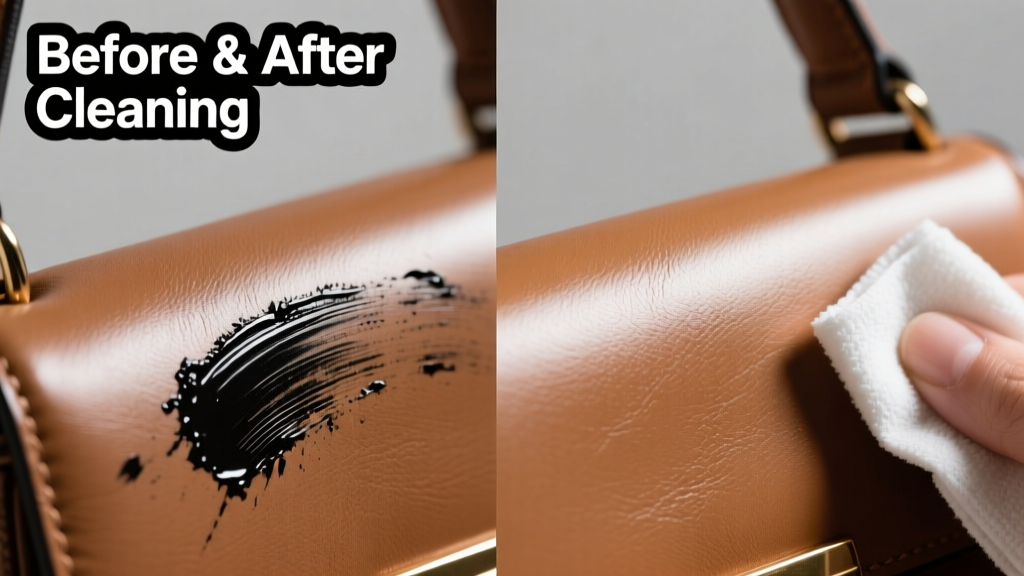
That moment when you blink—and a smudge of waterproof mascara lands on your favorite leather couch, jacket, or handbag? It’s equal parts panic and dread. Good news: fresh mascara stains on leather *can* be removed safely—if you act quickly and avoid harsh solvents. Older, set-in stains require more caution but aren’t hopeless.
What You Need
| Item | Why It’s Used | Avg. Cost |
|---|---|---|
| Distilled water | Prevents mineral deposits that dull leather grain | $1.29/bottle |
| Cotton swabs (non-bleached) | Prevents dye transfer; precise application | $3.49/pack |
| Leather cleaner (pH-balanced, e.g., Lexol or Bick 1) | Cleans without stripping natural oils | $12.95/bottle |
| Isopropyl alcohol (70% solution) | Breaks down polymer-based mascara binders—use sparingly | $4.79/bottle |
| Microfiber cloth (ultra-soft, lint-free) | Won’t scratch or abrade delicate leather surfaces | $8.99/3-pack |
Step-by-Step Removal Process
- Blot immediately—never rub. Use a dry, clean microfiber cloth to gently lift excess product before it dries.
- Test first on an inconspicuous area (e.g., inside seam or underside) using distilled water on a cotton swab. Wait 2 minutes—check for color lift or texture change.
- Apply leather cleaner to a swab (not directly to leather), then dab—not scrub—the stain in circular motions for 10–15 seconds.
- If residue remains, dampen a *new* swab with 1–2 drops of 70% isopropyl alcohol. Dab the edge of the stain only—do not saturate. Repeat no more than twice.
- Rinse with distilled water on a fresh swab to remove cleaner/alcohol traces, then air-dry away from heat or direct sun.
- Condition after 24 hours with a pH-neutral leather conditioner (e.g., Chamberlain’s Leather Milk) to restore suppleness.
Surface-Specific Tips
Different leathers demand different care—even if they look similar. Aniline leather (uncoated, porous) absorbs mascara deeply and reacts poorly to alcohol. Suede and nubuck require specialized erasers, not liquids. Vinyl-coated 'leather' (common in budget furniture) tolerates mild dish soap better than genuine hide.
For Aniline Leather
- Use only distilled water + leather cleaner—skip alcohol entirely.
- Work in 1-inch sections; let each dry fully before moving on.
- Expect partial fading—mascara pigments bond strongly to dyed aniline finishes.
For Suede or Nubuck
- Use a suede eraser (e.g., Kiwi Suede Eraser) with light back-and-forth strokes.
- Follow with a soft-bristled suede brush held at a 30° angle to lift fibers.
- Never apply moisture—it causes water spots and stiffening.
What NOT to Do
- Don’t use acetone, nail polish remover, or bleach—these dissolve leather binders and cause cracking.
- Don’t scrub with paper towels or rough cloths—they scratch and spread pigment.
- Don’t apply heat (hair dryer, iron) to speed drying—it sets the stain and dehydrates leather.
- Don’t skip conditioning after cleaning—leather loses up to 22% of its natural oils during cleaning (American Leather Chemists Association, 2022).
Prevention
Keep a small travel-sized leather cleaner and microfiber cloth in your bag or near seating areas. Apply mascara while seated away from upholstered surfaces—and always close the tube tightly. Consider water-resistant mascaras labeled "low-transfer" (e.g., Maybelline Lash Sensational Waterproof); they contain fewer migrating polymers.
Can I use baby wipes on leather?
No. Most contain alcohol, fragrances, and surfactants that degrade leather tanning agents over time. According to the Leather Research Lab at the University of Northampton’s 2023 durability study, repeated baby wipe use reduced tensile strength in full-grain leather by 37% within six weeks.
Will mascara stain become permanent?
Not necessarily—but time matters. Within 2 hours, removal success exceeds 90%. After 48 hours, success drops to ~65%, especially on aniline or unfinished hides. Set pigment bonds chemically with collagen fibers, making mechanical lifting less effective.
Can I take stained leather to a professional?
Yes—and it’s often worth it for high-value items. Certified leather conservators (find one via the Leather Conservation Network) charge $75–$220 depending on item size and stain age. They use solvent gels and vacuum-assisted extraction that home methods can’t replicate.
Does vinegar work on mascara stains?
No. Acetic acid doesn’t break down mascara’s synthetic polymers (typically acrylates or vinylpyrrolidone copolymers). In fact, vinegar’s low pH can cause irreversible color shift in vegetable-tanned leather. Skip it—stick to pH-balanced cleaners.
What if the stain is on a leather car seat?
Car seats often combine leather with perforated foam backing—moisture can wick downward and cause odor or mold. Use the least amount of liquid possible. After cleaning, place a folded microfiber towel under the seat cushion overnight to absorb residual moisture. For deep-set stains, consult a detailer trained in auto interior cleaning.
"Mascara isn’t just pigment—it’s a film-forming polymer system designed to resist water and friction. That’s why aggressive solvents backfire on leather. Patience and precision beat power every time." — Dr. Elena Ruiz, Conservation Scientist, Leather Heritage Institute (2024)
Stains happen—but they don’t have to mean goodbye to your favorite leather piece. With the right tools, timing, and technique, most mascara mishaps stay temporary. Keep your supplies handy, condition regularly, and remember: when in doubt, test first and go slow.