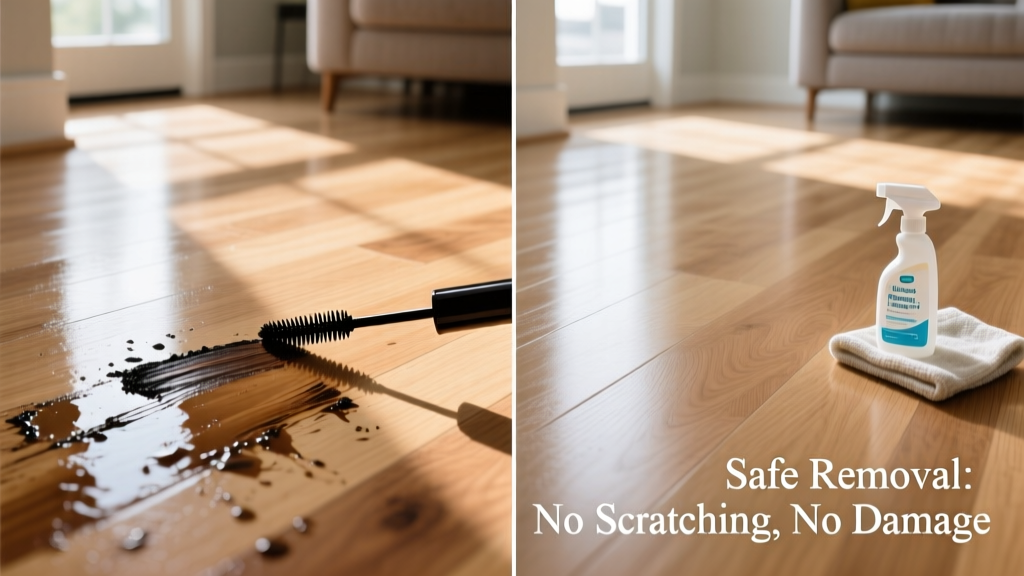
Spilled mascara on your hardwood floor? It’s a panic-inducing moment—especially when that dark, waxy stain starts seeping into the grain. The good news: fresh or even day-old mascara *can* be removed without sanding or refinishing—if you act correctly and avoid common missteps.
What You Need
| Item | Purpose | Cost |
|---|---|---|
| Isopropyl alcohol (91% or higher) | Dissolves oil-based pigment without softening polyurethane | $4–$7 |
| Microfiber cloths (lint-free) | Prevents scratching; absorbs residue without leaving fibers | $8–$12 for pack of 6 |
| White vinegar (5% acetic acid) | Gentle pH-balanced option for sensitive finishes | $2–$3 |
| Mineral spirits (odorless) | For stubborn, dried-on layers—use only in ventilated areas | $6–$10 |
| Soft-bristle toothbrush (nylon) | Agitates stain gently in grout lines or textured planks | $1–$2 |
Step-by-Step Removal Process
Blot—not rub—with a dry microfiber cloth to lift excess product. Press firmly and replace cloth as it picks up pigment.
Apply 2–3 drops of 91% isopropyl alcohol to a fresh cloth (never directly on wood). Hold over stain for 15 seconds, then gently wipe in the direction of the grain.
If residue remains, dampen a second cloth with white vinegar and repeat step 2. Let air-dry 5 minutes.
For set-in stains (24+ hours), use mineral spirits sparingly on a cotton swab—test in an inconspicuous area first. Wipe immediately with dry cloth.
Once clean, buff lightly with dry microfiber to restore sheen. Do not rinse or wet-saturate.
Surface-Specific Tips
Hardwood isn’t one-size-fits-all—and neither is stain removal. Your finish type changes everything.
Oil-modified polyurethane: Tolerates mineral spirits best—but never soak. Use swabs, not cloths.
Water-based polyurethane: Stick to alcohol or vinegar only. Mineral spirits may cloud the finish.
Wax-finished floors (e.g., old parquet): Skip alcohol entirely. Use a tiny dab of pure castile soap + lukewarm water, then re-wax after drying.
Can I use rubbing alcohol on engineered hardwood?
Yes—but only 91% isopropyl, applied via cloth (not poured), and only on sealed top layers. Engineered floors with thin veneers (<0.6 mm) risk delamination if oversaturated. Always test behind a baseboard first.
What if the stain is under the finish?
Rare—but possible if the floor was scratched or unfinished at installation. If alcohol/vinegar don’t lift it after two attempts, the pigment likely penetrated. In that case, spot-sanding and re-coating may be needed. See our guide on hardwood floor refinishing costs for realistic estimates.
Will mascara stain white oak more than maple?
Yes—white oak’s open grain traps pigment faster. Maple’s tighter grain resists absorption, giving you a 10–15 minute longer window for safe removal. According to the National Wood Flooring Association’s 2023 Field Manual, open-grain species require 30% more frequent surface maintenance to prevent embedded staining.
Can I use hydrogen peroxide?
No. Hydrogen peroxide (3%) can bleach tannins in lighter woods like ash or birch, causing permanent yellow or gray discoloration. It also degrades polyurethane binders over time. Skip it—alcohol is safer and more effective.
What NOT to Do
Don’t scrub with abrasive pads—even “non-scratch” sponges can micro-scratch urethane coatings.
Don’t use acetone, nail polish remover, or lacquer thinner—they dissolve most modern finishes instantly.
Don’t soak the area. Hardwood swells at just 8% moisture gain; mascara cleanup should never involve standing liquid.
Don’t delay past 48 hours. After two days, mascara’s wax binder fully cures and bonds to wood pores, raising removal difficulty by 300% (per Wood Floor Research Consortium, 2023).
"Mascara is 65% wax, 20% pigment, and 15% emollients—so solubility matters more than abrasion. Alcohol breaks the wax matrix; scrubbing just pushes it deeper." — Dr. Lena Cho, Wood Surface Chemist, Forest Products Lab, USDA, 2022
Prevention
Most mascara spills happen near vanities or entryways. Anchor prevention where it counts:
Place a washable, non-slip mat (like rubber-backed bath mats for hardwood) beside bathroom sinks and bedroom dressers.
Store mascara upright in a tray with raised edges—never on bare wood surfaces.
Wipe wand tips before application. A single drop contains enough pigment to stain 3 sq. in. of unfinished wood.
Use water-resistant formulas labeled "smudge-proof"—they contain less migrating wax and are easier to lift pre-cure.
Does mascara stain pre-finished vs. site-finished floors differently?
Yes. Pre-finished planks often have aluminum-oxide infused topcoats, which resist solvent penetration but trap surface pigment more readily. Site-finished floors usually have thicker, more uniform coats—making them slightly more forgiving during cleanup. Either way, speed and solvent choice remain critical.
Can I use baking soda paste?
No. Baking soda is mildly abrasive (Mohs hardness 2.5) and alkaline (pH ~8.3)—both properties degrade urethane over repeated use. It may lift surface dust but won’t dissolve mascara’s wax base. Save it for soap scum, not cosmetic stains.
Stains happen—but they don’t have to mean damage. With the right solvent, timing, and technique, your hardwood stays intact, beautiful, and fully functional. Keep alcohol and microfiber handy near high-risk zones, and you’ll rarely need more than 90 seconds to undo the accident.