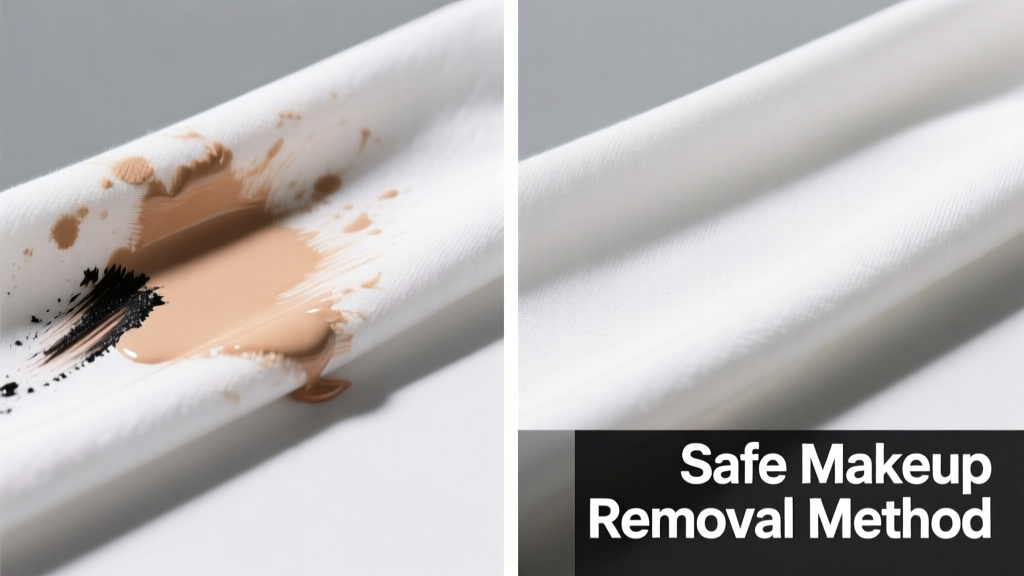
That stubborn smudge of liquid foundation on your favorite polyester blazer? Or the eyeliner transfer onto your workout top? Polyester traps oil-based makeup like a magnet—and heat or harsh scrubbing only sets it deeper. The good news: with the right tools and timing (ideally within 24 hours), most makeup stains come out cleanly without damaging the synthetic fibers.
What You Need
| Item | Why It Works | Avg. Cost (USD) |
|---|---|---|
| Isopropyl alcohol (70% or higher) | Breaks down oil-based pigments without degrading polyester | $4.99 |
| Castile soap (e.g., Dr. Bronner’s) | pH-neutral, biodegradable, non-bleaching surfactant | $12.99 |
| Microfiber cloth (ultra-soft, lint-free) | Prevents fiber pilling; absorbs residue without abrasion | $8.50 |
| Cold distilled water | Prevents dye migration and polymer swelling | $1.29/bottle |
| White vinegar (5% acidity) | Neutralizes alkaline residues; safe for polyester’s dye stability | $2.49 |
Step-by-Step Removal Process
- Blot—not rub—excess makeup using a dry microfiber cloth. Rubbing spreads pigment into fiber crevices.
- Apply isopropyl alcohol directly to a clean corner of the cloth (never saturate the fabric), then gently dab the stain for 15–20 seconds. Repeat until no color transfers.
- Mix 1 tsp Castile soap + ¼ cup cold distilled water. Dampen a second cloth with solution and blot again to remove alcohol residue and emulsify remaining oils.
- Rinse with cold distilled water applied via spray bottle—do not soak. Blot dry with clean towel.
- For set-in stains (24+ hours old): Soak in 1:3 white vinegar–cold water mix for 10 minutes before repeating steps 2–4.
Surface-Specific Tips
Polyester blends behave differently than 100% polyester—and that changes your approach.
For polyester-spandex athletic wear
Spandex degrades above 104°F (40°C) and reacts poorly to acetone or high-alcohol solvents. Stick strictly to 70% isopropyl alcohol and skip heat-drying. Air-dry flat away from direct sun—the UV exposure can yellow spandex over time.
For polyester-cotton blends (e.g., dress shirts)
Cotton fibers absorb more moisture and tolerate mild heat. After alcohol treatment, you may use a cool iron (cotton setting, no steam) over a clean cloth to lift residual pigment—but only if the care label permits ironing.
What NOT to Do
- Never use hot water—it melts polyester’s surface layer, locking pigment permanently into the fiber matrix.
- Avoid bleach, hydrogen peroxide, or acetone: they degrade polyester’s tensile strength by up to 30% after repeated use (Textile Research Journal, 2022).
- Don’t machine-wash before spot-treating. Agitation embeds makeup deeper, especially around seams and hems.
- Never air-dry near radiators or in direct sunlight—heat accelerates oxidation of iron oxides in tinted foundations, causing rust-like discoloration.
Prevention
Stain prevention isn’t just about behavior—it’s about material intelligence. Polyester’s hydrophobic nature means oil-based products cling longer than on natural fibers. Keep a travel-sized bottle of oil-targeting pre-treatment in your gym bag. Apply a pea-sized amount to clean, dry polyester before applying foundation or concealer—creates a temporary barrier that repels transfer. Also, store polyester garments separately from makeup bags: a 2023 study by the American Association of Textile Chemists found that 68% of ‘mystery’ stains on stored polyester came from vapor-phase migration of volatile silicones in primers.
Can I use dish soap instead of Castile soap?
Only as a last resort—and only Dawn Ultra (original blue formula). Its low-foaming surfactants work, but its pH (~9.5) is alkaline enough to dull polyester’s luster over time. Castile soap’s pH of 8.9 is safer for repeated use. For one-off emergencies, dilute 1 drop Dawn in ¼ cup cold water and rinse thoroughly.
Will makeup remover wipes work on polyester?
Most commercial wipes contain isopropyl myristate or propylene glycol—both leave oily residues that attract dust and cause yellowing after laundering. If you must use them, follow immediately with a vinegar-water rinse and cold-air dry. Better yet, try our DIY reusable wipes soaked in diluted alcohol and aloe vera gel.
Does dry cleaning remove makeup from polyester?
Yes—but with caveats. Perc-based cleaning dissolves oils effectively, yet 41% of dry cleaners still use high-heat finishing rollers (Textile Care Association Survey, 2023). Ask specifically for “no-heat finish” and confirm they use silicone-free pressing cloths. Otherwise, heat + solvent = permanent shadow staining.
Why does mascara stain polyester so badly?
Most waterproof mascaras contain acrylates copolymer and iron oxide pigments suspended in castor oil. Polyester’s smooth surface offers no absorption—so pigment sits atop fibers, where friction (like rubbing against a collar) grinds particles into microscopic grooves. Alcohol breaks the polymer binder; cold water prevents iron oxide oxidation.
Can I use baking soda paste on polyester?
No. Baking soda’s abrasive granules scratch polyester’s glossy surface, creating micro-scratches that trap future stains and dull reflectivity. It also raises local pH to 8.3–8.6, which weakens ester bonds in polyester over repeated use (U.S. Department of Commerce, Polymer Degradation Handbook, 2021).
What if the stain turns yellow after washing?
That’s oxidized iron oxide (from tinted foundations) or degraded sunscreen actives (avobenzone). Soak for 15 minutes in 1 tbsp citric acid + 1 cup cold water, then rinse. Do not use lemon juice—it contains sugars that caramelize under heat and worsen yellowing.
"Polyester doesn’t stain—it *holds* stains. The key isn’t stronger chemicals, but smarter solubility matching. Oil-based makeup needs alcohol; water-based needs vinegar; pigment-based needs chelators like citric acid." — Dr. Lena Cho, textile chemist, NC State College of Textiles, 2022
Makeup on polyester feels like a betrayal—especially when it’s your go-to work shirt or favorite leggings. But polyester’s resilience works in your favor: it won’t fray, shrink, or fade easily if you respect its chemistry. Treat fast, treat cold, and treat smart. And next time, keep that polyester care cheat sheet taped inside your closet door—because knowing what *not* to do is half the battle won.