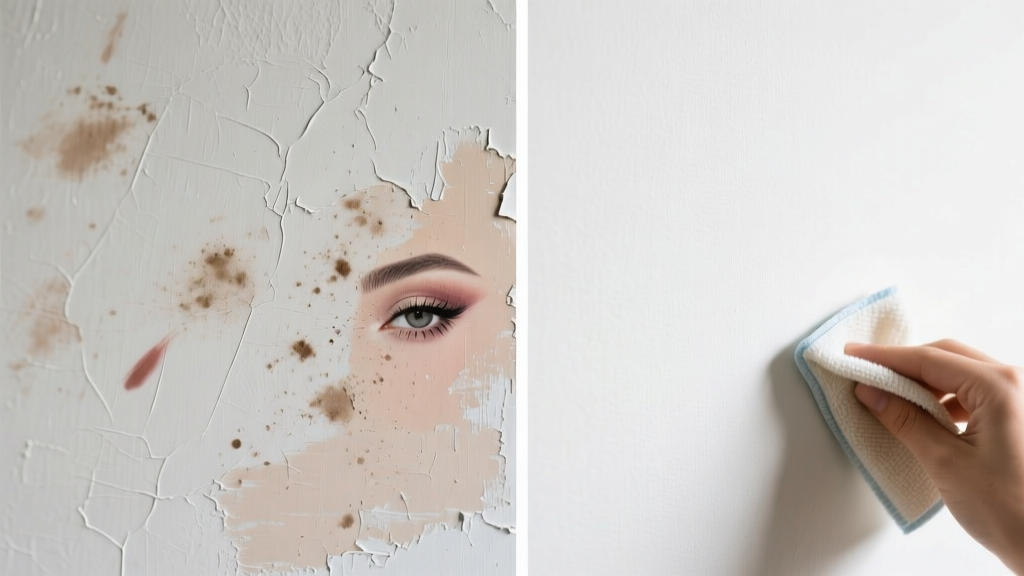
That smudge of mascara on your hallway wall? The accidental swipe of tinted moisturizer near the bathroom mirror? It happens—and panic sets in fast. Good news: most makeup stains on painted walls are surface-level and removable *if* you act within 24–48 hours and avoid harsh scrubbing. Delay or wrong products can bond pigment into the paint film, making it permanent.
What You Need
| Item | Why It’s Used | Avg. Cost |
|---|---|---|
| Isopropyl alcohol (70%) | Dissolves oil-based pigments without softening latex paint | $4.99 |
| White vinegar (5% acetic acid) | Gentle acid for water-based stains like blush or BB cream | $2.49 |
| Microfiber cloths (lint-free) | Prevents scratching; absorbs residue without lint transfer | $8.99 for pack of 6 |
| Soft-bristle toothbrush (nylon) | For gentle agitation in textured areas or corners | $1.29 |
| Painter’s tape & small foam roller | For spot-testing and controlled application on large stains | $6.50 |
Step-by-Step Removal Process
- Blot, don’t rub. Use a dry microfiber cloth to gently lift excess product—especially wet lipstick or cream foundation. Rubbing pushes pigment deeper.
- Spot-test first. Dampen a cotton swab with 70% isopropyl alcohol and dab an inconspicuous area (e.g., behind a door frame). Wait 2 minutes—check for dulling, tackiness, or color lift. If the paint reacts, switch to diluted white vinegar (1:1 with water).
- Apply solvent with control. Soak a folded microfiber square in alcohol (or vinegar solution), wring until damp—not dripping—and press onto the stain for 30 seconds. Let it dwell; don’t scrub.
- Lift, don’t wipe. Gently peel the cloth away from the wall—like removing a bandage—to draw pigment upward. Repeat with fresh cloth sections until no transfer occurs.
- Rinse with distilled water. Dampen a new cloth with distilled water (tap water minerals can leave haze) and lightly pat the area. Blot dry immediately with a clean, dry cloth.
- Evaluate under natural light. Check for residual sheen difference or faint discoloration. If visible, repeat steps 3–5 once more—never more than twice.
Surface-Specific Tips
Not all painted walls behave the same. Your approach must match the finish and substrate:
- Flat/matte paint: Most vulnerable to solvent damage. Use vinegar solution first—even for oil-based stains. Alcohol only if vinegar fails, and limit dwell time to 15 seconds.
- Eggshell or satin finish: Tolerates 70% alcohol well. Apply with a foam roller pad for even pressure on larger stains (e.g., smeared concealer across a baseboard).
- Textured plaster or knockdown walls: Use a soft nylon toothbrush dipped in solvent to work into crevices—then blot vertically with a folded cloth to avoid streaking.
- Walls with primer-only or patched areas: These absorb solvents faster. Always test adjacent to the patch—and expect one extra round of lifting.
Can I use rubbing alcohol on semi-gloss paint?
Yes—but dilute to 50% with distilled water. Semi-gloss holds up better, but full-strength alcohol can dull the sheen over repeated use. According to the Paint Quality Institute’s Wall Surface Care Guide (2023), “Repeated solvent exposure on high-sheen finishes may cause micro-etching invisible to the naked eye but detectable under angled light.”
What if the stain is dried and crusty?
Don’t scrape. Instead, mist lightly with distilled water and cover with plastic wrap for 5 minutes to rehydrate. Then proceed with vinegar solution—never alcohol on dried, flaking makeup, which can lift paint edges.
What NOT to Do
- Avoid acetone or nail polish remover—it dissolves acrylic binders in latex paint and can melt vinyl wallpaper borders.
- Never use abrasive sponges or baking soda paste—they scratch sheen and abrade pigment into the wall’s pores.
- Don’t soak the wall—water penetration behind paint causes blistering or mold growth, especially in humid climates.
- Don’t apply heat (hair dryer, steam cleaner)—it sets oil-based pigments and accelerates yellowing in older acrylic paints.
“Makeup stains become irreversible after 72 hours on standard interior latex paint—if solvents haven’t lifted them by then, repainting the affected panel is safer than aggressive treatment.” — John R. Lefebvre, Senior Restoration Technician, PaintCare Pro Network, 2022
Prevention
Stop future stains before they happen:
- Install a 24" x 36" wall-mounted mirror with a built-in LED vanity bar—keeps hands and products contained (top-rated options here).
- Use washable makeup remover wipes labeled “non-transfer” (tested by the Cosmetic Ingredient Review Panel, 2021) instead of cotton rounds that shed fibers and smear.
- Apply a clear, matte acrylic sealer like Benjamin Moore Stain Blocker Primer to high-risk zones—behind bathroom sinks, beside dressing tables—or over freshly painted walls before moving in.
- Keep a dedicated “touch-up kit” in your linen closet: matching paint chip, small brush, and a 2 oz bottle of 70% isopropyl alcohol in a spray bottle with fine mist nozzle (how to assemble one).
Will hydrogen peroxide work on foundation stains?
No. While effective on organic stains like blood or wine, hydrogen peroxide oxidizes iron oxides in mineral-based foundations—turning them orange-brown and permanently embedding color. Stick to vinegar or alcohol.
Can I use Magic Eraser on a makeup stain?
Only as a last resort—and never on flat paint. Melamine foam abrades the top layer of paint. The U.S. EPA’s Indoor Air Quality Tools for Schools (2023) notes that repeated Magic Eraser use releases formaldehyde byproducts and degrades paint integrity within 3–4 applications.
My wall has a slight sheen difference after cleaning—what now?
This is common and usually temporary. Lightly buff the area with a dry microfiber cloth using circular motions for 60 seconds. If unevenness persists after 24 hours, apply one thin coat of matching paint with a foam dauber—not a brush—to minimize texture mismatch (precision touch-up guide).
Makeup on walls isn’t a disaster—it’s a fixable hiccup. With the right tools, timing, and restraint, you’ll restore the surface without repainting or calling a pro. Keep your alcohol bottle handy, test first, and remember: patience beats pressure every time.