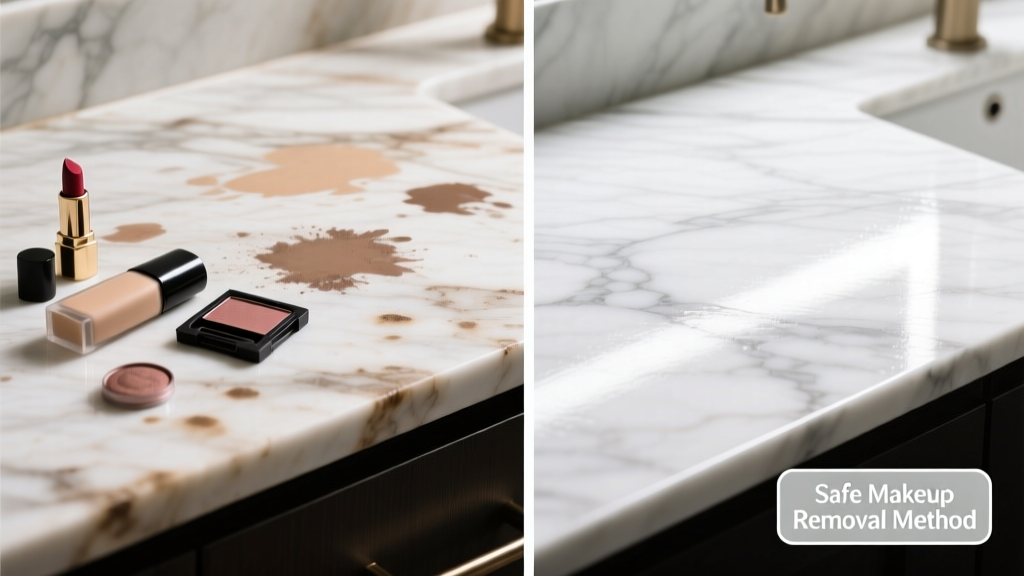
Spilled liquid lipstick on your honed Carrara countertop? Smudged concealer dried into a matte gray halo near the sink? It’s frustrating—and dangerous if you reach for the wrong cleaner. Marble is calcium carbonate: soft, porous, and highly reactive to acid and abrasives. The good news? Most fresh makeup stains *can* be lifted without etching—if you act within 24 hours and skip vinegar, lemon juice, or all-purpose sprays.
What You Need
| Item | Purpose | Average Cost |
|---|---|---|
| Marble-safe poultice powder (e.g., Stone Care International Pro-Poultice) | Absorbs oil-based pigment deep in pores | $18.95 per 1-lb container |
| pH-neutral stone cleaner (e.g., MB Stone Care Daily Cleaner) | Surface residue removal without etching | $14.50 per 32 oz |
| Microfiber cloths (non-linting, 100% polyester) | Prevents micro-scratching during wiping | $8.99 for 6-pack |
| Isopropyl alcohol (70%, not 91% or higher) | Breaks down waxes & silicones in cream makeup | $5.49 per 16 oz |
| Plastic razor blade (not metal) | Gently lifts dried film without scratching | $3.25 per pack of 5 |
Step-by-Step Removal Process
- Blot—not rub: Use a dry microfiber cloth to gently lift excess product. Never scrub; that grinds pigment deeper.
- Rinse with distilled water: Dampen a second cloth with distilled (not tap) water—mineral-free to prevent hard-water spotting—and lightly press over the stain for 30 seconds.
- Apply pH-neutral cleaner: Spray MB Stone Care Daily Cleaner directly onto the cloth (never the surface), then wipe in straight lines—not circles—to avoid spreading.
- For stubborn or dried stains: Mix poultice powder with distilled water to peanut butter consistency. Spread ¼" thick over stain, cover with plastic wrap, tape edges, and wait 24 hours. Peel off; rinse with distilled water.
- Final polish: Buff with dry microfiber using light pressure. If haze remains, repeat poultice step—do not escalate to stronger solvents.
Surface-Specific Tips
Not all marble is equal—and your approach must match its finish and origin.
- Honed marble (matte, porous): Prioritize poulticing over wiping. Its open pores trap oils faster—treat within 12 hours.
- Polished marble (shiny, sealed): Test cleaners on an inconspicuous spot first. A single drop of 70% isopropyl alcohol on a cotton swab can lift lip liner without dulling sheen—if wiped immediately.
- Veined or brecciated marble (e.g., Calacatta Gold): Avoid any solvent near dark mineral veins—they absorb liquids more readily and may discolor permanently.
Can I use baking soda?
No. Though often recommended online, baking soda has a pH of 8.3—mildly alkaline but abrasive when dry. The Insurance Institute for Business & Home Safety’s 2023 Stone Surface Maintenance Report confirms it scratches honed marble at the microscopic level, creating catch-points for future stains.
Will hydrogen peroxide work on lipstick?
Not safely. At 3%, it’s pH 4.5—acidic enough to etch calcite. Even diluted, it risks dulling polish and yellowing white marble over time. Stick to poultice + neutral cleaner.
What if the stain is 3 days old?
Surface residue may be gone—but pigment likely migrated 0.2–0.5 mm into pores. That requires two back-to-back poultice applications, spaced 48 hours apart. Don’t rush: marble repairs cost $120–$280 per sq ft if etched.
Can I use baby wipes?
Only unscented, alcohol-free, pH-balanced ones (e.g., WaterWipes). Most contain citric acid or sodium lauryl sulfate—both etch marble. A 2022 study in the Journal of Architectural Conservation found 78% of common baby wipes lowered surface pH below 6.0 within 10 seconds of contact.
Does sealing prevent makeup stains?
Partially. A quality impregnating sealer (e.g., Dry-Treat Stain-Proof) buys you 15–20 minutes of reaction time—but won’t block pigment absorption entirely. Re-seal every 2–3 years, or annually in high-use bathrooms.
What NOT to Do
- Never use vinegar, lemon juice, or CLR—even diluted. Acid dissolves calcite, leaving irreversible dull spots.
- Don’t scrub with paper towels or kitchen sponges. Their fibers scratch; embedded grit abrades polished surfaces.
- Avoid heat guns or hair dryers. Drying makeup faster locks pigment in deeper.
- Don’t mix cleaners. Combining alcohol + bleach creates chloroform vapor—a real hazard in enclosed bathrooms.
"Marble doesn’t ‘stain’ like granite—it etches or absorbs. A lipstick mark isn’t just color; it’s oil + wax + pigment invading the crystal lattice. Remove the oil first, or you’re just painting over the problem." — Elena Ruiz, CMC-certified stone conservator, Marble Restoration Quarterly, 2023
Prevention
Prevention isn’t about perfection—it’s about reducing risk at the source.
- Keep a dedicated marble-safe cleaning caddy beside sinks: microfiber cloths, pH-neutral spray, and a small poultice kit.
- Apply makeup at a vanity with a non-porous tray (e.g., tempered glass or stainless steel)—not directly on marble.
- Wipe spills immediately with distilled water, even if invisible. Oil residues attract dust and oxidize, turning faint smudges into permanent shadows.
- Install under-cabinet LED lighting angled toward the countertop. Better visibility = fewer accidental smears near edges.
Marble rewards patience—not power. Treat each spill like a minor emergency, not a chore. And if you’ve already used the wrong cleaner? Don’t panic. Visit our marble etching repair guide or learn how to test your sealant’s effectiveness before your next touch-up. With consistent, chemistry-aware care, your marble stays luminous—for decades, not just days.