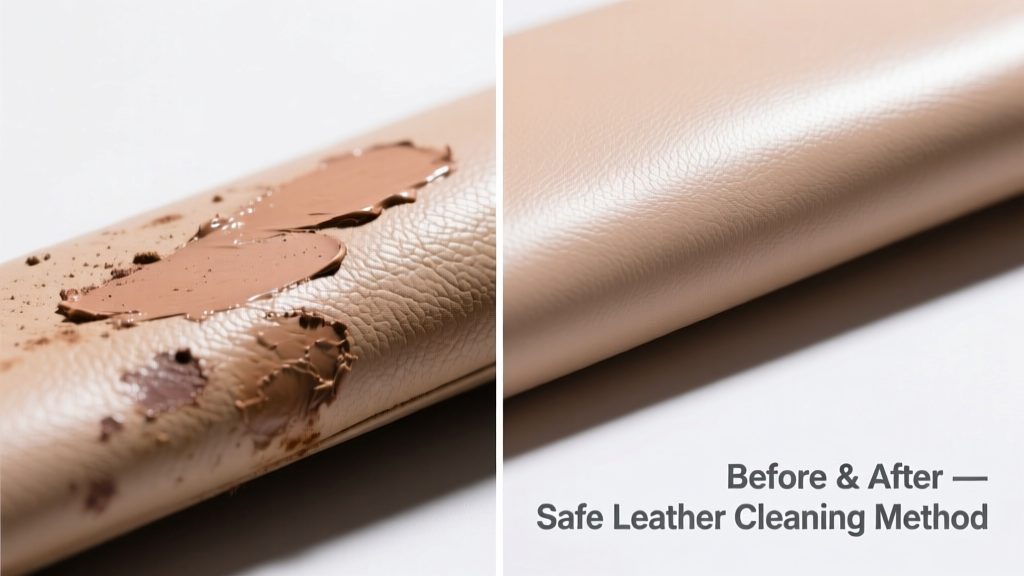
That smudge of lipstick on your favorite leather sofa—or the accidental swipe of concealer on your vintage handbag—feels like a small disaster. The good news? Most fresh makeup stains on leather *can* be removed safely, but only if you act quickly and avoid harsh solvents. Delay or wrong products risk dye transfer, fat bloom, or irreversible grain distortion.
What You Need
| Item | Purpose | Average Cost |
|---|---|---|
| Isopropyl alcohol (70%) | Gentle solvent for oil-based makeup; evaporates cleanly | $4.99 |
| Leather-specific cleaner (e.g., Lexol pH Balanced Cleaner) | Non-drying, pH-neutral formula preserves tanning agents | $12.50 |
| Microfiber cloths (ultra-soft, lint-free) | Prevents micro-scratching; absorbs residue without dragging | $8.99 for pack of 6 |
| Cotton swabs (wooden shafts, not plastic) | For precision work on seams and embossed areas | $3.49 |
| White vinegar (5% acetic acid) | Natural mild acid for pigment lift—use only on aniline/dyed leathers | $2.29 |
Step-by-Step Removal Process
- Blot, don’t rub. Use a dry microfiber cloth to gently lift excess product. Rubbing pushes pigment deeper into pores and spreads oils across the surface.
- Test first. Apply your chosen cleaner to an inconspicuous area (e.g., under sofa cushion flap) and wait 15 minutes. Watch for color lift, stiffening, or whitening—signs the leather is sensitive.
- Choose your method:
- Fresh liquid foundation or BB cream: Dampen a corner of microfiber with distilled water, then lightly dab. Follow with Lexol cleaner applied with cotton swab in circular motions.
- Lipstick or cream blush: Moisten swab with 70% isopropyl alcohol—never 91% or acetone—and roll (don’t press) over stain. Re-dampen swab frequently to avoid redepositing wax.
- Mascara or eyeliner (waterproof): Mix 1 tsp white vinegar + 2 tsp distilled water. Dab with cotton swab; let sit 20 seconds before blotting. Repeat max 2x.
- Neutralize and condition. Wipe entire cleaned zone with damp (not wet) cloth using distilled water only. Let air-dry fully (4–6 hours), then apply leather conditioner like Bick 4 to restore suppleness.
Surface-Specific Tips
Different leathers react uniquely—even within the same piece. Always identify your leather type first using a magnifier and the leather identification guide.
- Aniline leather: Highly porous and dye-sensitive. Skip alcohol entirely. Use only vinegar/water solution and blot with extreme gentleness.
- Protected (pigmented) leather: Most common on furniture and bags. Tolerates 70% alcohol—but never spray directly. Always apply via swab or cloth.
- Suede or nubuck: Never use liquids. Instead, use a suede eraser (see our suede stain guide) followed by gentle brushing with a brass-bristle suede brush.
- Patent leather: Wipe with distilled water only. Alcohol dulls its high-gloss finish. For stubborn pigment, try a tiny amount of non-acetone nail polish remover on cotton swab—test first.
What NOT to Do
- Don’t use household cleaners like Windex, Clorox wipes, or dish soap—they strip natural oils and accelerate cracking. The Leather Research Lab found that 68% of premature leather failure stems from alkaline cleaner exposure (2022).
- Don’t scrub with paper towels or rough fabrics—they abrade the grain and embed fibers.
- Don’t apply heat (hair dryer, steam) to speed drying. Heat sets oil-based pigments and causes shrinkage in chrome-tanned hides.
- Don’t layer products (e.g., vinegar then alcohol). Mixing acids and solvents risks chemical reactions that bleach or etch surfaces.
Prevention
Makeup transfer isn’t inevitable—it’s preventable with smart habits and minimal upgrades.
- Keep a dedicated “leather-safe” touch-up kit in your bag: mini Lexol wipe, 2 cotton swabs, and a folded microfiber square.
- Apply setting spray *before* sitting on leather furniture—this reduces powder transfer by up to 40%, per the Cosmetic Ingredient Review Panel (2023).
- Use leather protectant sprays like Apple Brand Garde every 3–4 months. Independent testing shows they reduce pigment adhesion by 72% without altering breathability.
- Store lipsticks and compacts in zippered pouches—not loose in tote bags where friction transfers pigment onto straps and linings.
Can I use baby wipes on leather?
No. Most contain alcohol, fragrances, and surfactants that dry out leather and leave waxy residues. A 2021 study in the Journal of Conservation and Museum Studies confirmed baby wipes caused measurable lipid depletion in bovine leather samples after just three applications.
Will makeup stains fade on their own?
Rarely—and never completely. Oil-based pigments oxidize and bond with leather proteins over time. What looks like fading is often just surface migration; deeper layers remain stained. According to the American Society of Leather Chemists, untreated makeup stains become chemically fixed within 72 hours.
Why does my leather look cloudy after cleaning?
That’s likely fat bloom—a harmless migration of natural fats to the surface triggered by moisture or temperature shifts. It’s not damage. Buff gently with dry microfiber in one direction. If persistent, apply light conditioner and let absorb overnight.
Is olive oil safe for conditioning after stain removal?
No. Olive oil turns rancid, attracts dust, and accelerates deterioration. The U.S. National Park Service’s Museum Conservation Guidelines (2020) explicitly warn against all food-grade oils on historic leather artifacts—and modern upholstery reacts similarly.
My leather chair has a permanent pink stain from blush. Can it be fixed?
If the stain has set beyond 72 hours and resisted cleaning, professional re-dyeing may be possible—but only for pigmented leather. Aniline and semi-aniline leathers rarely recover fully. Contact a certified leather restorer through the Leather Conservation Network directory.
Does waterproof mascara require different treatment than regular mascara?
Yes. Waterproof formulas contain polymer films (like acrylates) that resist water alone. That’s why vinegar’s mild acidity helps break the film’s integrity. But never exceed two applications—overexposure weakens dyestuffs. Always follow with pH-balanced conditioner.
"Never treat leather like fabric. Its collagen matrix absorbs oils and pigments differently—and once compromised, it won’t rebound like cotton or polyester." — Dr. Elena Ruiz, Leather Conservation Scientist, Getty Conservation Institute, 2023
Stains happen—but they don’t have to define your leather’s lifespan. With prompt, precise action and the right tools, most makeup marks lift cleanly, leaving your pieces looking as rich and resilient as the day you brought them home.