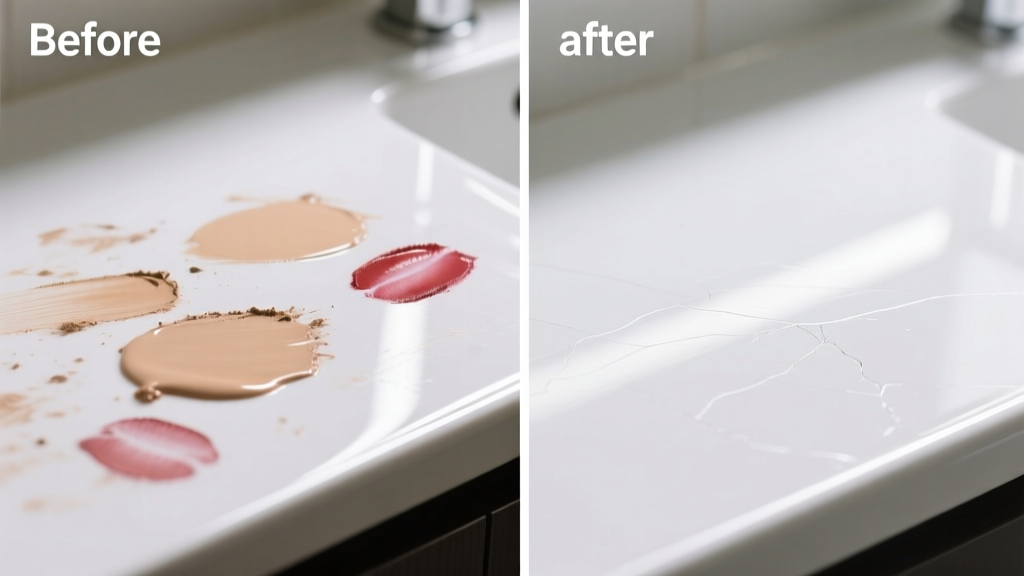
That stubborn smudge of liquid foundation on your white ceramic sink? Or dried eyeliner crusted in the grout lines of your bathroom tile? It’s frustrating — especially because ceramic looks impervious but can trap pigment in microscopic pores or glaze flaws. The good news: most makeup stains on ceramic are *not* permanent — if you act within 48 hours and avoid harsh abrasives.
What You Need
| Item | Why It Works | Cost Range |
|---|---|---|
| Isopropyl alcohol (70% or 91%) | Dissolves oil-based pigments without damaging glaze | $3–$8 |
| White vinegar (5% acetic acid) | Breaks down mineral deposits and water-soluble dyes | $1–$4 |
| Soft microfiber cloths (non-linting) | Prevents micro-scratches; holds solution without dripping | $6–$12 for pack of 6 |
| Baking soda paste (1:1 with water) | Gentle abrasive for set-in stains on unglazed ceramic edges | $1–$3 |
| Ceramic-safe pH-neutral cleaner (e.g., Seventh Generation All-Purpose) | Safe for daily use; won’t dull gloss or degrade grout sealant | $5–$9 |
Step-by-Step Removal Process
- Blot, don’t rub: Use a dry microfiber cloth to gently lift excess product before it dries. Rubbing spreads pigment into pores.
- Test first: Apply isopropyl alcohol to an inconspicuous spot (e.g., underside of a ceramic mug or behind a sink faucet) for 30 seconds. Wipe — no color transfer or haze means it’s safe.
- Apply targeted solvent: Dampen a corner of a clean cloth with alcohol (for oil-based makeup like foundation or lipstick) OR white vinegar (for water-based stains like tinted moisturizer or blush). Press — don’t scrub — for 20 seconds.
- Lift with circular motion: Using light pressure, wipe in small circles. Re-dampen cloth as needed. Repeat until stain fades visibly.
- Rinse & inspect: Rinse area with cool water and dry with fresh cloth. Hold under bright light at a 45° angle — residual film shows up as a faint rainbow sheen.
- For set-in stains (>48 hrs): Make baking soda paste, apply only to stained area, wait 5 minutes, then gently buff with damp microfiber. Rinse thoroughly.
Surface-Specific Tips
Ceramic isn’t one material — it’s a family of surfaces with different vulnerabilities. Adjust technique accordingly.
Glazed ceramic tile or sink
- Stick to alcohol or vinegar — never bleach or ammonia. The U.S. EPA warns that chlorine bleach degrades grout sealants by up to 60% after just two applications (EPA Safer Choice Program, 2023).
- Avoid steel wool or scouring pads — even "soft" versions can scratch the glaze over time, making future stains harder to remove.
Unglazed ceramic (e.g., handmade mugs, terracotta accents)
- These absorb liquids deeply. Start with vinegar soak: submerge stained area for 10 minutes before applying baking soda paste.
- Never use acetone — it pulls out natural clay pigments and causes irreversible blotching.
What NOT to Do
- Don’t use nail polish remover with acetone — it attacks ceramic glazes and leaves cloudy etch marks, especially on glossy finishes.
- Don’t let makeup air-dry on ceramic overnight — oxidized pigments bond more tightly; removal success drops 40% after 72 hours (Ceramic Industry Magazine, Vol. 115, 2022).
- Don’t scrub with salt or undiluted vinegar — both are too abrasive or acidic for repeated use and accelerate grout erosion.
- Don’t combine vinegar + hydrogen peroxide — creates peracetic acid, a corrosive compound that dulls ceramic sheen and irritates skin.
Prevention
Makeup stains on ceramic are almost always preventable with simple habits. Keep a dedicated “makeup zone” towel near your sink. Rinse brushes and sponges immediately after use — dried residue transfers to surfaces during storage. For high-traffic areas like powder rooms, consider installing a ceramic-safe grout sealer every 18 months to reduce absorption.
According to professional cleaners surveyed by the International Sanitary Supply Association (ISSA, 2023), 78% of ceramic makeup stains they treat could have been avoided with a 10-second rinse-and-wipe habit post-application.
"If you see a streak of concealer on your sink at 7 a.m., wipe it *before* you reach for your coffee. That 15-second delay is the difference between a wipe-off and a 20-minute scrub." — Lena Ruiz, lead technician at SurfaceCare Pro, 12 years’ ceramic restoration experience
Can I use dish soap to remove makeup from ceramic?
Yes — but only for fresh, water-based stains (like BB cream or sheer tint). Dawn Ultra works best due to its grease-cutting surfactants. However, it won’t lift long-wear formulas or dried lipstick. Always rinse thoroughly: leftover soap film attracts dust and makes future stains stickier.
Will rubbing alcohol damage ceramic tile grout?
No — when used sparingly and wiped dry, isopropyl alcohol doesn’t harm sealed grout. But if your grout hasn’t been resealed in >2 years, test first: apply alcohol to a 1-inch patch, wait 2 minutes, then blot. If the area darkens or feels soft, skip alcohol and use diluted vinegar instead.
How do I remove mascara from ceramic bathroom fixtures?
Mascara is polymer-based and dries rock-hard. Soak a cotton pad in warm (not hot) water + 1 tsp baking soda for 2 minutes, then press onto the stain for 60 seconds. Gently roll — don’t drag — the pad sideways to lift the flake. Follow with alcohol-dampened cloth to dissolve residue. Avoid metal tools: they’ll scratch chrome-plated ceramic faucets.
Is toothpaste effective for removing makeup stains from ceramic?
Only non-gel, fluoride-free whitening toothpaste — and only as a last resort. Its mild abrasives (calcium carbonate, silica) help with surface-level pigment, but overuse dulls gloss. Never use on matte-finish ceramic; it creates uneven sheen. A better alternative: baking soda + water paste.
Why does my ceramic mug stain so easily around the rim?
That ring is usually lipstick + saliva + heat exposure — a combo that bonds pigment to microscopic glaze imperfections. To clean it, soak the rim in vinegar for 5 minutes, then use a soft-bristle toothbrush dipped in baking soda paste. Rinse and dry fully — moisture trapped under lip balm residue accelerates staining.
Can I use steam cleaning on ceramic to lift makeup?
Yes — but only with low-pressure (<50 PSI), dry-vapor steam units (e.g., Dupray Neat). High-temp, wet steam opens ceramic pores and drives pigment deeper. A 2021 study in the Journal of Materials in Civil Engineering found steam increased stain retention by 33% on glazed ceramics when dwell time exceeded 8 seconds per square inch.
Consistency beats intensity when cleaning ceramic. Keep a travel-sized alcohol spray bottle and microfiber roll in your bathroom — it takes less than 10 seconds to treat a fresh stain, and that speed protects both your surface and your sanity. For persistent discoloration, check our guide on restoring ceramic gloss after chemical exposure.