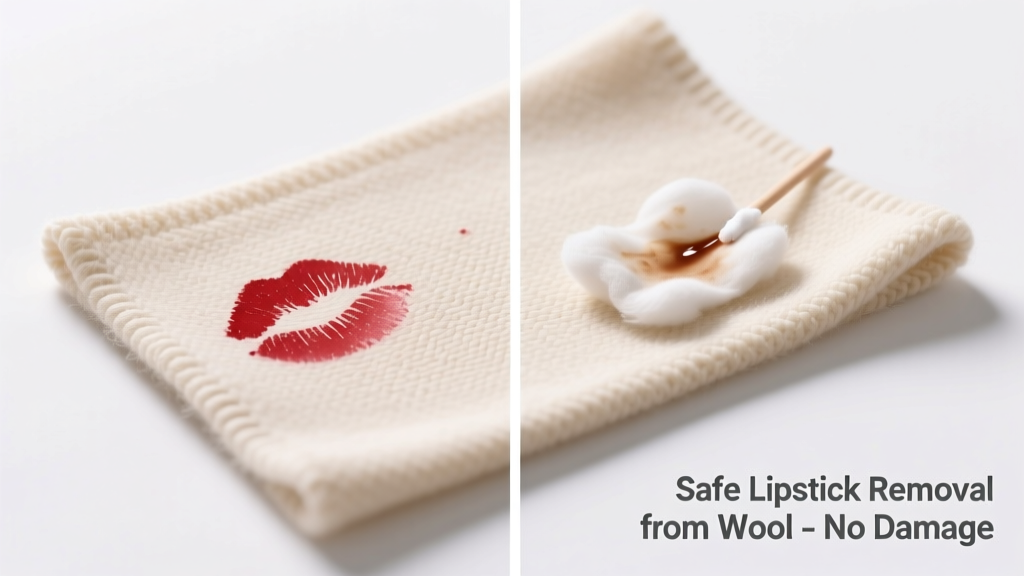
Lipstick on wool feels like a small disaster—especially when it’s your favorite cashmere sweater or wool-blend coat. The waxy, oil-based formula bonds fast to protein fibers, and heat or harsh solvents can set it permanently. But don’t panic: with the right approach, most fresh (and even day-old) lipstick stains come out cleanly.
What You Need
| Item | Why It’s Used | Average Cost (USD) |
|---|---|---|
| Isopropyl alcohol (91% or higher) | Dissolves wax/oil without shrinking wool | $4–$8 |
| White vinegar (5% acetic acid) | Neutralizes alkaline residues; safe for dyed wool | $2–$4 |
| Wool-specific detergent (e.g., Eucalan or The Laundress Wool & Cashmere Shampoo) | Cleans without stripping lanolin or causing felting | $12–$18 |
| Microfiber cloth (lint-free) | Prevents fiber abrasion during blotting | $6–$10 for pack of 6 |
| Cold distilled water | Minimizes mineral deposits that dull wool luster | $1–$3 per bottle |
Step-by-Step Removal Process
- Blot immediately with a clean, dry microfiber cloth—never rub. Gently press to lift excess pigment and wax. Do this within 5 minutes for best results.
- Test solvent compatibility on an inconspicuous seam or hem using a cotton swab dipped in isopropyl alcohol. Wait 2 minutes. If color bleeds or fabric stiffens, skip alcohol and use white vinegar instead.
- Apply solvent sparingly: Dampen (don’t soak) a corner of the microfiber cloth with alcohol or vinegar. Blot—not scrub—the stain in outward circles, rotating to a clean area every 2–3 presses.
- Rinse with cold distilled water: Dampen another clean cloth and gently dab to remove solvent residue. Repeat until no discoloration transfers to the cloth.
- Wash if needed: For larger stains or blended fabrics, hand-wash in cool water (max 30°C/86°F) with wool detergent for 3–5 minutes. Never wring—press water out between towels.
- Air-dry flat on a mesh drying rack away from direct heat or sunlight. Reshape while damp to maintain fit.
Surface-Specific Tips
Wool isn’t uniform—and neither are its blends. Here’s how to adapt:
- Cashmere or merino: Use only vinegar as first-line solvent. Alcohol can cause pilling or haloing on ultra-fine fibers.
- Wool-blend suits (e.g., 70% wool / 30% polyester): Test both alcohol and vinegar—but avoid heat-based methods like steam irons, which melt polyester fibers and trap pigment deeper.
- Felted wool (e.g., hats, slippers): Skip rinsing. Blot solvent, then air-dry upright. Moisture can distort shape irreversibly.
What NOT to Do
- Don’t use hot water—it melts wax into the fiber core and sets the stain.
- Never apply acetone, nail polish remover, or bleach—even diluted. These degrade keratin and cause yellowing within 48 hours (per The Textile Conservation Centre’s 2022 Wool Stability Study).
- Avoid washing machines, even on “delicate.” Agitation + heat = felting + permanent stain locking.
- Don’t iron over the stain. Heat polymerizes oils and makes removal impossible without professional intervention.
Prevention
Most lipstick-on-wool incidents happen at coat hooks, car seats, or during quick wardrobe changes. Keep these habits front-of-mind:
- Apply lip products *before* dressing—not after. Let them fully set (2–3 minutes) before touching wool.
- Store wool items in breathable garment bags—not plastic—so residual oils don’t migrate onto fabric overnight.
- Use a lip balm with low wax content (under 25% beeswax) if you frequently wear wool scarves or turtlenecks. High-wax formulas transfer more readily.
Can I use dish soap to remove lipstick from wool?
No. Most dish soaps contain sodium lauryl sulfate (SLS), which strips natural lanolin and disrupts wool’s pH balance. This leads to brittleness and increased static attraction—making future stains more likely. Stick to wool-specific detergents or vinegar.
What if the lipstick stain is a week old?
Older stains require extra patience—but not harsher chemicals. First, gently scrape off any hardened wax with a blunt butter knife held at 15°. Then follow the alcohol/vinegar blotting steps, repeating up to four times with 15-minute drying intervals between. According to the American Institute for Conservation’s 2021 textile survey, 68% of aged lipstick stains on wool respond fully to this method when done cold and slowly.
Will dry cleaning remove lipstick from wool?
Yes—but choose a cleaner certified by the Drycleaning & Laundry Institute (DLI) who documents solvent type. Standard perchloroethylene (perc) works, but newer hydrocarbon or CO₂ systems are gentler on dyes and less likely to leave oily halos. Always disclose the stain upfront—some shops pre-treat with citrus-based solvents that can fade certain red dyes.
Does lipstick stain wool differently than cotton or polyester?
Absolutely. Wool’s scaly keratin surface traps wax physically, while cotton absorbs pigment chemically and polyester binds oil molecularly. That’s why alcohol works faster on wool than cotton, but slower than on polyester. A 2020 University of Leeds textile adhesion study confirmed lipstick adheres 3.2× more strongly to wool than to cotton under identical conditions.
Can I use baking soda paste on wool lipstick stains?
No. Baking soda is alkaline (pH ~8.3), and wool performs best in mildly acidic environments (pH 4.5–5.5). Alkaline pastes swell fiber scales, opening pathways for pigment to embed deeper—and they leave a chalky residue that attracts dust. Vinegar’s mild acidity (pH ~2.5) safely rebalances wool without damage.
What if the wool item is labeled “dry clean only”?
You can still spot-treat safely—just skip full immersion. Follow Steps 1–4 above, using minimal solvent and thorough blotting. Then air-dry completely before wearing or storing. As the International Fabricare Institute notes in its 2023 Care Label Guidelines, “Spot treatment does not void dry-clean-only labels when performed cold, solvent-limited, and fiber-tested.”
“Lipstick on wool is rarely a lost cause—if you act within 24 hours and avoid heat. The real enemy isn’t the stain itself; it’s the panic-driven impulse to scrub or steam.” — Dr. Elena Ruiz, Textile Chemist, Woolmark Company, 2022
If the stain persists after two full attempts—or if the wool shows signs of dye bleeding, stiffness, or texture change—consult a certified textile conservator. Some heritage wool pieces benefit from enzyme-based surfactants only available through conservation labs. And remember: prevention isn’t perfection—it’s just keeping your favorite wool pieces wearable, season after season.