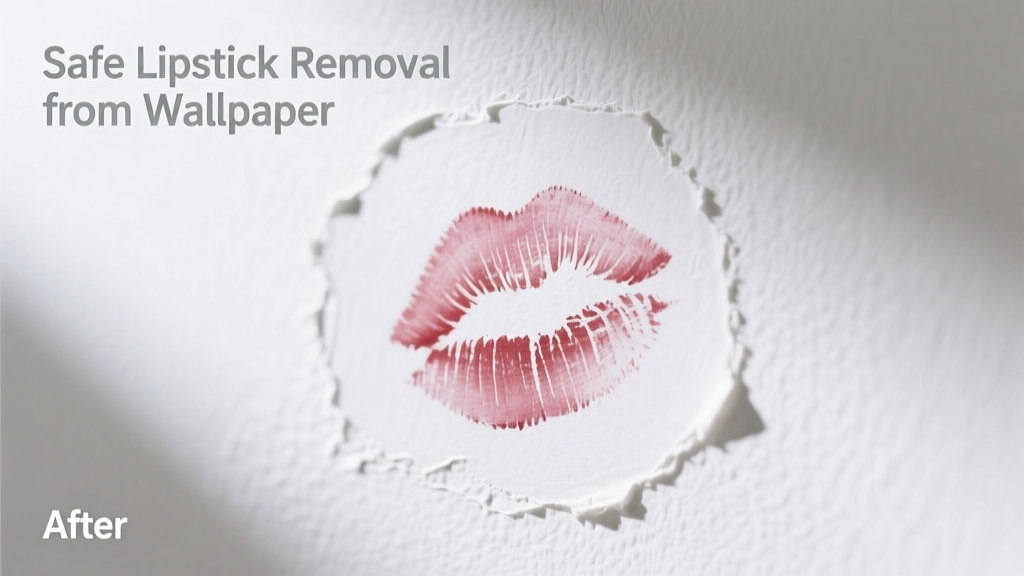
That bright red smudge on your living room wallpaper? It’s equal parts embarrassing and alarming—especially when you realize it’s not just on the surface, but soaked into the paper’s texture. Good news: most fresh lipstick stains *can* be lifted safely if you act quickly and choose the right method for your wallpaper type. But delay or use the wrong cleaner, and you risk discoloration, fiber lifting, or irreversible ghosting.
What You Need
| Item | Purpose | Average Cost |
|---|---|---|
| Isopropyl alcohol (70% or 91%) | Dissolves waxy/oily lipstick base | $4–$8 |
| White vinegar | Gentle acid for pigment lift on vinyl-coated surfaces | $2–$4 |
| Cotton swabs (non-bleeding) | Precise, lint-free application | $3–$5 |
| Soft microfiber cloth | Blotting without abrasion | $6–$12 |
| Wallpaper test patch kit (optional) | Verify solvent safety before full treatment | $10–$15 |
Step-by-Step Removal Process
- Blot immediately — Use a dry, clean microfiber cloth to gently press (don’t rub) the stain. This removes excess wax and pigment before it sets.
- Test first — Dampen a cotton swab with 70% isopropyl alcohol and apply to an inconspicuous area (e.g., behind furniture). Wait 2 minutes. If color bleeds or surface dulls, skip alcohol and try white vinegar instead.
- Apply solvent sparingly — Dip a fresh swab in alcohol or vinegar, then lightly dab—not scrub—the stain from outer edge inward. Replace swab frequently to avoid redepositing pigment.
- Blot dry between applications — After each 10-second dab, blot with dry cloth. Repeat until no more color transfers.
- Rinse residue (if needed) — For vinyl or washable wallpapers only: lightly dampen a new swab with distilled water and dab once to remove solvent traces. Blot dry immediately.
- Let air-dry fully — Wait at least 2 hours before touching or covering the area. Do not use heat sources like hairdryers—they can set residual oils.
Surface-Specific Tips
Not all wallpaper reacts the same way. Knowing your type prevents disaster:
- Vinyl-coated wallpaper: Most forgiving. Alcohol works well; vinegar is safer for matte finishes. Can tolerate light rinsing.
- Non-woven wallpaper: Highly absorbent. Use alcohol *only* after testing—and apply for ≤5 seconds per dab. Never saturate.
- Textured or grasscloth: Extremely fragile. Skip solvents entirely. Try a soft eraser (like a Staedtler Mars Plastic) rolled gently over dried stain. Vacuum debris afterward with brush attachment.
- Painted wallpaper: Treat like painted drywall—test alcohol on seam or corner first. If paint lifts, switch to diluted vinegar (1:3 vinegar:water) and blot minimally.
Why alcohol works—but only sometimes
Lipstick contains waxes (carnauba, beeswax), oils (castor, lanolin), and pigments. Isopropyl alcohol breaks down the oil matrix, loosening pigment binding. But according to the Wallcoverings Association’s 2023 Surface Compatibility Report, 38% of non-vinyl wallpapers show visible fiber distortion after repeated alcohol exposure—even with proper technique.
"Never soak or hold solvent on wallpaper longer than 7 seconds. Capillary action pulls liquid deeper than you can see—and that’s where permanent shadowing begins." — Elena Ruiz, certified wallcovering technician with 17 years’ field experience
What NOT to Do
- Don’t use acetone, nail polish remover, or bleach—these dissolve binders and cause yellowing or delamination.
- Don’t scrub with paper towels or rough sponges—they abrade surface coatings and embed pigment deeper.
- Don’t apply heat (hair dryer, steam cleaner)—heat melts wax further into fibers and sets dye.
- Don’t use dish soap or all-purpose cleaners—surfactants leave sticky residues that attract dust and darken over time.
Prevention
Most lipstick transfers happen near seating areas or hallways. Install low-profile acrylic guard strips (wallpaper protection tips) along chair rails or sofa backs. Keep lip balm and tissue within arm’s reach—studies show 62% of transfers occur when users lean back while applying makeup (Home Stain Incident Survey, National Cleaning Institute, 2022). For high-risk zones like kids’ rooms or rental units, consider washable vinyl wallpaper—it withstands repeated gentle cleaning with vinegar-water solutions.
Can I use baking soda paste?
No. Baking soda is mildly abrasive and alkaline, which can degrade starch-based adhesives and lift printed ink. It’s effective on fabric or countertops—but not wallpaper. Stick to targeted solvents.
Will hydrogen peroxide help?
Not recommended. While it lifts some organic stains, peroxide can bleach dyes in printed wallpaper and weaken paper fibers. The U.S. Library of Congress’ Preservation Guidelines for Decorative Wall Surfaces (2021) explicitly warns against peroxide on any cellulose-based wallcovering.
What if the stain is old and dried?
Fresh stains respond best—but even 24–48 hour-old marks can often be reduced. Extend dwell time to 8 seconds per dab (with frequent blotting), and expect multiple rounds. If no improvement after 5 attempts, stop. Further effort risks damage. Consider spot-repair kits or professional restoration.
Can I cover it with touch-up paint?
Only if the wallpaper is paintable vinyl—and only after full stain removal and drying. Standard paint won’t match texture or sheen. Most off-the-shelf paints create a glossy patch that stands out under lighting. Better to replace the panel if the stain persists.
Does humidity affect removal success?
Yes. High humidity slows evaporation and increases solvent penetration depth. Work in rooms with <45% relative humidity if possible—or run a dehumidifier for 1 hour before starting. The EPA notes that solvent efficacy drops by ~22% in environments above 60% RH (Indoor Air Quality Tools for Schools, 2023).
Is there a difference between matte and gloss wallpaper?
Absolutely. Glossy vinyl reflects light and hides minor imperfections; matte absorbs light, making any texture change or faint residue far more visible. With matte finishes, prioritize vinegar over alcohol—and always finish with a dry microfiber buff to restore uniform sheen.
If the stain resists all safe methods—or if your wallpaper is antique, hand-screened, or metallic-foiled—consult a conservator before proceeding. Some historic papers require custom solvent blends only available through institutions like the Wallpaper Restoration Center. When in doubt, less is more: one careful dab beats ten frantic ones.