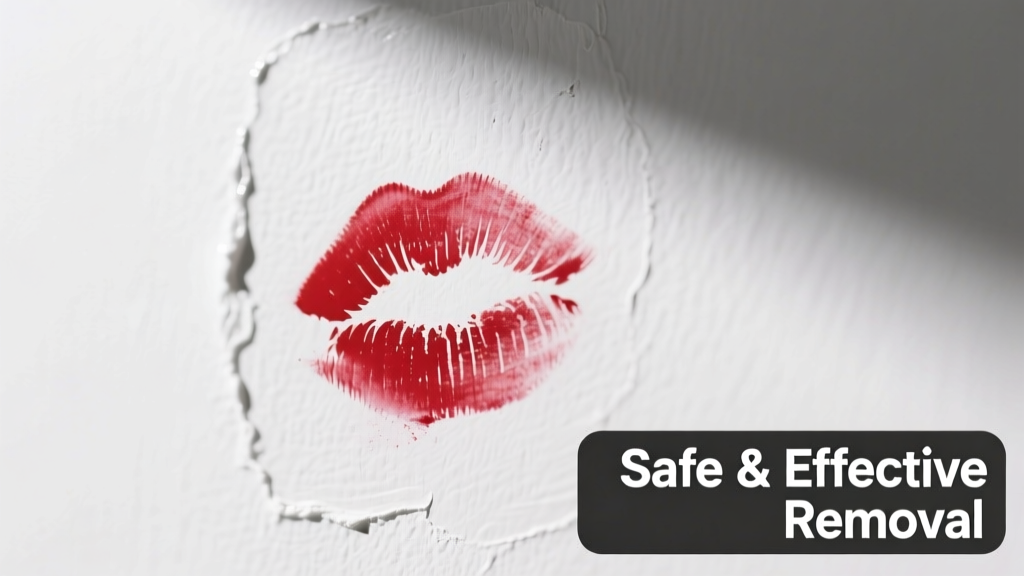
That bright red smear on your freshly painted wall—left by a toddler’s impromptu lip art or a guest’s careless kiss—feels like a tiny disaster. Good news: most lipstick stains on painted walls are surface-level and removable if addressed within 24–48 hours. Delay beyond that increases risk of pigment absorption into porous paint or primer.
What You Need
| Item | Purpose | Avg. Cost |
|---|---|---|
| Isopropyl alcohol (70% or 91%) | Dissolves waxy/oily lipstick base | $3–$6 |
| Microfiber cloth (lint-free) | Prevents scratching; absorbs residue | $5–$12 for pack of 4 |
| White vinegar | Mild acid for pigment lift on flat/matte finishes | $2–$4 |
| Soft-bristle toothbrush (new) | Gentle agitation without abrasion | $1–$3 |
| Touch-up paint + small brush | For minor scuffing or color loss | $8–$15 |
Step-by-Step Removal Process
- Blot first — never rub. Use a dry microfiber cloth to gently lift excess lipstick. Rubbing pushes pigment deeper into the paint film.
- Test in an inconspicuous area (e.g., behind a door frame) with isopropyl alcohol on a cotton swab. Wait 30 seconds—check for color lift or sheen change.
- Apply alcohol sparingly to a folded corner of the microfiber cloth—not directly to the wall. Press and hold for 5 seconds, then lift straight up. Repeat until no color transfers.
- If residue remains, mix 1 part white vinegar + 1 part water. Dampen (not soak) a fresh cloth and repeat the press-and-lift motion.
- Rinse with distilled water on a clean cloth to remove acid/alcohol residue, then air-dry. Avoid tap water—it can leave mineral deposits on matte finishes.
Surface-Specific Tips
Lipstick behaves differently depending on your wall’s finish—and its age. Here’s how to adapt:
- Flat or matte paint (most common in bedrooms/living rooms): Use only 70% isopropyl alcohol or diluted vinegar. Higher concentrations (91%) may dull the finish permanently.
- Eggshell or satin paint: Tolerates 91% alcohol better—but still test first. A soft toothbrush dipped in alcohol can loosen stubborn edges without scrubbing.
- Semi-gloss or gloss paint (kitchens/bathrooms): Wipe with alcohol-dampened cloth using light circular motions. These finishes resist penetration, so stains lift faster—but avoid abrasive pads.
- Textured walls (orange peel, knockdown): Use a cotton swab dipped in alcohol to target crevices. Follow with a dry microfiber brush to lift loosened wax from valleys.
Can I use acetone or nail polish remover?
No. Acetone dissolves acrylic binders in latex paint and will etch or cloud the surface. According to the American Coatings Association’s 2022 Surface Safety Guidelines, acetone should never contact interior wall paint—even in trace amounts.
What if the stain is days old?
Older stains require more patience—and sometimes professional help. Pigment migrates past the top layer into micro-cracks or primer. Try a 50/50 mix of hydrogen peroxide (3%) and baking soda paste, applied with a cotton swab for 90 seconds before blotting. If color remains after two attempts, consult a painter before sanding or repainting.
Will this work on wallpaper?
No—this guide applies only to painted drywall or plaster. For vinyl or non-porous wallpaper, use a dab of rubbing alcohol on a cotton swab and wipe *with* the grain. For fabric-backed or delicate papers, see our guide on how to remove lipstick from wallpaper.
Does temperature affect removal?
Yes. Cold walls (below 60°F / 15°C) slow solvent evaporation and reduce effectiveness. Warm the room to 68–72°F before starting. The U.S. Department of Housing and Urban Development notes that chemical reactions on interior surfaces drop 40% in efficiency below 65°F (HUD Home Maintenance Manual, 2021).
How do I match touch-up paint perfectly?
Take a chip (use a utility knife to cut a 1/8" square near baseboard) to your local paint store. Most retailers scan and match with spectrophotometers—even for 10-year-old paint. Store leftover paint in a sealed jar with a drop of water on top to prevent skinning.
What NOT to Do
- Don’t use bleach—it oxidizes dyes and often turns red lipstick brown or purple, making it harder to cover.
- Don’t scrub with paper towels or napkins—they shed fibers and scratch sheen.
- Don’t apply heat (hair dryer, steam cleaner)—melts wax deeper into pores and sets the stain.
- Don’t ignore primer exposure—if you’ve worn through to bare drywall or primer, stop immediately and patch before repainting.
"Lipstick removal is 80% about timing and 20% technique. After 72 hours, pigment binds to acrylic polymers in latex paint—and mechanical lifting becomes your only option." — Elena Ruiz, Certified Restoration Technician, IICRC-certified since 2015
Prevention
Keep lipstick away from walls with simple habits: place a small dish or tray near entryways for guests to set cosmetics; install low-profile hooks at child-height for lip balm storage; and use washable, scrubbable paints (like Benjamin Moore Aura Bath & Spa or Sherwin-Williams Emerald) in high-contact zones like hallways and kids’ rooms.
Accidents happen—but now you know exactly how to fix them without repainting the whole wall. For related fixes, see our guides on removing crayon marks and lifting permanent marker. Keep your microfiber cloths handy, and treat stains fast—the clock starts ticking the moment pigment hits paint.