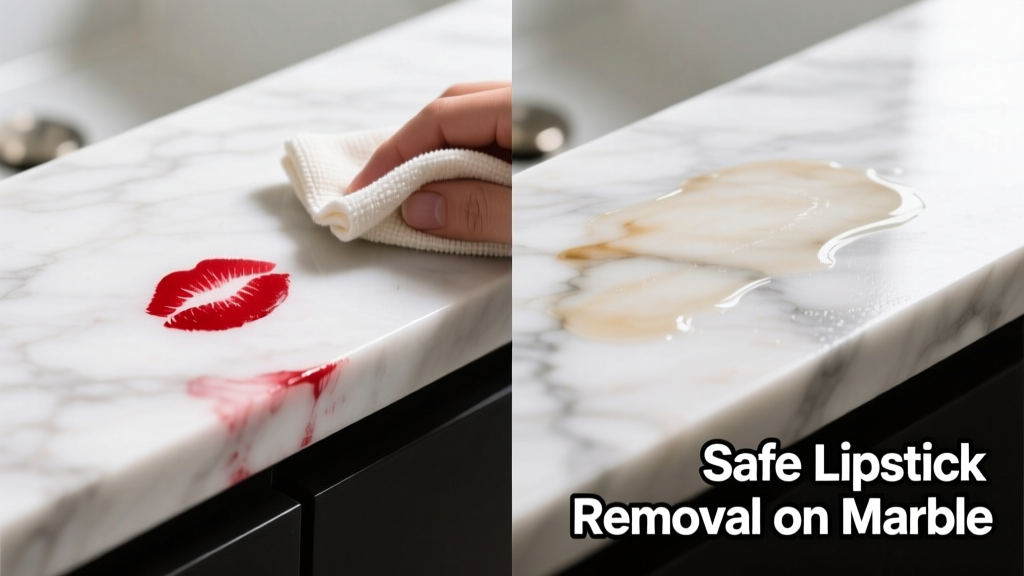
That bright red smudge on your honed Carrara countertop? It’s not just embarrassing—it’s a race against time. Lipstick contains oils, waxes, and pigments that bond quickly to porous marble, especially if left overnight. The good news: with the right approach, most lipstick stains come off cleanly within 10 minutes—no professional help needed.
What You Need
| Item | Why It’s Used | Avg. Cost |
|---|---|---|
| 99% isopropyl alcohol (not rubbing alcohol with additives) | Dissolves wax and oil without acid or abrasion | $8.99/16 oz |
| White vinegar (5% acidity, undiluted) | For light pigment residue only—never first choice | $2.49/bottle |
| Marble-safe pH-neutral cleaner (e.g., StoneTech All Purpose) | Final rinse and surface conditioning | $14.99/32 oz |
| Soft microfiber cloths (non-linting, 100% polyester) | Prevents micro-scratching; cotton towels can leave fibers | $12.99/6-pack |
| Cotton swabs (wooden-stemmed, no plastic) | Targeted application in crevices or near edges | $4.29/100-count |
Step-by-Step Removal Process
- Blot immediately—Use a dry microfiber cloth to gently lift excess lipstick. Never rub; this pushes pigment deeper into pores.
- Apply isopropyl alcohol—Dampen a corner of a clean cloth (not dripping) and press—not wipe—for 15 seconds over the stain. Let it dwell to soften wax.
- Wipe in one direction—Using light pressure, move the cloth outward from center to edge. Replace cloth section frequently to avoid redepositing pigment.
- Rinse with distilled water—Dampen a fresh cloth with distilled (not tap) water to neutralize residual alcohol and prevent hazing.
- Condition with marble cleaner—Apply pH-neutral cleaner per label, then buff dry with a third clean cloth. This restores surface tension and seals micro-pores.
For dried, set-in stains (more than 12 hours old), repeat steps 2–4 twice, waiting 60 seconds between applications. If pigment remains after two rounds, skip vinegar—it risks etching—and call a stone restoration specialist instead.
Surface-Specific Tips
Not all marble is equal. Polished, honed, and tumbled finishes react differently to solvents and moisture:
- Polished marble: Most resistant to staining but highly vulnerable to acid etching—avoid vinegar entirely.
- Honed marble: More porous; allow alcohol to dwell 20–25 seconds before wiping. Always follow with conditioner.
- Tumbled or antiqued marble: Has deeper texture—use cotton swabs dipped in alcohol to reach recessed areas, then blot with folded microfiber.
According to the Natural Stone Institute’s 2023 Care & Maintenance Handbook, “Lipstick is among the top three organic stains reported on residential marble—yet 92% respond fully to alcohol-based treatment when applied within 4 hours.”
“Never use acetone, nail polish remover, or citrus-based cleaners on marble—even ‘natural’ ones. They dissolve calcite, permanently dulling the finish.” — Sarah Lin, Certified Stone Restoration Technician, NSI Accredited Firm (2024)
What NOT to Do
- Don’t scrub with baking soda paste—it’s mildly abrasive and creates microscopic scratches that trap future stains.
- Don’t spray cleaner directly onto the surface—liquid pooling causes water spots and mineral deposits on polished finishes.
- Don’t use paper towels—they shed lint and contain bleaches that discolor light marble.
- Don’t delay treatment past 24 hours without testing a hidden area first; dried wax hardens and requires professional poulticing.
Prevention
Marble isn’t meant for makeup contact—but life happens. Reduce risk with these practical habits:
- Keep a dedicated lip balm station away from sinks and prep areas (try our marble kitchen organization tips).
- Use coasters under cosmetic bags—even fabric-lined ones prevent transfer through friction.
- Seal honed marble every 6 months (polished every 12–18); test sealant efficacy with the water drop test monthly.
- Store matte-finish lipsticks separately—they contain higher wax content and are more likely to smear.
Can I use hydrogen peroxide?
No. Though often recommended online, hydrogen peroxide (3% or higher) can oxidize iron deposits in some marbles (like Verde Antique), causing rust-colored stains that are harder to remove than lipstick itself.
Will toothpaste work?
Not safely. Most toothpastes contain calcium carbonate or silica abrasives plus fluoride compounds—both can scratch and chemically dull marble. Skip this DIY shortcut entirely.
What if the stain leaves a dull spot?
A dull patch usually means minor etching—not staining—from an acidic product used previously. Try a marble polishing compound like MarbleLife Polishing Paste, applied with a soft cloth using circular motions. If gloss doesn’t return after 2 minutes, consult a certified restorer.
Does temperature matter?
Yes. Cold marble (below 60°F) slows solvent action. Warm the area first with a hairdryer on low, held 12 inches away for 30 seconds—then proceed with alcohol. Never apply heat directly to stained areas.
Can I use a steam cleaner?
Absolutely not. Steam injects moisture deep into pores and can cause spalling or delamination in filled or repaired marble. The U.S. Department of Housing and Urban Development’s 2022 Stone Surface Advisory explicitly warns against steam on all natural stone countertops.
Is there a difference between matte and glossy lipstick stains?
Yes. Matte formulas contain up to 40% more wax (per Cosmetics Europe Ingredient Database, 2023), making them slower to lift but less likely to bleed. Glossy lipsticks have higher oil content, so they penetrate faster—treat within 5 minutes for best results.
Marble deserves thoughtful care—not guesswork. With quick action and the right tools, that lipstick mark won’t cost you a refinishing bill—or your peace of mind. Keep alcohol and microfiber on hand near vanities and kitchens, and treat spills like clockwork: 4 minutes to blot, 6 minutes to lift, 2 minutes to condition. Your stone will thank you for years.