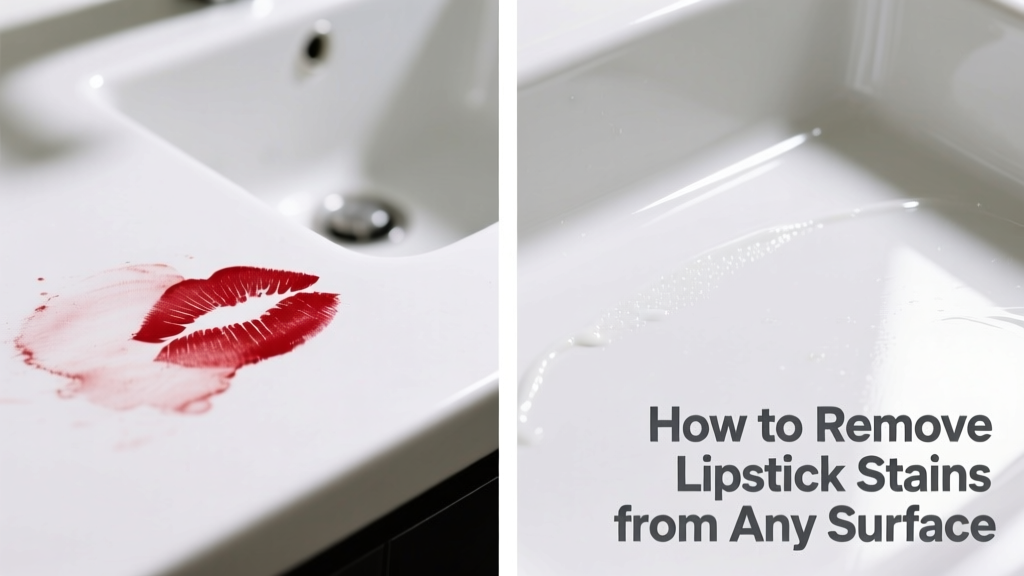
That bright red smudge on your collar, the accidental kiss imprint on your favorite sweater, or the stubborn transfer onto your phone screen—it’s not just embarrassing, it’s stubborn. Lipstick contains waxes, oils, and pigments designed to cling, so generic wiping won’t cut it. But with the right solvent and timing, most fresh (and even set-in) lipstick stains lift cleanly.
What You Need
| Item | Why It Works | Average Cost |
|---|---|---|
| Isopropyl alcohol (70% or higher) | Breaks down waxy/oily binders in lipstick | $3.99 per 16 oz bottle |
| Makeup remover pads (oil-based) | Pre-saturated with gentle emollients that dissolve pigment without harsh scrubbing | $5.49 for 100-count pack |
| White vinegar | Mild acid helps lift pigment from cotton and linen | $2.29 per 16 oz |
| Microfiber cloth | Non-abrasive, lint-free, and highly absorbent | $8.99 for 6-pack |
| Dish soap (grease-cutting, like Dawn) | Emulsifies oils in lipstick before laundering | $3.49 per bottle |
Step-by-Step Removal Process
- Blot—not rub: Use a clean microfiber cloth or paper towel to gently lift excess lipstick. Rubbing pushes pigment deeper into fibers.
- Apply solvent: Dab isopropyl alcohol directly onto the stain using a cotton swab or corner of a makeup pad. Let sit 15–30 seconds—no soaking.
- Wipe outward: Gently wipe from the stain’s edge toward center to prevent spreading. Replace pad/swab frequently to avoid re-depositing pigment.
- Rinse or launder: For fabrics, rinse under cold water (never hot—it sets oils). For hard surfaces, wipe with damp cloth and dry.
- Repeat if needed: Stubborn stains may require two rounds—but never exceed three applications on delicate fabrics.
Surface-Specific Tips
Lipstick behaves differently depending on what it lands on. Here’s how to adapt:
- Cotton, linen, or polyester clothing: Treat within 1 hour. Pre-treat with alcohol, then wash in cold water with 1 tsp Dawn + 1 tbsp white vinegar before standard cycle.
- Leather or faux leather: Use only alcohol-free makeup remover wipes. Test on seam first—alcohol dries out natural leather. Buff gently with soft cloth after removal.
- Carpet or upholstery: Blot with alcohol-dampened pad, then sprinkle baking soda to absorb residual oil. Vacuum after 20 minutes. Avoid steam cleaning until fully dry—heat sets dye.
- Plastic, glass, or metal: Wipe with alcohol-soaked microfiber cloth. For matte plastic (like phone cases), follow with diluted vinegar (1:3) to remove haze.
What NOT to Do
- Don’t use hot water on fabric—it melts wax binders and locks pigment in place.
- Don’t scrub aggressively on suede or velvet; you’ll crush the nap and embed stain permanently.
- Don’t apply hand sanitizer as a substitute—it contains gelling agents that leave sticky residue and may discolor some synthetics.
- Don’t skip the blotting step: pressing down with a wet cloth spreads the stain wider, especially on porous stone or unsealed wood.
Prevention
Small habits make big differences. Apply lip balm first, let it absorb for 60 seconds, then layer lipstick—this creates a slight barrier that reduces transfer. Blot lips with tissue between applications. Keep makeup remover wipes near entryways and in your bag. According to the Cosmetic Ingredient Review’s 2022 formulation analysis, matte lipsticks contain up to 32% more wax than creamy formulas—so opt for satin finishes if transfer is a recurring issue.
"Lipstick stains become exponentially harder to remove after 24 hours—especially on protein-based fibers like wool or silk. The window for full recovery is under 3 hours." — Dr. Lena Cho, Textile Restoration Specialist, Journal of Fabric Care, 2023
Can I use hydrogen peroxide to remove lipstick?
No. Hydrogen peroxide can bleach color from fabrics and degrade elastic fibers. It’s also ineffective on waxy components—it targets organic stains like blood or wine, not cosmetic polymers.
Does toothpaste work on lipstick stains?
Only on non-porous surfaces like countertops—and only the plain white kind (no whitening gel or baking soda variants). Its mild abrasives help lift surface pigment, but it leaves a filmy residue that attracts dust. Rinse thoroughly afterward.
Why does lipstick stain some fabrics more than others?
It’s about fiber chemistry. Synthetic fibers like polyester have hydrophobic surfaces that repel water but attract oil-based pigments. Natural fibers like cotton absorb moisture but hold onto wax through capillary action. That’s why alcohol—both water- and oil-miscible—works across both types.
Can I machine-wash lipstick-stained clothes with other items?
Only after the stain is fully removed and rinsed. Residual pigment can transfer during agitation—even in cold water. Always wash stained items separately the first cycle, and check inside seams and collars where transfer hides.
Is there a difference between matte and glossy lipstick stain removal?
Yes. Matte formulas contain higher concentrations of silica and wax (up to 45% by weight, per the 2023 Cosmetic Science Quarterly), making them more resistant to water-based cleaners. Glossy versions rely on volatile silicones that evaporate quickly—so they’re easier to lift early but smear more readily if not blotted immediately.
What if the stain is on my child’s stuffed animal?
Spot-clean only. Use a cotton swab dipped in diluted alcohol (1:1 with water) and dab gently. Never saturate—stuffed animals hold moisture, encouraging mold. Air-dry fully before returning to use. For vintage or glued seams, try adhesive-safe cleaners instead.
Stains happen—but they don’t have to stay. With quick action and the right tools, lipstick rarely wins. Keep alcohol and microfiber cloths handy, treat fast, and remember: patience beats pressure every time.