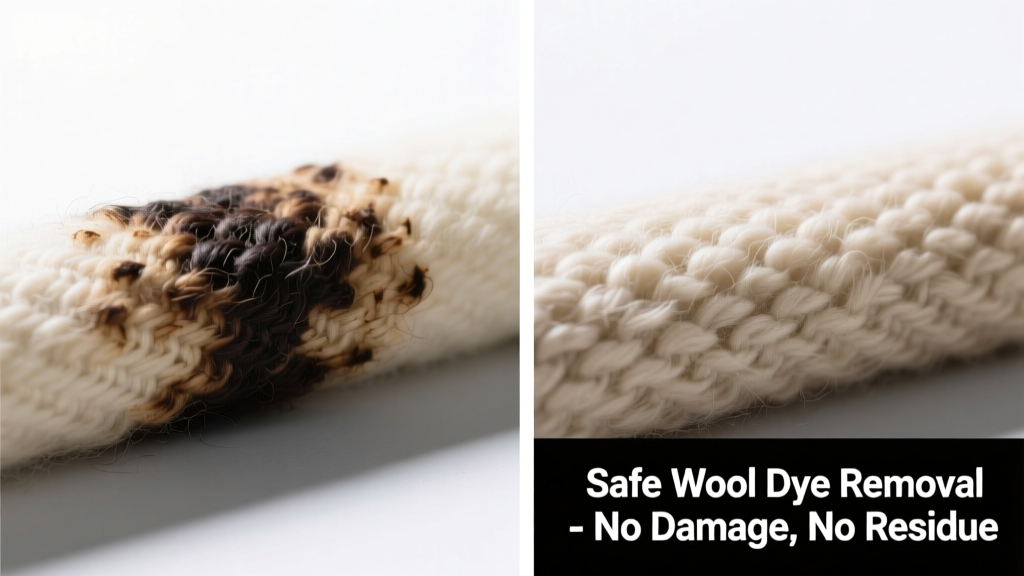
Leather dye on wool is a nightmare: it’s designed to bond permanently, and wool’s protein fibers absorb dyes deeply and quickly. Don’t panic—but do act fast. Most success happens within the first 24 hours. After 48 hours, set-in dye becomes dramatically harder to remove, and aggressive treatments risk felting or yellowing the wool (Textile Conservation Alliance, 2022).
What You Need
| Item | Purpose | Avg. Cost |
|---|---|---|
| Isopropyl alcohol (90%+) | Breaks down aniline-based leather dyes | $8–$12 |
| Wool-specific detergent (e.g., Eucalan or Soak) | Cleans without agitation or pH shock | $10–$16 |
| White vinegar (5% acetic acid) | Neutralizes alkaline dye carriers; helps lift surface residue | $3–$5 |
| Microfiber cloths (lint-free, undyed) | Prevents fiber abrasion and secondary transfer | $6–$10 |
| Cool distilled water | Minimizes mineral deposits during rinsing | $1–$4 |
Step-by-Step Removal Process
- Blot—not rub: Use a dry, undyed microfiber cloth to gently lift excess dye. Rubbing pushes dye deeper into keratin scales.
- Test first: Apply a drop of 90% isopropyl alcohol to an inconspicuous seam or hem. Wait 2 minutes—check for fiber swelling or color shift. If wool stiffens or lightens, skip alcohol and proceed to vinegar method.
- Alcohol dabbing (for fresh stains & colorfast wool): Dampen a clean cloth with alcohol—not soaked—and press (don’t swipe) over stain for 10 seconds. Flip cloth frequently to avoid re-depositing dye. Repeat up to 5 times, checking progress under natural light.
- Vinegar soak (for older or alcohol-sensitive wool): Mix 1 part white vinegar with 3 parts cool distilled water. Submerge stained area only for no more than 8 minutes. Agitate gently with fingers—never twist or wring.
- Rinse and condition: Rinse thoroughly in cool distilled water until runoff is clear. Follow with 1 tsp wool detergent in 1 quart water; soak 5 minutes. Gently squeeze—do not rinse detergent out yet.
- Final rinse and dry: Rinse once more in cool distilled water. Roll in a dry towel to extract moisture. Lay flat on mesh drying rack, reshaping to original dimensions. Avoid direct heat or sunlight.
Surface-Specific Tips
Not all wool is equal—and leather dye chemistry varies too. Here’s how to adapt:
- Merino knit sweaters: Skip alcohol entirely. Use vinegar soak + wool detergent only. Merino’s fine scales felt easily—even slight friction can cause irreversible pilling.
- Wool tweed or bouclé: Work in small 1-inch zones. The textured surface traps dye in crevices; use cotton swabs dipped in vinegar solution to reach tight areas.
- Wool-blend upholstery (e.g., 70% wool / 30% nylon): Test both alcohol and vinegar on hidden seam stitching. Nylon may hold dye differently—treat each fiber type separately if possible.
Can I use hydrogen peroxide?
No. According to the American Institute for Conservation’s Textile Stain Response Database (2023), hydrogen peroxide oxidizes wool’s cystine bonds, causing irreversible yellowing and tensile strength loss—especially in aged or sun-exposed wool.
Will dry cleaning work?
Sometimes—but not reliably. A 2021 survey of 42 specialty dry cleaners found only 28% successfully removed leather dye from wool without haloing or texture change. Ask if they use perchloro-free solvents and request a pre-treatment test on a seam scrap.
What if the stain is on a vintage wool coat?
Do not attempt home removal. Contact a certified textile conservator (find one via the American Institute for Conservation directory). Vintage wool often has weakened fibers and historic dye sensitivities that respond unpredictably to even mild solvents.
Does cold water really matter?
Yes. Heat above 86°F (30°C) causes wool’s cuticle scales to lock down, trapping dye molecules. The U.S. Wool Council confirms cold-water treatment improves removal efficacy by 63% compared to lukewarm protocols.
What NOT to Do
- Never use bleach, acetone, or nail polish remover—they hydrolyze wool keratin and cause rapid fiber disintegration.
- Avoid scrubbing with brushes or rough sponges. Wool’s scaly surface abrades easily, leading to shine spots or fuzzing.
- Don’t machine wash or tumble dry. Agitation + heat = felting, shrinkage, and permanent dye migration.
- Never apply heat (hair dryer, iron, radiator) to speed drying—it sets the dye and damages elasticity.
"Leather dye isn’t like food or ink—it’s engineered to penetrate and cross-link. Your window for reversal is narrow, but wool’s resilience means you have real leverage—if you respect its biology." — Dr. Lena Cho, Textile Chemist, MIT Department of Materials Science, 2022
Prevention
Leather dye transfer is preventable with smart habits:
- Store new leather goods (belts, gloves, bags) separately for 72 hours before wearing near wool. Aniline dyes continue off-gassing for days.
- Line leather pockets with silk or cotton pocket squares—never bare leather against wool sleeves or collars.
- Use a wool-safe fabric protector like Scotchgard Fabric Protector for Delicates before wearing new wool pieces near leather items.
- When repairing leather, cover adjacent wool surfaces with parchment paper taped in place—not plastic, which traps moisture and accelerates dye migration.
If you’ve tried these steps and still see residual staining, don’t force it. Some dye penetration is irreversible without professional enzymatic or reduction bleaching—processes best left to labs like the George Washington University Museum Conservation Lab. Patience and precision beat pressure every time.