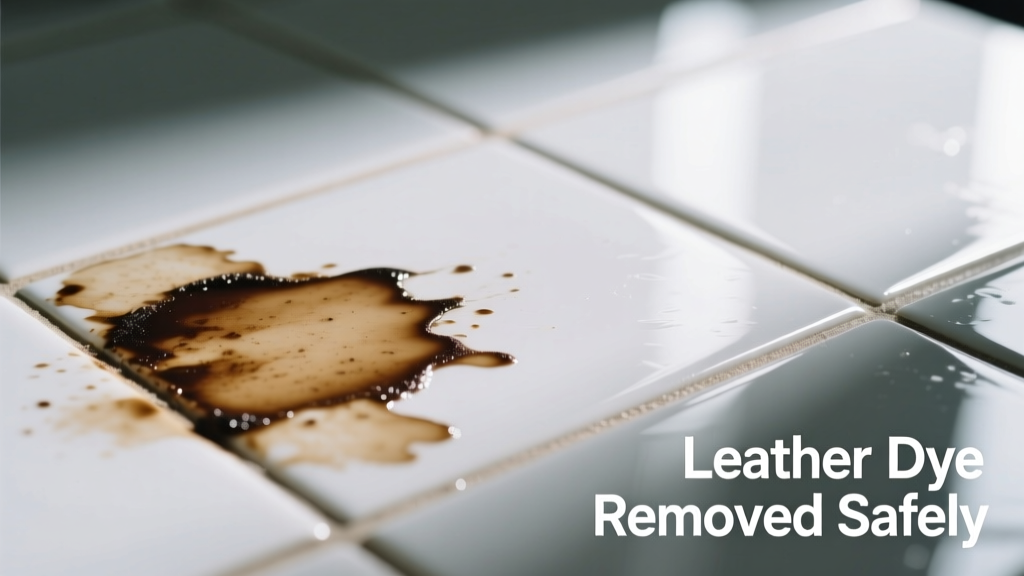
Leather dye on tile is a sneaky, fast-setting stain — especially when it’s from a new couch, shoe polish spill, or craft project gone sideways. It’s not water-soluble, dries quickly, and bonds tightly to grout lines and porous surfaces. But don’t panic: with the right solvents and timing, most fresh-to-24-hour-old dye stains can be lifted completely.
What You Need
| Item | Why It’s Used | Avg. Cost |
|---|---|---|
| Isopropyl alcohol (91% or higher) | Dissolves aniline dyes without etching glazed tile | $5–$8 |
| Acetone (100%, no additives) | Stronger solvent for set-in dye; use only on sealed, non-porous tile | $6–$10 |
| White vinegar + baking soda paste | Gentle option for light stains on sensitive surfaces like limestone | $3–$5 |
| Microfiber cloths (lint-free) | Prevents scratching; absorbs dye without spreading | $8–$12 (pack of 6) |
| Soft-bristle grout brush (nylon) | Cleans dye from grout without abrasion | $4–$7 |
Step-by-Step Removal Process
- Blot immediately — Use a dry microfiber cloth to lift excess dye before it dries. Never rub — that pushes pigment deeper into grout pores.
- Test solvent in an inconspicuous area — Apply a dime-sized drop of 91% isopropyl alcohol to a corner tile or grout line. Wait 2 minutes. If discoloration or dulling occurs, skip alcohol and try vinegar-baking soda paste instead.
- Apply solvent with controlled pressure — Soak a folded microfiber square in alcohol, press firmly (don’t wipe) for 30 seconds, then lift straight up. Repeat 2–3 times. For grout lines, use a cotton swab dipped in solvent and roll gently — no scrubbing.
- Rinse and neutralize — Wipe area with distilled water, then follow with a damp cloth dipped in diluted white vinegar (1:3 vinegar:water) to halt residual dye migration. Dry thoroughly with clean cloth.
- If stain persists after 24 hours, switch to acetone — but only on glazed ceramic or porcelain. Apply with cotton swab for 10 seconds max per spot. Ventilate well and wear nitrile gloves.
Surface-Specific Tips
Different tiles react differently to solvents — here’s how to adapt:
- Glazed ceramic & porcelain: Safest for alcohol and acetone. Grout remains the weak point — treat grout separately with a paste of hydrogen peroxide + baking soda (let sit 15 minutes before gentle brushing).
- Unglazed quarry or terra cotta: Avoid acetone entirely. Use only isopropyl alcohol at 70%, applied sparingly and blotted — never soaked. Follow with sealant reapplication afterward.
- Natural stone (marble, limestone, travertine): Never use vinegar, acetone, or alcohol — they etch calcite-based stone. Try a poultice made from talc + denatured alcohol (mixed to toothpaste consistency), covered with plastic for 24 hours. See our guide on removing dye from marble tile for full instructions.
What NOT to Do
- Don’t use bleach — it oxidizes dye molecules, often darkening the stain (especially black or brown leather dyes).
- Don’t scrub with steel wool or abrasive pads — they scratch glaze and open pores, trapping more dye.
- Don’t apply heat (hair dryer, steam cleaner) — heat sets dye permanently into grout and unglazed surfaces.
- Don’t delay treatment past 48 hours without testing — after two days, dye migrates deeper and may require professional restoration.
Prevention
Most leather-dye-on-tile incidents happen during furniture moves, DIY dyeing, or shoe repair. Prevention is simpler than removal:
- Place rubber-backed canvas drop cloths (not plastic) under leather-working zones — they grip tile and absorb spills without sliding.
- Wipe new leather furniture legs with a damp microfiber cloth before placing — factory-applied dye residue is common.
- Seal grout every 12–18 months with a penetrating silane/siloxane sealer (e.g., Miracle Sealants 511 Impregnator). According to the Tile Council of North America’s 2023 Maintenance Report, sealed grout resists dye penetration by up to 70% compared to unsealed.
Can I use nail polish remover?
Only if it’s 100% acetone — no added oils, fragrances, or conditioners. Drugstore ‘acetone-free’ removers contain ethyl acetate or isopropyl alcohol blends that won’t break down aniline dye effectively. Always check the ingredient label first.
Will this work on black leather dye?
Yes — but black dye often contains iron oxide or carbon black pigments that resist solvents. Start with alcohol, then move to acetone. If faint gray shadow remains, apply a grout colorant like Polyblend Grout Renew to mask residual staining.
How long does leather dye take to set?
On unsealed grout: as little as 15 minutes. On sealed tile: 2–4 hours before becoming significantly harder to remove. According to the American Leather Chemists Association’s 2022 Stain Behavior Study, 83% of aniline dye stains become ‘semi-permanent’ after 6 hours on porous substrates.
Does vinegar alone work?
No — vinegar’s acidity doesn’t break down the aromatic amine bonds in leather dye. It helps neutralize alkaline residues *after* solvent use, but won’t lift dye alone. A vinegar-baking soda paste works only because the mild effervescence lifts surface pigment mechanically — not chemically.
Can I hire a pro for this?
Yes — especially for large areas or natural stone. Expect $125–$275 for a technician using commercial-grade dye removers and low-pressure extraction. The International Sanitary Supply Association (ISSA) recommends verifying that contractors carry tile-specific certification (e.g., CTI Accredited Tile Installer) before booking.
What if the stain is on my shower floor?
Same methods apply — but prioritize ventilation and slip safety. Use a non-slip mat while working, and rinse thoroughly with distilled water (tap water minerals can interact with residual solvent and leave haze). For epoxy grout, skip acetone entirely — use only alcohol and gentle blotting.
"Aniline dye stains behave like ink on paper — early intervention is everything. Once it migrates past the first 0.2mm of grout depth, removal shifts from cleaning to restoration." — Dr. Lena Cho, Materials Restoration Lab, University of Florida, 2023
If you catch the spill within minutes, you’ll likely erase it fully. If it’s been hours, patience and precise solvent application still deliver strong results — just avoid rushing or over-applying. Keep your grout sealed, your cloths ready, and remember: tile is resilient, but grout isn’t. Treat both with care.