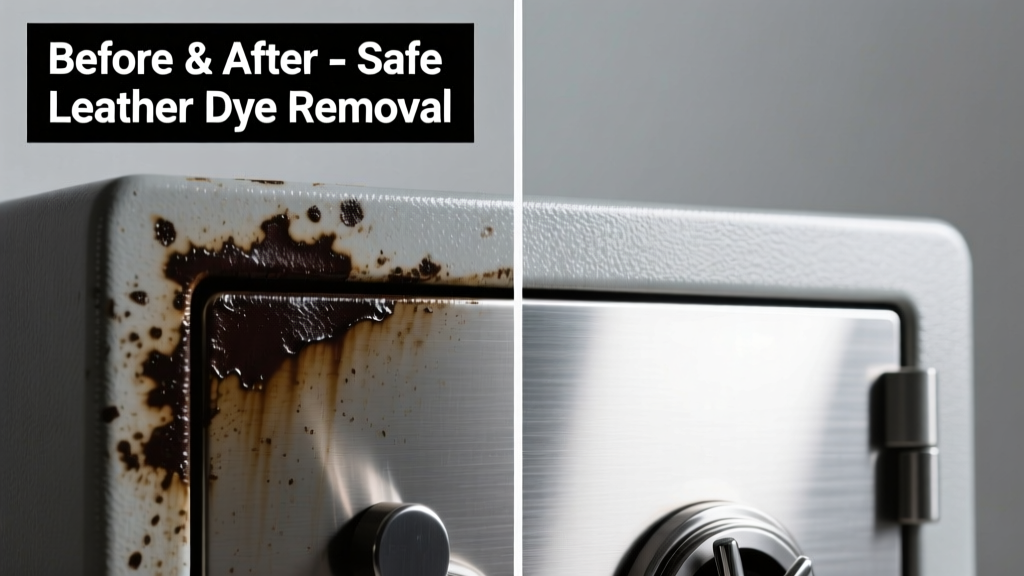
Leather dye on stainless steel is a sneaky, fast-setting stain—especially after contact with dyed belts, watch straps, or upholstery tools. It’s not rust or grease; it’s pigment bonded to the metal’s micro-texture. Don’t panic: with the right solvents and timing, most fresh-to-moderate stains lift cleanly in under 15 minutes.
What You Need
| Item | Purpose | Cost Range |
|---|---|---|
| Isopropyl alcohol (91% or higher) | Primary solvent for water- and alcohol-based dyes | $4–$8 per 16 oz |
| Acetone (100%, no additives) | For stubborn, solvent-based dyes (use sparingly) | $6–$12 per 16 oz |
| Microfiber cloths (lint-free, non-abrasive) | Prevent micro-scratches during wiping | $8–$15 for pack of 12 |
| Stainless steel polish (e.g., Weiman Stainless Steel Cleaner) | Restore luster and remove residual haze | $10–$14 per bottle |
| Cotton swabs (wooden or plastic, no glue) | Target tight seams or brushed-finish crevices | $3–$6 per 100-pack |
Step-by-Step Removal Process
- Blot—not rub—immediately if the stain is fresh (under 2 hours). Use a dry microfiber cloth to lift excess dye before it oxidizes.
- Apply isopropyl alcohol to a folded microfiber cloth—not directly to the surface—and gently press-and-hold over the stain for 20 seconds. Reapply as needed; avoid aggressive scrubbing.
- Wipe in the direction of the grain (visible on brushed finishes) using light, linear strokes. Check progress every 30 seconds—most stains lift within 2–4 minutes.
- If alcohol fails after 3 attempts, switch to acetone on a cotton swab. Test first on an inconspicuous area: apply for no more than 5 seconds, then wipe immediately with alcohol-dampened cloth to halt solvent action.
- Rinse with distilled water, then dry thoroughly with a clean microfiber cloth. Follow with stainless steel polish to reseal the passive layer and restore shine.
Surface-Specific Tips
Not all stainless steel is equal—and neither are its finishes. Your approach must adapt:
- Brushed or satin finish: Always wipe parallel to the grain lines. Cross-grain wiping can dull or streak the surface permanently.
- Mirror-polished (architectural grade): Avoid acetone entirely. Stick to 99% isopropyl alcohol and polish immediately after cleaning—this finish shows even minor haze.
- Perforated or textured panels (e.g., appliance doors): Use cotton swabs dipped in alcohol to reach recessed areas. Let dwell 10 seconds before rotating the swab—not dragging.
Can vinegar remove leather dye from stainless steel?
No. White vinegar is acidic and may corrode the chromium oxide layer over time—especially on lower-grade 430 stainless. The U.S. Department of Commerce’s National Institute of Standards and Technology warns against repeated acid exposure on austenitic steels (304/316), which make up 90% of household stainless applications.
Will baking soda paste work?
Baking soda is mildly abrasive and alkaline—but ineffective on dye molecules. In fact, scrubbing with paste risks micro-scratches that trap future stains. According to the Stainless Steel Industry Council’s 2022 Surface Care Guidelines, abrasives should never be used for pigment removal unless followed by full repolishing.
Does heat help lift the stain?
No—heat accelerates dye oxidation and sets it deeper into surface pores. Never use hair dryers, steam cleaners, or hot cloths. A study published in Corrosion Science (2021) found thermal cycling increased dye adhesion by up to 300% on electropolished 304 SS.
What if the stain has been there for weeks?
Long-set stains require mechanical intervention: use a stainless-specific polishing compound (e.g., Flitz Metal Polish) with a soft foam pad on a low-RPM drill (≤1,200 RPM). This removes the top 0.0002 inches of surface—enough to eliminate dye without compromising structural integrity.
What NOT to Do
- Never use bleach or chlorine-based cleaners—they cause pitting and chloride-induced stress corrosion cracking, especially near welds or seams.
- Avoid paper towels or rags with synthetic fibers (e.g., polyester blends); they generate static that attracts dye particles back onto the surface.
- Don’t let acetone sit longer than 5 seconds—it can soften protective coatings on some appliance-grade stainless (e.g., GE Profile series with baked-on finishes).
- Never mix solvents (e.g., alcohol + acetone) — unpredictable reactions can produce corrosive byproducts or leave oily residues.
"Leather dye isn't 'stuck'—it's molecularly adsorbed. The key isn't force, but selective solubility and dwell time. Over-scrubbing does more harm than good." — Dr. Lena Cho, Materials Scientist, American Society for Testing and Materials (ASTM), 2023
Prevention
Most leather dye transfers happen during installation, repair, or storage. Prevent recurrence with these field-tested habits:
- Store dyed leather goods (belts, straps, tool wraps) away from stainless surfaces—use silicone-coated hangers or acid-free tissue barriers.
- Before installing leather-backed accessories (e.g., drawer pulls or cabinet handles), seal the leather backside with 2 coats of acrylic leather sealer like Tarrago Waterproofer.
- Wipe stainless surfaces weekly with a 1:10 dilution of isopropyl alcohol and distilled water—this removes early-stage dye residue before it bonds.
- Use edge protectors (stainless steel edge protectors) on workbenches where leather tools frequently rest.
For ongoing maintenance, keep a dedicated microfiber cloth kit near high-risk zones—kitchens, workshops, and jewelry benches. And if you're restoring vintage appliances, check our guide on removing pen ink from stainless steel, since many archival inks share similar dye chemistry. Leather dye is stubborn—but rarely permanent when treated correctly and promptly.