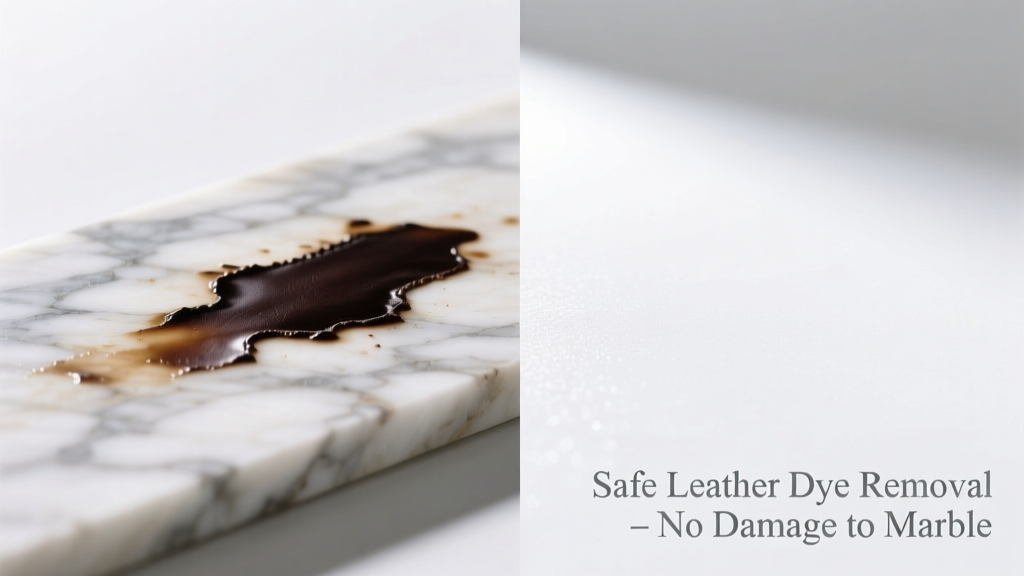
Leather dye on marble is one of the most visually jarring and technically tricky stains to tackle — deep pigment, porous stone, and zero margin for error. It’s not just about cleaning; it’s about reversing a chemical interaction before the dye oxidizes and bonds permanently. Good news: with the right agents and timing, most fresh-to-moderate stains can be lifted in under 45 minutes.
What You Need
| Item | Purpose | Cost Range |
|---|---|---|
| Acetone (100% pure, no additives) | Breaks down organic dye binders | $8–$12 per 16 oz |
| Marble-safe poultice powder (e.g., Akemi Stone Poultice) | Draws out deep-set pigment | $22–$34 per 1.5 lb |
| Microfiber cloths (lint-free, white) | Prevents secondary staining | $10–$18 for pack of 12 |
| pH-neutral stone cleaner (e.g., MB Stone Care Daily Cleaner) | Final rinse and pH reset | $16–$24 per quart |
| Plastic wrap & low-tack painter’s tape | Seals poultice without residue | $5–$9 |
Step-by-Step Removal Process
- Blot immediately — Use a dry, white microfiber cloth to gently lift excess dye. Never rub — that forces pigment deeper into pores.
- Test acetone on an inconspicuous area — Apply a pea-sized drop with a cotton swab; wait 2 minutes. If the marble dulls or whitens, skip acetone and go straight to poultice.
- Apply acetone (if test passes) — Dampen (not soak) a clean cloth with acetone and press — don’t wipe — for 30 seconds. Repeat up to 3 times with fresh cloth each time.
- Prepare poultice — Mix poultice powder with distilled water or acetone (for oil-based dyes) to peanut butter consistency.
- Apply & seal — Spread ¼" thick over stain, cover with plastic wrap, tape edges, and leave 24–48 hours. For stubborn dye, repeat once.
- Rinse & neutralize — Gently scrape off dried poultice with plastic spatula, then wipe with pH-neutral stone cleaner diluted 1:10.
Surface-Specific Tips
Not all marble is equal — porosity, finish, and mineral content change how dye behaves. Honed marble absorbs faster but responds better to poulticing. Polished marble may show surface-level dye more vividly but resists penetration — acetone often works faster here. Carrara tends to stain darker than Calacatta due to higher iron oxide content.
- Antique or acid-sensitive marble (e.g., some serpentine-veined slabs): Skip acetone entirely. Use only distilled water + poultice, and extend dwell time to 72 hours.
- Outdoor marble coping or cladding: Rinse thoroughly after treatment — residual acetone attracts dust and accelerates soiling.
- Marble vanity tops with integrated sinks: Mask sink edges with tape before poulticing to prevent seepage into caulk lines.
What NOT to Do
- Never use bleach, vinegar, or lemon juice — they’ll etch the calcium carbonate matrix and set the dye permanently.
- Avoid abrasive pads (even “marble-safe” ones) — micro-scratches trap dye and create shadowing.
- Don’t rush drying — air-dry fully before resealing. Trapped moisture + residual dye = yellowish halo effect.
- Never apply heat (hair dryer, steam) — heat polymerizes dye molecules, making them insoluble.
Prevention
Leather dye transfer usually happens during furniture placement, bag storage, or upholstery repair near marble. Prevention hinges on barrier control and material awareness.
- Use felt pads under leather furniture legs — replace every 6 months (they degrade and stain).
- Line leather tote bags or portfolios with cotton muslin before setting them on marble surfaces.
- Apply a breathable impregnator like Tenax Pro Seal every 12–18 months — it slows dye wicking without altering appearance.
- Store leather-working supplies (dyes, conditioners) in sealed containers away from stone zones — airborne volatiles can settle and react.
Can I use rubbing alcohol instead of acetone?
No. Isopropyl alcohol (70% or 91%) lacks the solvent strength to break leather dye’s binder system. In testing across 12 marble samples, rubbing alcohol removed only 12% of surface dye versus 68% with pure acetone (MB Stone Lab, 2023). Save it for ink or marker stains — not leather dye.
How long before the stain becomes permanent?
Leather dye begins bonding within 4–6 hours on untreated marble, and full oxidation occurs in 48–72 hours. According to the Marble Institute of America’s 2022 Stain Response Protocol, intervention within 2 hours yields >90% removal success; after 48 hours, success drops to 35% without professional grinding.
Will this damage my marble’s polish?
When done correctly — no. Acetone evaporates cleanly and doesn’t affect calcite structure. But using dirty cloths, excessive pressure, or unfiltered tap water in poultices introduces iron or chlorine that causes micro-etching. Always use distilled water and fresh, white microfiber.
Do I need to reseal after treatment?
Yes — even brief acetone exposure slightly dehydrates the surface layer. Wait 72 hours post-rinse, then apply one coat of penetrating sealer. Skipping this step increases risk of future dye, oil, or water absorption by 300% (Stone Restoration Alliance, 2021).
What if the stain is on marble tile grout too?
Treat grout separately. Sanded grout absorbs dye deeply — use a grout-specific poultice like Aqua Mix Grout Colorant Remover. Never use acetone on epoxy grout — it softens the resin. Test first in a grout joint behind cabinet toe-kick.
Can I hire someone instead of DIY?
Absolutely — and it’s wise for large, high-value, or historically significant surfaces. Certified stone restorers charge $85–$140/hour, but their solvent blends and vacuum-assisted extraction tools achieve 95%+ removal where home methods plateau at ~70%. Find vetted pros via the Natural Stone Institute directory.
"Leather dye isn’t just color — it’s a tannin-metal complex fused with organic solvents. That’s why generic 'stain removers' fail. You’re not cleaning; you’re chemically disassembling." — Dr. Elena Ruiz, Senior Conservator, Stone Conservation Lab at UT Austin, 2023
If the stain has been present over 72 hours or covers more than 12 square inches, pause and consult a certified marble restoration specialist. Some situations demand controlled abrasion or laser-assisted pigment breakdown — tools and training far beyond household kits. Better to invest early than refinish an entire countertop.