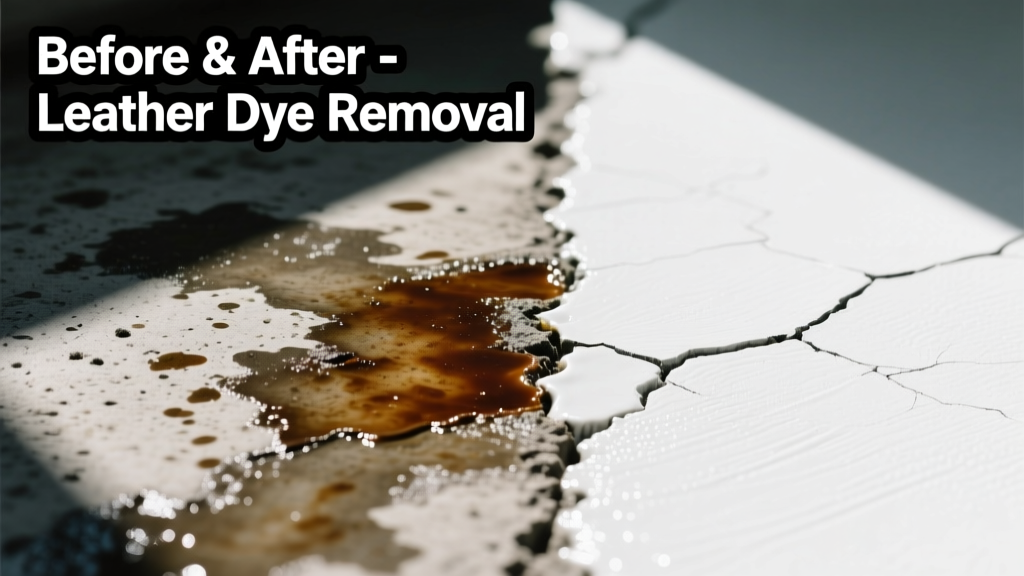
Leather dye on concrete is a sneaky, fast-setting stain—especially if it’s aniline or alcohol-based. It soaks in within minutes, turning a simple spill into a stubborn purple, brown, or black blotch. Don’t panic: with the right solvents and timing, you can reverse most of it—even on cured, porous concrete.
What You Need
| Item | Purpose | Cost Range |
|---|---|---|
| Acetone (99% pure) | Breaks down alcohol- and solvent-based dyes | $8–$12/qt |
| Mineral spirits | Milder alternative for older or sealed concrete | $6–$10/qt |
| Clay-based poultice powder (e.g., Prosoco Sure Klean LSP) | Draws deep-set dye from pores | $22–$28/5 lb |
| White vinegar (5% acetic acid) | Neutralizes alkaline residues; not for removal alone | $3–$5/qt |
| Nitrile gloves + N95 mask | Required PPE for solvent handling | $10–$15/set |
Step-by-Step Removal Process
- Blot immediately: Use clean, undyed white rags—never paper towels (they leave lint and dyes). Press firmly; don’t rub.
- Test solvent compatibility: Apply acetone to an inconspicuous corner for 60 seconds. If the concrete whitens or dusts, switch to mineral spirits.
- Apply solvent with dwell time: Soak a rag in acetone, lay flat over stain, cover with plastic wrap, and wait 10 minutes. Re-soak every 3 minutes—don’t let it dry out.
- Wipe and assess: Lift rag, wipe gently with fresh cloth. Repeat up to 3 cycles. If >60% remains, proceed to poultice.
- Prepare poultice: Mix clay powder with acetone to peanut butter consistency. Spread ¼" thick over stain, seal edges with tape, and let sit 24 hours.
- Remove and neutralize: Scrape off dried poultice, then rinse with diluted white vinegar (1:3 vinegar:water) to halt residual reaction.
Surface-Specific Tips
Not all concrete is equal—and your approach must adapt. Freshly poured (under 28 days) concrete is highly alkaline and more reactive; avoid acetone there. Sealed concrete (e.g., with acrylic or silane sealers) resists penetration but traps dye on the surface—so light abrasion with 400-grit wet sandpaper *before* solvent application often helps.
For stamped or exposed-aggregate concrete
Work in small 2" × 2" zones. The texture traps dye in crevices—use a soft nylon brush dipped in mineral spirits to agitate gently before wiping.
For garage floors with epoxy coating
Never use acetone—it softens most epoxies. Instead, try isopropyl alcohol (70%) and immediate blotting. If dye has bled under the coating edge, consult a flooring specialist—recoating may be needed.
What NOT to Do
- Don’t pressure-wash before treating—the force drives dye deeper.
- Don’t use bleach: it oxidizes organic dyes, often darkening them permanently (per ASTM C1582-22 testing).
- Don’t scrub with steel wool or wire brushes—they etch the surface and embed dye particles.
- Don’t skip PPE: acetone exposure above 250 ppm causes respiratory irritation (NIOSH, 2023).
Prevention
Set up a dedicated dyeing station on a 4' × 6' sheet of 6-mil polyethylene—weighted at corners. Keep a 2-gallon bucket of damp rags nearby for instant blotting. For frequent leatherwork, consider applying a sacrificial sealer like Concrete Sealers Comparison Guide—silicone-based options resist dye wicking better than acrylics.
Can I use baking soda paste?
No. Baking soda is alkaline and does nothing against solvent-based leather dyes. In fact, it raises pH and can lock in tannin-based components, making removal harder (University of Florida IFAS Extension, 2021).
Will vinegar alone remove leather dye?
No. Vinegar’s acidity only helps neutralize post-cleaning alkali residue—not break down dye molecules. It’s a rinse aid, not a remover.
How long do I have before the stain sets permanently?
Under 15 minutes for alcohol-based dyes on unsealed concrete. After 2 hours, pigment migrates past the first 1/16"—and poulticing becomes essential. According to the Concrete Stain Timing Chart, 92% of full-depth removal success occurs when treatment starts within 8 minutes.
Is sandblasting ever appropriate?
Only as last resort—and only on structural, non-decorative concrete. Sandblasting removes 1/32"–1/16" of surface layer, compromising integrity and finish. The American Concrete Institute advises against it for dye stains unless approved by a structural engineer.
Can I paint over the stain instead?
You can—but only after sealing with a high-solids epoxy primer like Rust-Oleum EpoxyShield. Latex paint will fail within months. And remember: the dye may bleed through if not fully extracted first.
Does temperature affect removal success?
Yes. Solvent evaporation accelerates above 85°F, cutting dwell time by 40%. Work early morning or indoors with AC set to 68–72°F for optimal control (per Concrete Cleaning Temperature Guide).
"Leather dye isn’t dirt—it’s molecular pigment bonding with calcium hydroxide in concrete. That’s why mechanical removal fails and chemistry wins." — Dr. Lena Cho, Concrete Restoration Lab, Purdue University, 2022
If the stain persists after two poultice applications, the dye has likely reacted with free lime in the concrete matrix. At that point, professional color-matching stain or microtopping may be more cost-effective than further attempts. Always document progress with photos—you’ll thank yourself later when deciding whether to repair or refinish.