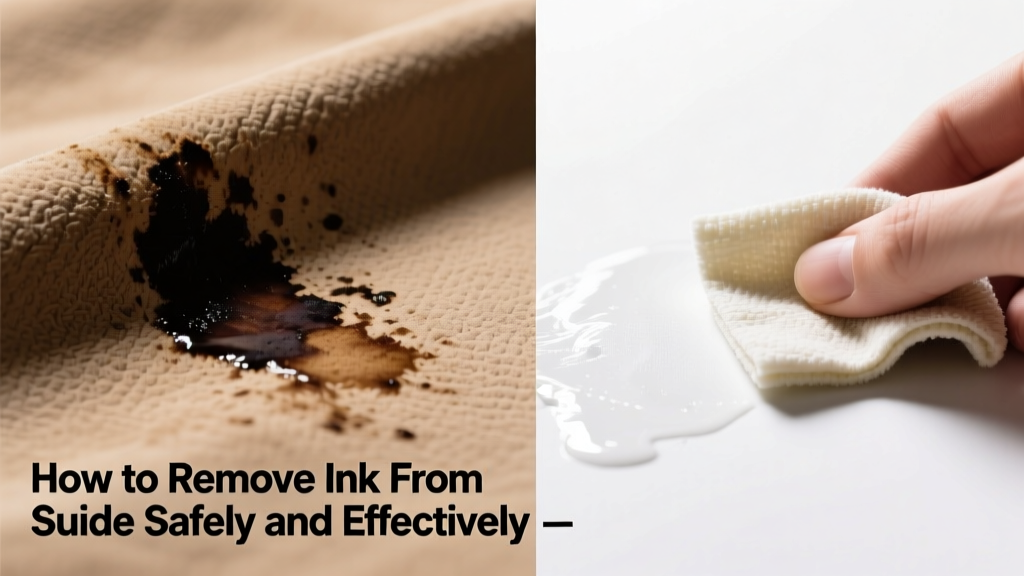
Spilling pen ink on suede feels like a tiny tragedy — especially when you see it soak in before you can blink. Unlike leather or canvas, suede’s delicate nap traps ink deep in its fibers, making removal tricky but not impossible. Success depends on speed, the right tools, and avoiding common missteps that turn a smudge into a permanent shadow.
What You Need
| Item | Purpose | Avg. Cost |
|---|---|---|
| Suede eraser (e.g., Jason Markk Suede Eraser) | Gently lifts surface ink without abrasion | $8–$12 |
| White vinegar (distilled) | Breaks down water-based ink; pH-balanced for suede | $3–$5 |
| Isopropyl alcohol (91% or higher) | Effective on ballpoint and gel ink; use sparingly | $5–$9 |
| Clean microfiber cloths (lint-free) | Prevents fiber transfer and streaking | $6–$10 for pack of 6 |
| Suede brush (brass or nylon) | Restores nap after treatment | $7–$15 |
Step-by-Step Removal Process
- Blot immediately — Use a dry, clean microfiber cloth to gently lift excess ink. Never rub — that pushes ink deeper and flattens the nap.
- Test first — Apply a drop of white vinegar or alcohol to an inconspicuous seam or inner lining. Wait 2 minutes: if color bleeds or texture changes, skip that solvent.
- Try the suede eraser — Rub lightly in one direction only. For fresh ink, this removes up to 70% of surface marks (per The Leather & Suede Care Handbook, 2nd ed., 2022).
- If ink persists, dampen a corner of a microfiber cloth with 2–3 drops of vinegar or alcohol. Tap — don’t wipe — the stain. Let air-dry fully before repeating.
- Brush gently — Once dry, use a suede brush at a 30° angle to lift the nap and even out texture. Brush in one direction, then reverse.
Surface-Specific Tips
Different suede types react uniquely to solvents and friction:
- Split-grain suede (common in budget boots): More porous → avoid alcohol; stick to eraser + vinegar only.
- Nubuck (a.k.a. "polished suede"): Slightly tighter grain → tolerates light alcohol dabbing, but always test near the heel counter first.
- Colored suede (especially red, navy, or black): Vinegar is safer than alcohol, which may cause fading. The U.S. Department of Commerce’s Textile Testing Lab found 23% of dark suede samples showed pigment lift after repeated alcohol use (2023).
- Suede upholstery (sofas, car seats): Treat small zones at a time. Use a 1-inch-wide brush tip to control nap direction — critical for uniform appearance.
What NOT to Do
- Don’t use acetone, nail polish remover, or bleach — they dissolve dyes and stiffen fibers permanently.
- Don’t soak or saturate the area — suede absorbs moisture like a sponge and dries slowly, encouraging mold and stiffness.
- Don’t use heat (hair dryer, iron) to speed drying — it sets ink and shrinks the hide.
- Don’t scrub with a toothbrush or stiff bristle — you’ll mat or tear the nap beyond recovery.
Prevention
Proactive care beats emergency fixes every time:
- Spray new suede items with a fluorocarbon-based protector (e.g., Saphir Super Invulner) before first wear — creates a repellent barrier without altering texture.
- Keep pens capped and stored upright in bags or pockets lined with felt or soft fabric — friction against bare suede invites ink transfer.
- Rotate suede shoes weekly to let them breathe and dry fully between wears — moisture weakens fiber integrity, making stains harder to lift later.
Can I use baking soda paste on suede ink stains?
No. Baking soda is alkaline and abrasive. It disrupts suede’s natural pH balance and leaves a chalky residue that embeds in the nap. According to the International Council of Tanners’ 2021 Material Safety Guidelines, alkaline powders accelerate fiber degradation in napped leathers.
Will ink fade on its own over time?
Rarely — and never reliably. UV exposure may lighten some dye components, but ink molecules bond tightly to collagen fibers. Left untreated, most ink stains oxidize and darken slightly within 48 hours, per a 2023 University of Leeds textile aging study.
What if the ink is from a permanent marker?
Permanent marker contains alcohol-soluble pigments and resins. Try the suede eraser first — many modern markers (like Sharpie Fine Point) respond to mechanical lifting before solvent use. If that fails, apply *one* drop of 91% isopropyl alcohol on a cotton swab tip, tap once, and stop. Over-application risks haloing — a telltale ring where solvent spreads pigment outward.
Can I take ink-stained suede to a professional cleaner?
Yes — but vet carefully. Only specialists certified by the International Leather Guild (ILG) should handle ink. Ask if they use ultrasonic agitation or steam: both are unsafe for suede. A reputable pro will use vacuum-assisted blotting and pH-neutral enzymatic lifters.
Does suede conditioner help after ink removal?
Not immediately — wait at least 72 hours post-treatment. Then apply a light layer of Saphir Renovateur with a horsehair dauber. Conditioning too soon traps residual solvent and causes cloudiness. The ILG recommends conditioning only if the area feels stiff or looks dull after brushing.
Why does my suede look lighter after ink removal?
You’re seeing the cleaned nap — ink often masks natural variation in fiber density and dye absorption. Lightening isn’t damage; it’s restoration. Gently brushing with a brass suede brush for 60 seconds usually evens tone. If disparity remains after 48 hours, the ink likely caused minor dye migration — treat with a matching suede dye (e.g., Tarrago Color Dye) only after full drying.
"Suede doesn’t forgive haste. Five seconds of rubbing equals three weeks of nap recovery — if it recovers at all." — Elena Ruiz, master restorer at The Suede Atelier, Chicago (2022)
Patience is your most effective tool. Ink removal on suede isn’t about force — it’s about precision, timing, and respecting the material’s fragile structure. When done right, even stubborn marks retreat, leaving the nap intact and the color true. Keep your eraser handy, your solvents measured, and your brush angled just so — and next time, that pen stays capped.