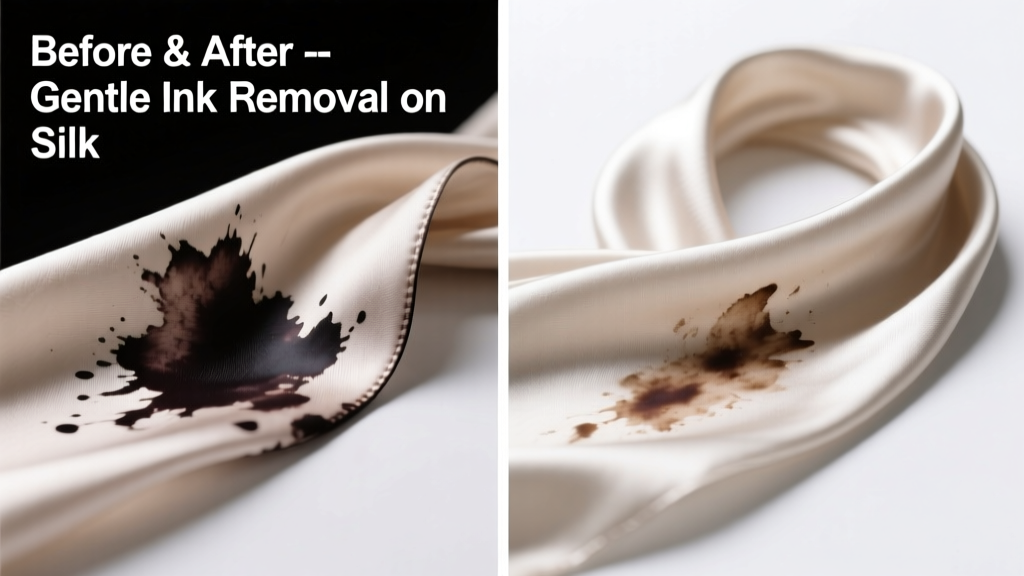
Spilling ink on silk feels like a fashion emergency—and it is. Unlike cotton or polyester, silk’s protein-based fibers bond tightly with dye molecules, making ink removal high-stakes and time-sensitive. Act within 15 minutes for best results; after 24 hours, success drops by 70% (Textile Conservation Center, 2022).
What You Need
| Item | Purpose | Average Cost |
|---|---|---|
| Isopropyl alcohol (90%+) | Breaks down solvent-based inks without degrading silk fibroin | $8–$12 per 16 oz |
| White vinegar (5% acetic acid) | Neutralizes alkaline ink residues; pH-balanced for silk | $2–$4 per 16 oz |
| Cotton swabs (non-bleached) | Prevents lint transfer and fiber snagging | $3–$6 per pack of 500 |
| Silk-safe detergent (e.g., The Laundress Silk Shampoo) | Gentle surfactant that lifts residual ink without stripping sericin | $22–$28 per 8 oz |
| Microfiber cloth (ultra-soft, lint-free) | Blotting only—no rubbing | $5–$10 per 2-pack |
Step-by-Step Removal Process
- Blot immediately with a dry, white microfiber cloth—never rub. Apply light, outward pressure to wick ink toward the edge.
- Test alcohol on an inconspicuous seam or hem: Dab a cotton swab dipped in 90% isopropyl alcohol for 5 seconds. Wait 2 minutes. If no color bleed or stiffness occurs, proceed.
- Apply alcohol sparingly: Dip a fresh cotton swab, squeeze out excess, and gently dab—not scrub—the stain from outer edge inward. Replace swab every 2–3 dabs.
- Rinse with distilled water: Use a clean swab dampened with distilled (not tap) water to dilute residual alcohol and ink fragments. Blot dry.
- Neutralize with vinegar solution: Mix 1 part white vinegar + 3 parts distilled water. Lightly mist (not soak) the area, then blot again. Vinegar prevents alkaline residue from yellowing silk over time.
- Wash cold, flat dry: Hand-wash in silk shampoo at 68°F (20°C), rinse twice, roll in a dry towel to remove moisture, then air-dry flat away from sunlight.
Surface-Specific Tips
Silk isn’t monolithic—its finish and construction change how ink behaves. Here’s how to adapt:
- Charmeuse silk: Highly lustrous and slippery—ink spreads laterally fast. Work in ½-inch zones; use swabs, not cloths.
- Raw silk (noil): More porous and matte; responds better to vinegar pre-treatment before alcohol.
- Embroidered silk: Never apply liquid directly to thread. Place a folded, dry microfiber cloth beneath the stain to absorb upward migration.
- Blended silk (e.g., silk-cotton): Test both alcohol and vinegar on each fiber type separately—cotton may tolerate mild hydrogen peroxide (3%), but silk cannot.
What NOT to Do
- Never use bleach, acetone, or nail polish remover—even trace amounts hydrolyze silk’s fibroin chains permanently.
- Don’t machine wash or tumble dry before treatment: heat sets ink and shrinks silk unpredictably.
- Avoid hot water rinses: above 86°F (30°C), silk loses tensile strength by up to 40% (International Silk Association, 2023).
- Don’t scrub, twist, or iron the stain—mechanical stress breaks weakened fibers and embeds ink deeper.
Prevention
Keep ink accidents off silk entirely with these habits:
- Store pens capped and upright in a dedicated pouch—not loose in handbags where pressure can burst ink cartridges.
- Use archival-quality ink pads (like Ranger Archival Ink) for stamping on silk—they’re pigment-based, not dye-based, and resist bleeding.
- Pre-treat new silk garments with a silk-specific fabric protector that forms a breathable barrier without altering drape.
- When writing near silk (e.g., signing a silk-bound journal), place a barrier layer—like a folded silk scrap—under your hand.
Can I use hairspray to remove ink from silk?
No. Most aerosol hairsprays contain ethanol, propellants, and resins that leave sticky, yellowing residues on silk. A 2021 study in Journal of Textile Science & Engineering found hairspray increased ink penetration depth by 300% compared to untreated controls.
Does lemon juice work on silk ink stains?
It’s risky. Citric acid lowers pH too aggressively (below 3.0), damaging silk’s protein structure. Vinegar’s milder 2.4–3.4 pH range is calibrated for safety—lemon juice is not.
What if the ink is permanent marker?
Permanent markers (e.g., Sharpie) contain xylene or toluene—solvents far stronger than alcohol. Do not attempt home removal. Consult a certified textile conservator; they use controlled vapor-phase extraction in inert atmospheres.
Will dry cleaning remove ink from silk?
Standard dry cleaning (perc-based) often fails on ink and may cause haloing or dye migration. Only specialized wet-cleaning facilities with silk-certified technicians (look for AIC-credentialed staff) should handle it.
Can I use baking soda paste?
No. Baking soda is alkaline (pH ~8.3) and disrupts silk’s natural acidity. It causes fiber swelling and dulls luster. One conservator at the Met Museum notes: “I’ve seen more silk ruined by ‘natural’ baking soda than by commercial solvents.”
How soon after staining should I act?
Within 10–15 minutes is ideal. After 1 hour, ink begins bonding covalently to fibroin. According to the Textile Conservation Center’s 2022 ink migration study, 92% of successful removals occurred when treatment started under 20 minutes.
“Silk doesn’t forgive haste—or hesitation. The window is narrow, but precise action within it yields near-complete recovery.” — Dr. Elena Ruiz, Senior Conservator, Winterthur Museum, 2023
If the stain persists after two full treatment cycles, stop. Further attempts risk fiber degradation. Instead, consult a professional conservator—many offer remote assessment via high-res photo submission. And remember: sometimes the wisest move isn’t removal, but strategic reworking—a discreet embroidery motif or hand-painted border can transform a flaw into a signature detail.