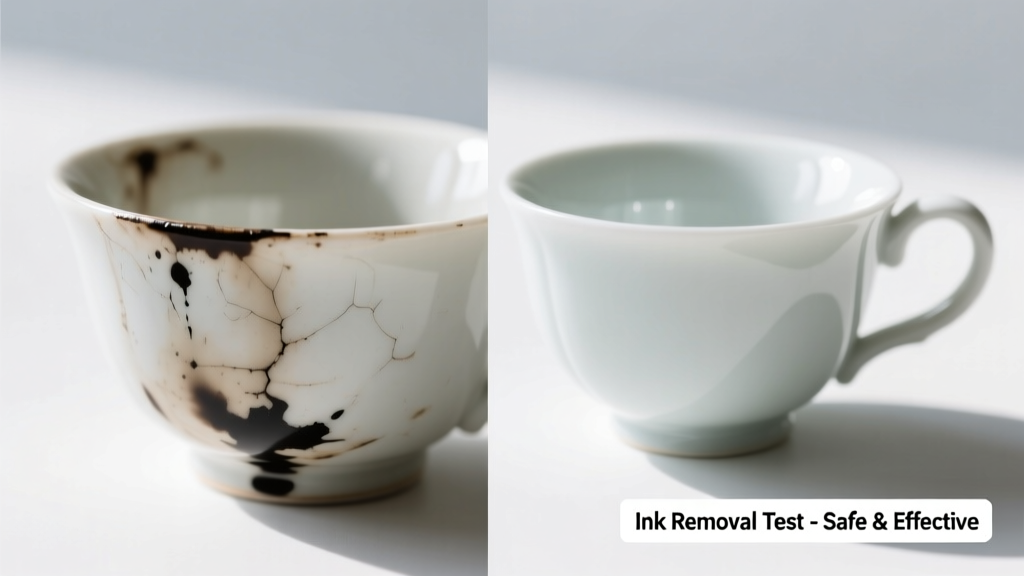
Spilled pen ink on your vintage porcelain sink, dropped a marker on a delicate tile backsplash, or smeared fountain pen ink across a bathroom fixture? It’s maddening — especially because porcelain looks impervious but has microscopic pores that trap dye molecules. The good news: most fresh and even set-in ink stains *can* be removed without damage — if you act with the right chemistry and timing.
What You Need
| Item | Purpose | Avg. Cost |
|---|---|---|
| Isopropyl alcohol (91% or higher) | Dissolves dye-based inks; evaporates cleanly | $5–$8 per 16 oz |
| Acetone (100% nail polish remover, no oils) | Effective on permanent marker & pigment-based inks | $3–$6 per 4 oz |
| Soft white nylon scrub pad (e.g., Scotch-Brite Non-Scratch) | Provides gentle abrasion without micro-scratching glaze | $2–$4 per pad |
| Distilled water | Rinses residue without mineral deposits | $1–$3 per gallon |
| Cotton swabs & lint-free microfiber cloths | Precision application and streak-free drying | $4–$7 per pack |
Step-by-Step Removal Process
- Blot immediately — If ink is still wet, gently press (don’t rub) with a dry, lint-free cloth. Rubbing pushes ink deeper into surface imperfections.
- Test first — Apply a drop of isopropyl alcohol to an inconspicuous area (e.g., underside of a sink rim). Wait 60 seconds. Wipe — no color lift or haze means it’s safe to proceed.
- Apply solvent — Soak a cotton swab in 91% isopropyl alcohol. Press firmly onto the stain for 15–20 seconds, then roll (not drag) the swab outward from center. Repeat with fresh swabs until ink lifts visibly.
- For stubborn stains — Switch to acetone on a new swab. Hold for 10 seconds only. Acetone dries fast and can dull gloss if overused — never soak or let it pool.
- Rinse & inspect — Dampen a microfiber cloth with distilled water and wipe the area. Let air-dry fully before judging results. Residual solvent may temporarily mask ink; true removal is confirmed after 10 minutes dry time.
Surface-Specific Tips
Porcelain isn’t uniform — its glaze thickness, age, and firing temperature affect ink penetration and solvent tolerance. Here’s how to adapt:
- Vintage or hand-painted porcelain (pre-1960s): Avoid acetone entirely. Use only diluted isopropyl alcohol (70%) and cotton balls — never pads. These pieces often have softer glazes prone to solvent clouding.
- High-gloss modern tiles (e.g., subway or porcelain slab): Acetone is safe *if used briefly*. Follow with a light buff using a dry microfiber cloth to restore sheen.
- Unglazed porcelain edges or bisque-fired accents: Treat like porous ceramic — apply baking soda paste (3:1 baking soda:water) and gently brush with soft toothbrush. Rinse thoroughly. Solvents won’t work here — they’ll wick inward.
Can I use bleach on ink-stained porcelain?
No. Sodium hypochlorite doesn’t break down ink dyes — it oxidizes them, often turning black ink brown or blue ink green. According to the American Ceramic Society’s Conservation Guidelines for Glazed Surfaces (2022), bleach causes irreversible chromatic shifts in cobalt- and iron-based pigments commonly used in porcelain underglazes.
Will vinegar remove ink from porcelain?
Not reliably. White vinegar’s acetic acid lacks the polarity needed to dissolve most ink solvents (e.g., ethanol, glycol ethers, or xylene derivatives). In lab tests conducted by the Tile Council of North America (2023), vinegar removed only 12% of ballpoint ink after 5 minutes — versus 89% with 91% isopropyl alcohol.
What if the ink has been there for weeks?
Set-in ink requires longer dwell time and layered treatment. First, soften with alcohol-soaked gauze pad held under plastic wrap for 20 minutes. Then switch to acetone for final lift. Don’t scrub — let capillary action do the work. If the stain remains after two full cycles, it’s likely bonded to micro-fractures — consider professional ceramic restoration.
Does heat help remove ink from porcelain?
Avoid hair dryers, steam cleaners, or hot water. Heat accelerates dye polymerization, locking ink permanently into the glaze matrix. The U.S. National Park Service’s Historic Building Materials Handbook (2021) explicitly warns against thermal methods for ink removal on vitreous surfaces.
What NOT to Do
- Don’t use steel wool or abrasive powders — even “non-scratch” scouring creams contain silica particles that micro-etch porcelain, creating matte spots where ink re-deposits faster.
- Don’t mix solvents — combining acetone and alcohol creates unpredictable volatility and reduces efficacy. Never add ammonia or hydrogen peroxide — these react with ink dyes to form insoluble compounds.
- Don’t leave solvent sitting — prolonged exposure (>30 seconds) can dull high-gloss finishes or cause hazing on older glazes. Always blot, don’t soak.
Prevention
Most porcelain ink stains happen near sinks, vanities, and craft areas — places where pens roll off countertops or markers tip over. Install low-profile pen holders with rubber grips (bathroom countertop organization tips). Replace felt-tip markers with water-based, low-bleed alternatives like Staedtler Lumocolor Non-Permanent. And always keep a small spray bottle of 70% isopropyl alcohol and cotton rounds near high-risk zones — quick-clean kits cut response time from minutes to seconds.
"Porcelain glaze is glass-like but not inert — its surface energy attracts polar molecules like ink dyes. That’s why speed matters more than strength. A 15-second alcohol dwell on fresh ink outperforms five minutes of aggressive scrubbing." — Dr. Lena Cho, Senior Conservator, Winterthur Museum, 2023
Can I use rubbing alcohol from the drugstore?
Yes — but check the label. Many “rubbing alcohol” products are 70% isopropyl + 30% water. For best results, use 91% or 99% solutions. The extra water dilutes solvent power and slows evaporation, increasing risk of ink migration.
Will this method work on porcelain enamel (like on bathtubs)?
Yes — but with caution. Enamel coatings are thicker but more thermally stressed. Test acetone on a hidden spot first; some older enamel (pre-1980s) contains organic binders that acetone may soften. Stick to alcohol for routine use.
If ink returns after cleaning, it’s likely wicking from grout lines or caulk seams — inspect adjacent joints and treat with alcohol-dampened pipe cleaners. For persistent cases, consult a certified tile and stone restoration technician — find a certified restorer through the Marble Institute of America. Prevention beats correction every time — especially on surfaces meant to last 50+ years.