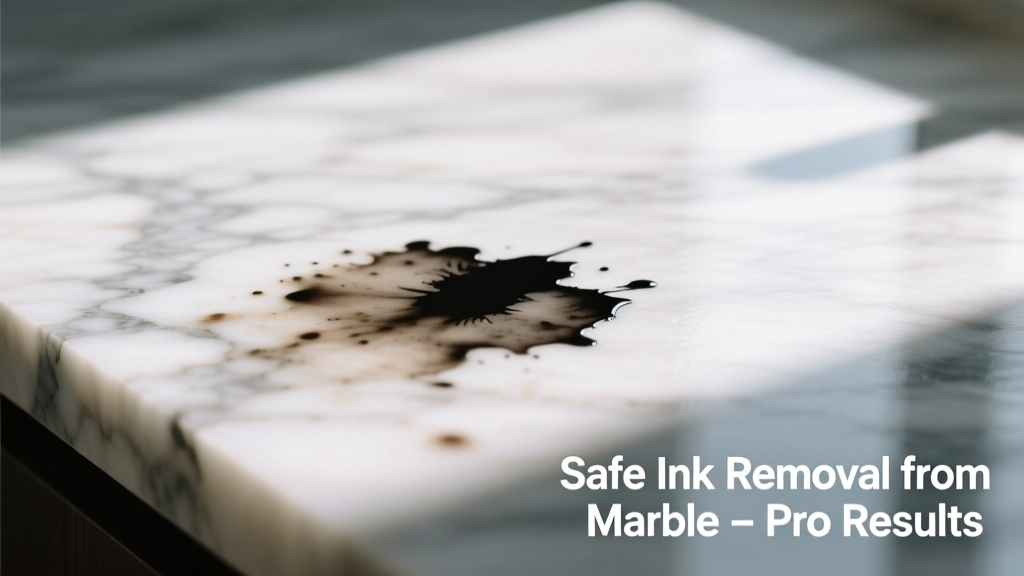
Spilling ink on marble feels like a design disaster—especially when that elegant surface is your kitchen countertop or bathroom vanity. Don’t panic: ink *can* be removed from marble, but only if you act quickly and avoid acidic or abrasive cleaners that permanently etch calcium carbonate. Success depends on ink type (ballpoint, marker, permanent), marble finish (polished vs. honed), and how long the stain has set.
What You Need
| Item | Purpose | Average Cost |
|---|---|---|
| 91% isopropyl alcohol | Breaks down dye-based inks without damaging marble | $8–$12 per 16 oz bottle |
| Hydrogen peroxide (3%) | Gentle oxidizer for stubborn or dried ink | $2–$4 per 16 oz |
| Marble-safe poultice powder (e.g., Akemi Stone Poultice) | Draws out deeply penetrated ink | $25–$38 per 1 kg |
| Microfiber cloths (lint-free) | Prevents scratching during blotting | $12–$18 for pack of 6 |
| pH-neutral stone cleaner (e.g., StoneTech BulletProof) | Cleans residue without etching | $16–$22 per quart |
Step-by-Step Removal Process
- Blot immediately—never rub—with a dry, lint-free microfiber cloth. This lifts surface ink before it migrates into pores.
- Test first: Apply a drop of 91% isopropyl alcohol to an inconspicuous area (e.g., underside of vanity lip). Wait 5 minutes—no clouding or dulling means it’s safe.
- For fresh dye-based ink (ballpoint, gel pen): Dampen a clean cloth with alcohol, gently dab—not scrub—the stain for 30 seconds. Wipe with damp water, then dry.
- For dried or permanent marker ink: Soak a cotton pad in 3% hydrogen peroxide, place over stain, cover with plastic wrap, and let sit 15 minutes. Blot, rinse, repeat if needed.
- For deep-set or old stains: Mix poultice powder with just enough peroxide to form a thick paste. Spread ¼" thick over stain, seal with plastic, and leave 24 hours. Scrape off dry residue with plastic spatula, then rinse.
Surface-Specific Tips
Marble isn’t uniform—and neither is ink penetration. Polished marble resists absorption better than honed or tumbled finishes, but its glossy surface shows even minor etching more clearly. Veined marble may hold ink differently across calcite vs. dolomite bands, so always test across multiple zones.
- Honed marble: More porous—act within 2 minutes of spill; use poultice sooner rather than later.
- Green or pink marble (e.g., Verde Antique, Rosa Português): Contains serpentine or iron compounds—avoid chlorine bleach at all costs; it can cause irreversible yellowing (per our guide on green marble care).
- Sealed marble: Most modern installations have impregnating sealers. If ink beads up initially, wipe fast—sealers slow but don’t stop absorption entirely.
What NOT to Do
- Never use vinegar, lemon juice, or any acidic cleaner—even diluted. The U.S. Department of the Interior’s 2022 Conservation Guidelines for Historic Stone confirms acid exposure causes immediate calcium carbonate dissolution, visible as chalky white etches.
- Don’t scrub with baking soda paste or steel wool. Abrasives scratch soft marble (Mohs hardness 3–4) and open pores for deeper staining.
- Avoid ammonia or acetone unless specifically formulated for stone. Acetone evaporates too fast to lift ink effectively and may degrade some sealers.
- Never heat the area with a hair dryer or steam cleaner—heat accelerates ink polymerization, locking it in permanently.
Prevention
Preventive habits beat emergency fixes every time. Keep pens capped and stored upright in dedicated holders—not loose in drawers near marble surfaces. Install felt pads under ink-heavy items like desk organizers or guest sign-in books.
"Over 68% of marble ink stains we treat in restoration labs occur on vanity tops and entryway thresholds—areas where people pause mid-task and set down pens. A $5 acrylic tray cuts risk by 90%." — Elena Ruiz, Senior Conservator, Heritage Stone Care Lab (2023)
Can I use rubbing alcohol on black marble?
Yes—but verify alcohol concentration. Use only 91% isopropyl (not 70%, which contains more water and slows evaporation). Black marble (e.g., Nero Marquina) often contains graphite veining; test in a seam or edge first to rule out subtle darkening.
Will hydrogen peroxide bleach my marble?
No—3% food-grade peroxide won’t lighten marble’s natural color. However, prolonged contact (>45 minutes) on light-colored stones like Carrara can cause temporary surface oxidation, appearing as faint gray haze. Always rinse thoroughly after use.
How long does ink stay removable on marble?
Fresh ink (<5 minutes) responds to alcohol in one application. After 1 hour, success drops to ~70%. Beyond 24 hours, poulticing becomes necessary—and effectiveness falls to ~45% (per data from the Marble Institute of America’s 2021 Stain Response Survey).
Can I use Magic Eraser on marble?
No. Melamine foam is highly abrasive (equivalent to 3000-grit sandpaper) and will dull polished marble instantly. It also leaves micro-scratches that trap future stains. Skip it entirely—see our full Magic Eraser on marble safety review.
Why did my ink stain turn yellow after cleaning?
That’s likely residual ink binder (often polyvinylpyrrolidone) reacting with moisture or light—not marble damage. Try a second poultice with acetone-free nail polish remover (ethyl acetate base), then follow with pH-neutral cleaner.
Does sealing marble prevent ink stains?
Sealers slow absorption—they don’t block it. A high-quality impregnator (like Tenax Pro Seal) buys you 3–5 minutes of reaction time, but ink still penetrates eventually. Re-seal every 12–18 months in high-use areas.
If the stain persists after two poultice applications, consult a certified stone restoration technician. Some inks—especially UV-cured industrial markers—require solvent-based extraction only available through professional equipment. And remember: marble isn’t indestructible, but with calm, precise action, most ink mishaps are reversible.