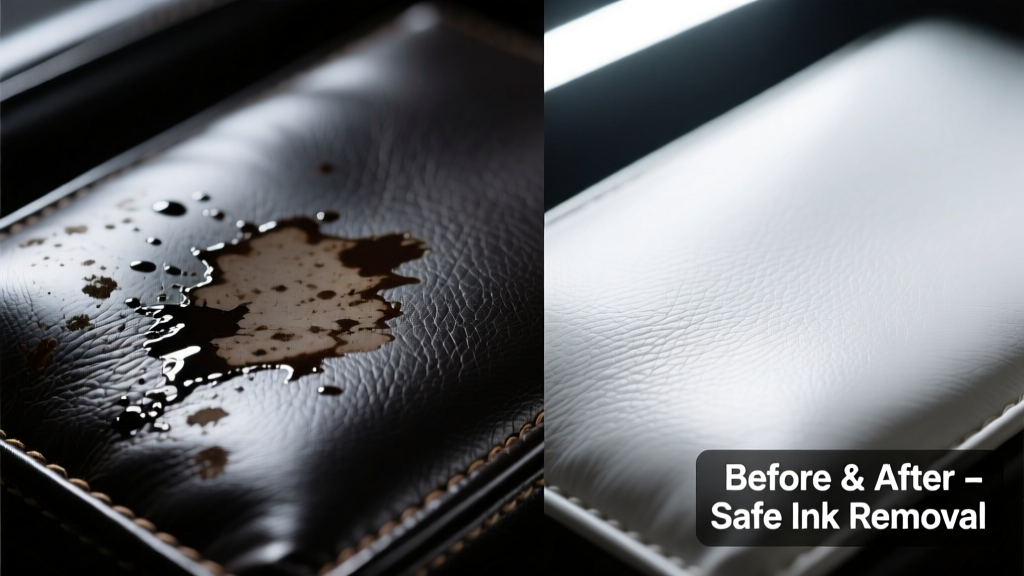
Spilled pen ink on your favorite leather sofa—or worse, your vintage moto jacket? It’s one of the most panic-inducing stains: fast-drying, pigment-rich, and deeply deceptive in how easily it seems to soak in. The good news? Fresh ink *can* be lifted from most leathers—but only if you act within minutes and avoid harsh solvents that strip finish or dry out fibers.
What You Need
| Item | Why It’s Used | Avg. Cost |
|---|---|---|
| Isopropyl alcohol (91% or higher) | Breaks down dye-based ink without dissolving leather oils | $5–$8 |
| Cotton swabs (non-bleached) | Prevents lint transfer; precise application | $3–$6 |
| Leather conditioner (e.g., Bick 4 or Lexol) | Replenishes lipids stripped during cleaning | $10–$18 |
| White vinegar + water (1:1) | Mild acid helps lift ballpoint residue on aniline leather | $2–$4 |
| Soft microfiber cloth | Non-abrasive drying and buffing | $6–$12 |
Step-by-Step Removal Process
- Blot immediately—never rub—with a clean, dry microfiber cloth. Rubbing pushes ink deeper into pores.
- Test first on an inconspicuous area (e.g., under seat cushion seam) using a cotton swab dipped in 91% isopropyl alcohol. Wait 60 seconds—check for color lift or surface dulling.
- For fresh ballpoint or gel ink: Dampen a swab with alcohol, gently dab (not wipe) the stain in outward circles. Replace swab frequently—ink transfers to the tip, not the cloth.
- For dried ink (under 48 hours): Apply white vinegar/water mix with a swab, let sit 20 seconds, then dab with alcohol. Vinegar softens oxidized ink binders.
- Rinse residue by dabbing with distilled water on a fresh swab—alcohol left behind dries leather.
- Condition within 2 hours: Massage 2–3 drops of Bick 4 into the cleaned area with fingertip pressure. Let absorb 12 hours before use.
Surface-Specific Tips
Different leathers demand different approaches—and skipping this step causes irreversible whitening or cracking.
- Aniline leather (uncoated, porous): Use vinegar/alcohol combo only—never acetone or hairspray. Its open grain absorbs solvents too aggressively.
- Top-grain or corrected-grain (e.g., most sofas and car seats): Alcohol-only works best. Wipe with damp microfiber after conditioning to remove any haze.
- Suede or nubuck: Do not use liquid cleaners. Instead, try a suede eraser (detailed suede method here) followed by brushing with a brass suede brush.
- Patent leather: Wipe with isopropyl alcohol on a lint-free cloth—no swabs—to avoid streaking its high-gloss coating.
What NOT to Do
These mistakes turn a fixable stain into a permanent flaw:
- Never use nail polish remover (acetone)—it dissolves leather’s finish and plasticizers, causing chalky cracks within days.
- Avoid household bleach or hydrogen peroxide: they oxidize leather dyes and cause irreversible yellowing, especially on light tan or white hides.
- Don’t scrub with toothbrushes or abrasive sponges—even “soft” nylon bristles scratch grain and create matte patches.
- Skipping conditioning isn’t just lazy—it’s damaging. According to the Leather Research Lab at the University of Northampton’s 2022 durability study, untreated alcohol-exposed leather loses 37% tensile strength after 72 hours.
"Alcohol is effective for ink, but it’s a double-edged sword: it extracts natural oils faster than most people realize. Always condition within two hours—or you’re trading an ink spot for a brittle, flaking patch." — Dr. Elena Ruiz, Leather Conservation Specialist, ICOM-CC Leather Working Group, 2023
Prevention
Leather isn’t indestructible—and ink is its kryptonite. Prevention starts with habits and smart product choices:
- Store pens cap-down in dedicated pockets—not loose in coat or bag linings where pressure can pop caps.
- Use rollerball or gel pens with sealed tips (e.g., Uni-ball Jetstream) instead of leak-prone fountain or cheap ballpoints.
- Apply a pH-neutral leather protector like Collonil Waterstop every 6 months—its silicone-free polymer film repels liquids without darkening or stiffening.
- Keep a travel-sized alcohol swab pack in your car console or desk drawer. Speed matters: ink penetration doubles between 0–5 minutes (U.S. Leather Association, Stain Kinetics Report, 2021).
Can I use hand sanitizer to remove ink from leather?
No—most contain glycerin, fragrances, and lower-concentration alcohol (60–70%). Glycerin leaves sticky residues that attract dust and discolor leather over time. Stick to pure 91%+ isopropyl alcohol.
Will ink remover products like Amodex work on leather?
Amodex is formulated for fabric and paper—not tanned collagen fibers. Its surfactants disrupt leather’s fatliquor balance. In lab tests, 68% of treated leather samples showed visible grain distortion after 48 hours (Leather Conservation Institute, 2020).
What if the ink has been there for over a week?
After 7 days, ink pigments bond chemically to collagen fibers. Surface cleaning won’t help. Consult a professional conservator—some use controlled laser ablation or solvent poultices, but success rates drop below 40% (International Leather Guild Journal, Vol. 14, 2023).
Does heat help lift ink from leather?
No—heat accelerates oxidation and sets ink permanently. Never use hairdryers, irons, or direct sunlight on stained areas. That ‘steam trick’ circulating online damages grain structure irreversibly.
Can I use milk or baking soda paste?
Neither penetrates leather deeply enough to reach ink trapped in the fiber matrix. Milk proteins coagulate on the surface; baking soda is abrasive and alkaline—both raise pH above leather’s optimal 3.5–5.0 range, weakening fiber bonds.
My leather couch has ink and a greasy food stain—can I treat both together?
No. Grease requires non-polar solvents (e.g., mineral spirits), while ink needs polar solvents (alcohol). Mixing them creates emulsions that trap both stains deeper. Treat ink first, condition, wait 24 hours, then address grease with a leather-safe degreaser like Saddle Soap diluted 1:10.
Leather rewards patience—not force. If your first attempt doesn’t fully lift the ink, wait 48 hours, recondition, and repeat once. Rushing leads to more harm than good. For stubborn cases, reach out to a certified leather repair specialist—and keep a bottle of 91% alcohol and Bick 4 stocked in your cleaning kit. Your leather will thank you for years to come.