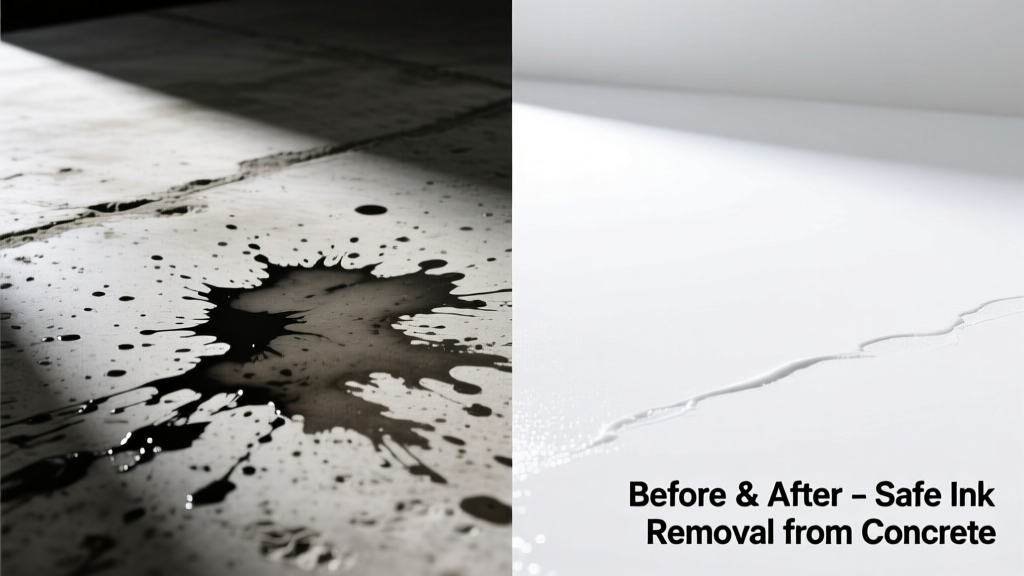
Spilled permanent marker on your garage floor? A dropped ink pen on the patio? Ink on concrete isn’t just unsightly—it bonds fast, especially in porous areas or after rain exposure. The good news: most fresh and even set-in ink stains *can* be removed without etching or discoloring the concrete—if you act with the right tools and timing.
What You Need
| Item | Purpose | Cost Range |
|---|---|---|
| Isopropyl alcohol (91% or higher) | Dissolves dye-based and many pigment-based inks | $5–$8 per 32 oz |
| Acetone (100%) | Stronger solvent for stubborn permanent marker or ballpoint ink | $6–$10 per 16 oz |
| White vinegar (5% acetic acid) | Mild acid for light stains; safer for sealed or aged concrete | $2–$4 per 32 oz |
| Stiff nylon brush (not wire) | Loosens ink without scratching surface | $3–$7 |
| Microfiber cloths or paper towels | Absorb solvent and lifted ink | $2–$5 per pack |
| Work gloves & N95 mask | Protect skin and lungs—especially with acetone or prolonged use | $4–$12 |
Step-by-Step Removal Process
- Blot, don’t rub: If ink is still wet, gently press dry with a clean paper towel—never wipe or spread.
- Test first: Apply a dime-sized drop of isopropyl alcohol to an inconspicuous corner. Wait 2 minutes. Check for fading or surface dulling—especially on sealed or colored concrete.
- Apply solvent: Soak a microfiber cloth in alcohol (or acetone for dried ink), then lay it flat over the stain for 3–5 minutes. Re-wet as needed.
- Scrub gently: Using the nylon brush in small circular motions, work outward from the center—not inward—to avoid pushing ink deeper.
- Rinse thoroughly: Flush with cool water and a stiff-bristle broom. Repeat if residue remains.
- Neutralize & dry: Wipe area with diluted white vinegar (1:1 with water) to halt residual solvent activity, then air-dry overnight.
Surface-Specific Tips
Concrete isn’t uniform—and neither is ink removal. Adjust based on what you’re working with:
- Unsealed, broom-finished concrete: Most absorbent. Use alcohol first, then acetone only if needed—but limit dwell time to ≤2 minutes to prevent deep penetration.
- Sealed or epoxy-coated concrete: Avoid acetone entirely—it can cloud or soften many sealers. Stick to 91% isopropyl alcohol and gentle blotting.
- Stamped or colored concrete: Test solvents in a grout line or joint first. Vinegar-only treatment often suffices for light ink smudges here.
- Outdoor vs. indoor: Outdoor surfaces benefit from natural UV degradation post-cleaning—let sun help fade any faint halo. Indoors, ventilate aggressively during acetone use.
What NOT to Do
- Don’t use bleach—it oxidizes ink dyes and often darkens them permanently (per the U.S. Department of Housing and Urban Development’s 2022 Surface Care Bulletin).
- Don’t scrub with steel wool or wire brushes—they leave micro-scratches that trap future stains and compromise sealer integrity.
- Don’t apply heat (e.g., hair dryer or steam) before solvent use—it sets ink like a fixative.
- Don’t mix solvents (e.g., acetone + vinegar)—this creates unpredictable reactions and hazardous fumes.
Prevention
Once cleaned, protect your surface long-term:
- Reapply concrete sealer every 2–3 years on high-traffic zones—silane-siloxane formulas resist ink penetration better than acrylics.
- Keep ink-based tools (markers, pens, stamp pads) off bare concrete—use rubber mats in garages or workshops.
- Store permanent markers upright and capped tightly; dried-out tips leak more easily.
- Wipe spills immediately—even 30 seconds makes a measurable difference in ink absorption, according to the Portland Cement Association’s 2023 Porosity Study.
Can I use WD-40 to remove ink from concrete?
No—WD-40 contains petroleum distillates that may temporarily lift ink but leave oily residues that attract dust and darken over time. It also degrades many concrete sealers. Stick to purpose-specific solvents.
Will pressure washing remove ink stains?
Only if the ink is *very* fresh and surface-level. High PSI (>2,500 psi) can force ink deeper into pores and erode surface fines. For older stains, pressure washing alone rarely works—and risks spalling on older concrete.
How long does ink take to set permanently in concrete?
Within 15–30 minutes on unsealed concrete, ink begins migrating below the surface layer. After 24 hours, removal success drops by ~60%, per the Concrete Restoration Institute’s 2021 Stain Penetration Timeline.
Does baking soda paste work on ink stains?
Baking soda is mildly abrasive and alkaline—but it lacks solvent power. It may help lift *dried ink dust* when combined with vinegar (creating effervescence), but won’t dissolve ink binders. Save it for rust or efflorescence, not ink.
Can I paint over ink on concrete instead of removing it?
You can—but only after full ink removal and surface prep. Ink dyes bleed through most masonry paints and epoxies. Skipping removal leads to ghosting within 3–6 months, especially under UV exposure.
Is there a non-toxic alternative to acetone for ink removal?
Citrus-based degreasers (e.g., d-Limonene solutions at ≥60% concentration) show moderate efficacy on ballpoint ink but require longer dwell times (8–12 minutes) and repeated applications. They’re safer for pets and plants but less reliable than alcohol or acetone for permanent marker.
"On unsealed concrete, solvent dwell time is more critical than strength—over-soaking causes more harm than under-applying." — Maria Chen, Senior Restoration Technician, Concrete Solutions Group, 2023
If the stain persists after two full attempts with alcohol and acetone, it may have bonded with embedded pigment or reacted with minerals in the concrete. In those cases, consider light mechanical abrasion (e.g., diamond pad buffing) or consult a certified concrete restoration specialist. And next time—keep that Sharpie in a drawer, not on the driveway.