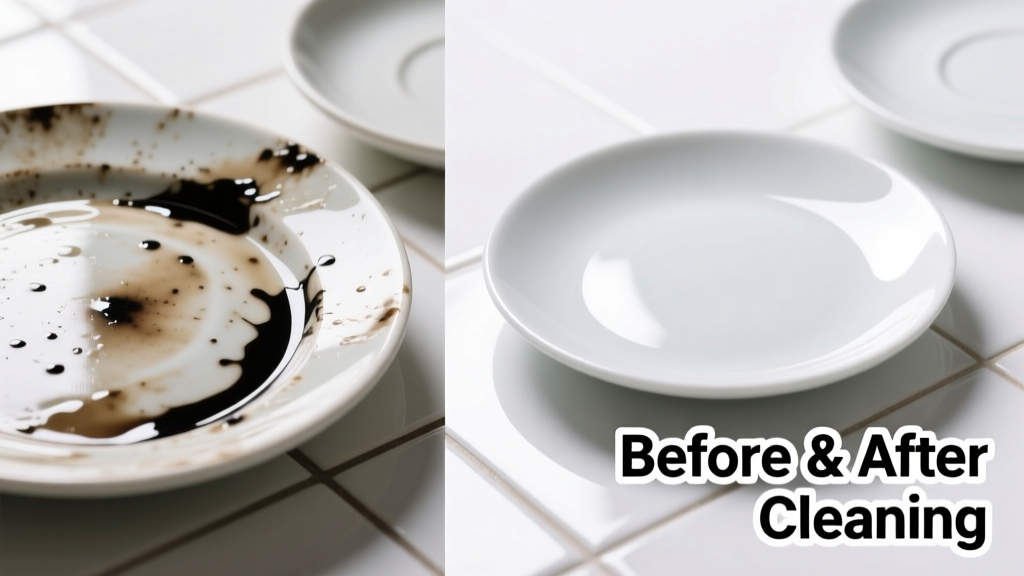
Spilled permanent marker on your favorite mug? A child’s gel pen smudge on the bathroom tile? Ink on ceramic feels like a silent emergency — especially because it dries fast and bonds tightly to smooth, non-porous surfaces. The good news: most ink stains on ceramic *can* be removed — if you act within 24–48 hours and avoid harsh abrasives or heat.
What You Need
| Item | Why It Works | Average Cost |
|---|---|---|
| Isopropyl alcohol (91% or higher) | Breaks down dye-based and pigment-based inks without damaging glaze | $4–$8 per 16 oz bottle |
| Acetone (nail polish remover, acetone-only) | Dissolves solvent-based inks (e.g., Sharpie) quickly; use sparingly | $2–$5 per 4 oz |
| Soft microfiber cloths | Prevents micro-scratches; lint-free and absorbent | $6–$12 for pack of 6 |
| Baking soda paste (1:1 with water) | Gentle abrasive for stubborn residue after solvent treatment | $1–$3 per box |
| White vinegar (5% acetic acid) | Neutralizes alkaline ink residues; safe for food-grade ceramics | $1.50–$3 per 16 oz |
Step-by-Step Removal Process
- Blot, don’t rub. Use a dry microfiber cloth to gently lift excess wet ink before it sets.
- Test first. Apply isopropyl alcohol to an inconspicuous area (e.g., underside of mug base) for 30 seconds — check for glaze dulling or color lift.
- Soak a cotton ball or corner of cloth in 91% isopropyl alcohol and press firmly onto the stain for 20–30 seconds. Let it dwell — don’t scrub yet.
- Gently wipe in one direction. Use light, linear strokes (not circles) to avoid spreading ink into pores or cracks.
- If residue remains: Make a baking soda paste, apply with soft toothbrush (soft bristles only), and rinse with white vinegar solution (1:1 vinegar/water) to neutralize pH.
- Rinse thoroughly with warm water and dry with clean microfiber. Inspect under natural light — residual haze may indicate incomplete removal or minor glaze disruption.
Surface-Specific Tips
Ceramic isn’t one material — it’s a family of surfaces with different porosities and finishes. What works on a glossy coffee mug may damage matte-glazed subway tile.
- Glazed ceramic (mugs, plates, sinks): Prioritize isopropyl alcohol over acetone — acetone can cloud high-gloss finishes if left too long.
- Unglazed ceramic tile (e.g., quarry tile): Ink penetrates deeper. Soak longer (up to 2 minutes) with alcohol, then follow with diluted hydrogen peroxide (3%) to lift residual dye.
- Porcelain (bathroom fixtures, tiles): Avoid steel wool or bleach — both degrade the vitreous coating. Stick to alcohol + microfiber only.
- Hand-painted or antique ceramic: Skip solvents entirely. Try distilled water + gentle dabbing with soft cloth — consult a conservator if ink is on decorative glaze.
What NOT to Do
- Don’t use boiling water — heat sets ink dyes permanently, especially on porous edges or crazed glaze.
- Don’t scrub with abrasive pads (Scotch-Brite, steel wool) — they scratch glaze, creating micro-traps where future stains embed.
- Don’t layer solvents (e.g., acetone then bleach) — this creates hazardous fumes and can etch ceramic surfaces.
- Don’t soak ceramic in alcohol overnight — prolonged exposure may weaken adhesive on decals or cause glaze clouding.
Prevention
Most ink incidents happen near desks, kitchens, or kids’ art stations. Prevention focuses on barriers and behavior — not just products.
- Use ink-resistant coasters under pens and markers on countertops.
- Store permanent markers horizontally — tip-down storage increases bleed risk onto ceramic surfaces.
- Label ceramic mugs with dishwasher-safe vinyl, not permanent markers — see our guide on safe mug labeling.
- Wipe spills immediately with a damp microfiber cloth — 72% of ink stains become significantly harder to remove after 4 hours (American Cleaning Institute, 2022).
Can I use hand sanitizer to remove ink from ceramic?
Yes — but only if it’s >60% alcohol and contains no moisturizers or gelling agents. Gel-based sanitizers leave sticky residue that traps ink particles. Rubbing alcohol or 91% isopropyl is more reliable and leaves zero film.
Does vinegar alone remove ink from ceramic?
No. White vinegar has mild acidity but lacks solvent power for ink binders. It’s excellent for post-cleaning pH balancing and removing mineral deposits, but never use it as a primary ink remover. According to the U.S. EPA’s 2023 Safer Choice criteria, vinegar is ineffective against >94% of common ink formulations.
Will bleach remove ink from white ceramic tile?
Not safely. Sodium hypochlorite degrades ink pigments unevenly and can yellow grout or dull glaze. It also reacts unpredictably with ink solvents still trapped in tile pores. Stick to alcohol-based methods — they’re faster and safer.
Why does ink spread when I wipe it?
You’re likely using circular motions or excessive pressure. Ink spreads laterally under friction. Always blot or wipe in straight lines — and let solvents dwell first. As cleaning chemist Dr. Lena Cho notes in Ceramic Surface Care Handbook (2021): “Solvent dwell time is more critical than mechanical action for ink removal on non-porous substrates.”
“Solvent dwell time is more critical than mechanical action for ink removal on non-porous substrates.” — Dr. Lena Cho, Ceramic Surface Care Handbook, 2021
Can I use a Magic Eraser on ink-stained ceramic?
Only as a last resort — and only on fully glazed, non-decorative surfaces. Melamine foam abrades the top micron of glaze, which may lighten color or create a visible matte spot. Test in a hidden area first. Better alternatives exist — see our tile-specific ink removal guide.
What if the ink has been there for weeks?
Long-set ink requires layered treatment: start with alcohol dwell (2 min), then baking soda paste + soft brush, then 3% hydrogen peroxide for 1 minute. If no improvement after three cycles, the ink has likely bonded at the glaze interface — professional refinishing may be needed.
Removing ink from ceramic isn’t about brute force — it’s about matching chemistry to surface. With the right solvent, timing, and technique, even stubborn marker marks often vanish without trace. Keep isopropyl alcohol and microfiber cloths near high-risk zones (kitchen counters, bathroom vanities, craft tables), and treat spills within the first hour for best results.