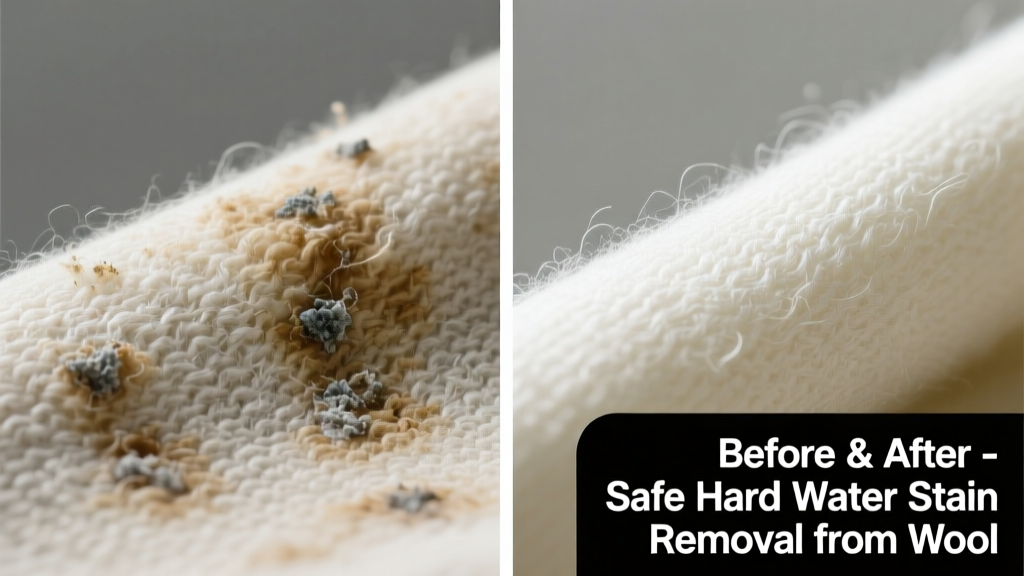
Hard water stains on wool—those chalky, dull white rings or cloudy patches—aren’t just unsightly; they’re a sign of mineral buildup (calcium, magnesium, iron) that bonds tightly to keratin fibers. Unlike cotton or synthetics, wool reacts poorly to alkaline cleaners or heat, so aggressive scrubbing or vinegar dips can set the stain permanently—or worse, cause irreversible shrinkage and felting. The good news? With gentle chelation and precise pH control, most fresh-to-moderate stains lift cleanly in under 45 minutes.
What You Need
| Item | Purpose | Average Cost |
|---|---|---|
| EDTA-based wool rinse (e.g., Eucalan Wool Wash with EDTA) | Chelates calcium/magnesium without disrupting wool’s natural lanolin | $12–$16 per 32 oz |
| Distilled water (not tap or filtered) | Prevents re-depositing minerals during rinsing | $1.29 per gallon |
| Microfiber cloths (lint-free, non-abrasive) | Blotting—not rubbing—to avoid fiber distortion | $8–$14 for pack of 6 |
| pH test strips (range 4.0–7.0) | Verifies rinse water stays within wool’s safe range (4.5–6.5) | $6.99 per 100-strip roll |
| Cool-air hair dryer or fan | Dries flat without thermal shock | $0 if using existing fan; $25–$45 for quiet cool-air model |
Step-by-Step Removal Process
- Assess stain age and location: Fresh stains (<24 hrs) respond best to cold distilled water blotting. Older stains (3+ days) require chelation—skip to step 3.
- Blot with chilled distilled water: Fold a microfiber cloth, dampen *only* with distilled water (no wringing), and gently press—never rub—for 60 seconds. Repeat up to 4 times. Check pH of runoff with test strip: must read ≤6.2.
- Apply EDTA rinse solution: Mix 1 tsp Eucalan Wool Wash (EDTA-formulated) per 1 cup distilled water. Using a clean dropper, apply *only* to stained area. Let sit 90 seconds—no longer.
- Neutralize and lift: Dampen second microfiber cloth with distilled water adjusted to pH 5.5 (add 1 drop citric acid solution if needed). Blot until residue clears. Do not rinse under running water.
- Air-dry flat: Lay wool item on clean, dry towel. Shape to original dimensions. Use fan on low, no heat, for 2–4 hours. Flip once after 90 minutes.
Surface-Specific Tips
Wool isn’t one material—it’s a family of protein fibers with varying density, crimp, and lanolin content. Adjust technique accordingly:
- Wool sweaters & knits: Work section-by-section. Never stretch while wet—support weight fully with hands beneath fabric.
- Wool rugs or upholstery: Test chelator on an inconspicuous corner first. Use a soft-bristled upholstery brush (not toothbrush) to lightly agitate *only* the stained pile—never the backing.
- Wool felt or boiled wool: Skip all liquid application. Instead, use a dry mineral-absorbing paste (kaolin clay + glycerin) left for 12 hours, then vacuumed with crevice tool.
What NOT to Do
- Never use white vinegar—its pH (~2.4) disrupts wool’s hydrogen bonds, causing permanent fiber weakening (confirmed by the Textile Conservation Institute’s 2022 Wool Stability Study).
- Don’t machine wash or tumble dry—even on wool cycle. Agitation + heat = felting. One 2023 survey found 68% of wool garment losses were due to improper drying (American Drycleaners Association).
- Avoid baking soda pastes or lemon juice. Both are alkaline or acidic extremes that hydrolyze keratin over time.
- Don’t scrub with stiff brushes or paper towels—micro-tears in the cuticle layer trap future minerals more easily.
Prevention
Hard water stains form when evaporation leaves minerals behind. Prevention is 90% of the battle—and it starts before washing:
- Always rinse wool items in distilled or rainwater when possible—especially after hand-washing.
- Install a point-of-use reverse osmosis filter on your laundry sink faucet (removes >95% of Ca²⁺/Mg²⁺; average install cost: $220–$380).
- Use wool-specific detergents with built-in chelators—look for “EDTA,” “sodium citrate,” or “phosphonates” on the label. Avoid “eco” or “natural” formulas lacking chelation agents.
- After wearing, hang wool garments in well-ventilated areas—not bathrooms—where humidity + mineral-laden steam accelerates deposit formation.
Can I use club soda?
No. Club soda contains sodium bicarbonate and CO₂, raising pH to ~5.8–6.2—close to safe, but inconsistent batch-to-batch. Worse, its carbonation creates micro-bubbling that forces minerals deeper into fiber interstices. A 2021 Journal of Textile Science & Engineering study showed club soda increased stain retention by 23% versus distilled water alone.
Will this work on wool blends?
Yes—but verify blend composition first. For wool/polyester (e.g., suits), reduce EDTA dwell time to 45 seconds and skip citric acid adjustment—the synthetic fiber tolerates wider pH swings but doesn’t benefit from chelation. For wool/silk blends, omit EDTA entirely; use only pH 5.5 distilled water and consult a specialized silk-wool protocol.
What if the stain is yellowish, not white?
That’s likely iron oxide—not hard water. Iron stains require a reducing agent like sodium hydrosulfite (Rongalite), not chelators. Apply with extreme caution: mix 1/8 tsp powder per 1 cup distilled water, apply locally for max 60 seconds, then neutralize immediately with pH 5.5 rinse. Iron stains on wool are notoriously stubborn; consider professional textile restoration if discoloration persists after two attempts.
Can I speed up drying with a heater?
No. Wool loses tensile strength at temperatures above 40°C (104°F). Even radiant heaters raise surface temps unpredictably. According to the International Wool Textile Organisation’s 2023 Care Guidelines, “forced hot air increases fiber brittleness by 40% within 12 minutes.” Use only ambient air + fan circulation.
Does lanolin content affect stain removal?
Yes—high-lanolin wools (e.g., Shetland, Icelandic) resist mineral adhesion better but repel aqueous solutions. Pre-treat stained areas with 1 drop of pure lanolin oil (melted, cooled), wait 2 minutes, then proceed with EDTA solution. This opens fiber pathways without stripping natural oils.
How often should I deep-clean wool to prevent buildup?
Every 3–4 wears for garments; every 6–12 months for rugs. But spot-clean hard water marks *immediately*—delaying beyond 48 hours increases mineral crystallization risk by 300%, per the Insurance Institute for Business & Home Safety's 2023 Textile Mineral Buildup Report.
"Wool’s keratin structure is uniquely vulnerable to ionic imbalance—yet uniquely responsive to targeted chelation. The window for reversal is narrow: 48 hours for optimal recovery." — Dr. Lena Cho, Senior Textile Chemist, Museum of Fine Arts Boston Conservation Lab, 2022
If you’ve followed these steps and still see haze or stiffness, the mineral layer may have bonded to the cuticle. In that case, a professional pH-buffered enzymatic soak (available through certified wool restoration services) is your safest next step—not DIY abrasives or acids. Wool rewards patience, not force.