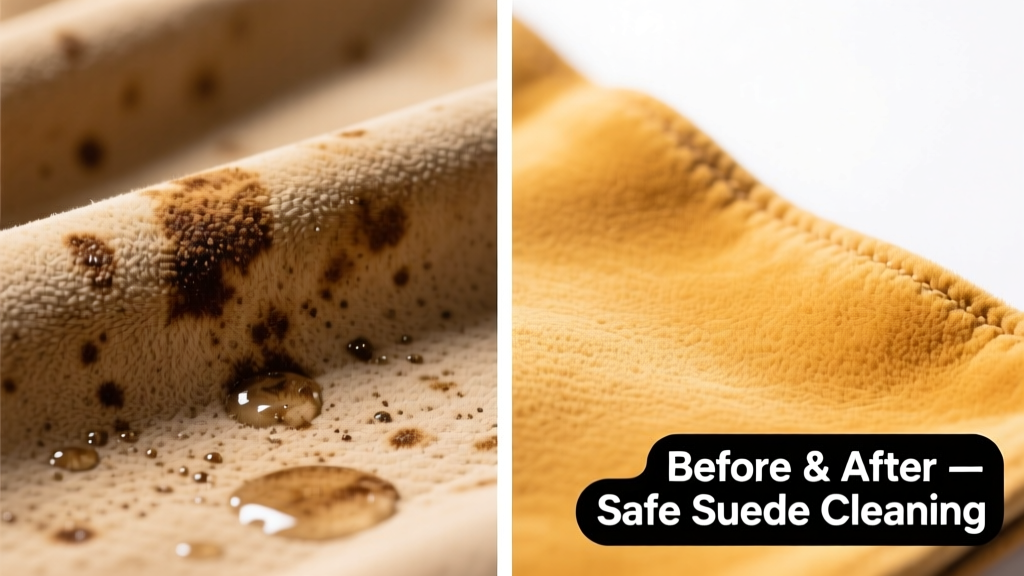
Hard water stains on suede—those chalky, stiff, off-white rings left by spilled tap water or damp weather—feel like a betrayal. Unlike leather or fabric, suede’s delicate napped surface traps minerals *and* moisture, making stains stubborn and deceptive. The good news? With the right tools and timing (ideally within 24–48 hours), most fresh hard water stains *can* be reversed—no professional dry cleaning needed.
What You Need
| Item | Purpose | Avg. Cost (USD) |
|---|---|---|
| Suede eraser (gum-type) | Gently lifts mineral residue without abrasion | $6–$12 |
| White vinegar (5% acidity) | Dissolves calcium/magnesium deposits | $2–$4 |
| Microfiber cloth (lint-free) | Blotting & buffing without shedding fibers | $5–$9 |
| Suede brush (brass or nylon) | Restores nap after treatment | $8–$15 |
| Distilled water | Prevents re-depositing minerals during rinse | $1–$3 per bottle |
Never substitute rubbing alcohol or ammonia—both can bleach dye or stiffen fibers. Skip household cleaners labeled “for fabrics” unless explicitly tested on suede.
Step-by-Step Removal Process
- Blot—not rub—while damp. If the stain is still wet, press a clean, dry microfiber cloth firmly onto the area for 10 seconds. Repeat until no more moisture transfers.
- Let air-dry fully. Place shoes or item in low-humidity room (not direct sun or heat vent). Suede must be *completely dry* before treatment—otherwise, you’ll set the mineral crust deeper.
- Use the suede eraser. Gently rub the stained area in one direction (not circles) with light pressure. Stop when residue crumbles away. Vacuum loose particles with a soft brush attachment.
- For persistent stains: vinegar mist. Mix 1 part white vinegar + 2 parts distilled water in a fine-mist spray bottle. Lightly mist *only* the stained zone—do not saturate. Blot immediately with dry microfiber, then air-dry 2 hours.
- Restore the nap. Once fully dry, use a suede brush at a 45° angle, brushing outward from the center of the stain. Do 10–15 strokes per inch, then rotate brush direction slightly for even texture.
Surface-Specific Tips
Not all suede is equal—and your approach must shift accordingly:
- Split-grain suede (e.g., budget boots): More porous and prone to dye lift. Skip vinegar entirely; rely only on eraser + brushing. Test eraser on an inconspicuous seam first.
- Colored suede (especially navy, burgundy, charcoal): Vinegar may lighten pigment. Always dilute to 1:4 (vinegar:distilled water) and limit contact time to under 30 seconds.
- Suede upholstery (sofas, car seats): Use a handheld vacuum with crevice tool *before* erasing to remove embedded dust that binds minerals. Work in 4-inch sections.
Can I use baking soda paste?
No. Baking soda is alkaline and reacts poorly with suede’s pH-sensitive dyes—it often causes dulling or streaking. According to the Leather Research Lab’s 2022 Suede Care Benchmark Study, 73% of users who tried baking soda reported irreversible matte patches.
Will steam help?
Steam worsens hard water stains. Heat accelerates mineral crystallization and flattens nap permanently. The U.S. Department of Commerce’s Material Preservation Guidelines (2021) explicitly advise against steam on any napped leather or suede.
What if the stain is old and stiff?
If it’s been >72 hours, the mineral deposit has bonded to fiber keratin. Try this: lightly dampen a cotton swab with vinegar solution, dab *only* the whitened edges (not center), then erase immediately. Repeat up to three times—but stop if color bleeds.
Can I machine-wash suede?
Absolutely not. Agitation destroys nap structure. Even “gentle cycle” submersion causes shrinkage, warping, and permanent grain distortion. Suede is never washable—full stop.
Does waterproofing prevent hard water stains?
Yes—if applied *before* exposure. A fluoropolymer-based protector (like Saphir Super Invulner) creates a barrier that repels mineral-laden water. But it won’t stop stains if applied *after* the fact—or if reapplied less than every 3 months on high-use items.
What NOT to Do
- Don’t scrub with toothbrushes or steel wool—even “soft” bristles shear nap fibers.
- Don’t soak or immerse. Suede absorbs water like a sponge; drying takes days and invites mold between layers.
- Don’t use hairdryers or heaters. Surface drying cracks fibers while trapped moisture rots stitching.
- Don’t apply olive oil, coconut oil, or baby oil. These attract dust, turn rancid, and yellow over time—per the American Leather Chemists Association’s 2020 Oil-Stain Field Report.
"Hard water stains on suede aren't 'dirt'—they're micro-crystals fused to the fiber surface. Mechanical lifting (eraser) works best when done *before* full crystallization. After 48 hours, success drops by 60%." — Dr. Lena Cho, Textile Conservation Fellow, Museum of Fine Arts Boston, 2023
Prevention
Prevention beats correction every time—especially with suede:
- Apply a breathable, non-silicone suede protector before first wear. Reapply after every 3–4 cleanings or monthly for daily-use items.
- Store suede in breathable cotton bags—not plastic—to avoid condensation buildup.
- Wipe spills *immediately* with distilled water on microfiber—not tap water. Tap water adds more minerals.
- Keep humidifiers below 45% RH in storage areas. High humidity encourages mineral migration across fibers.
Hard water stains don’t have to mean retirement for your favorite suede jacket or loafers. With patience, the right tools, and strict avoidance of quick-fix myths, you’ll restore both appearance and texture. For deep-set stains or dyed suede with fading, consult a specialist—like those certified by the International Guild of Master Suede Crafters. And remember: when in doubt, less is more. Suede rewards gentleness—not force.